

Fulfillment solutions


How to Organize a Warehouse Efficiently: 15 Proven Ideas
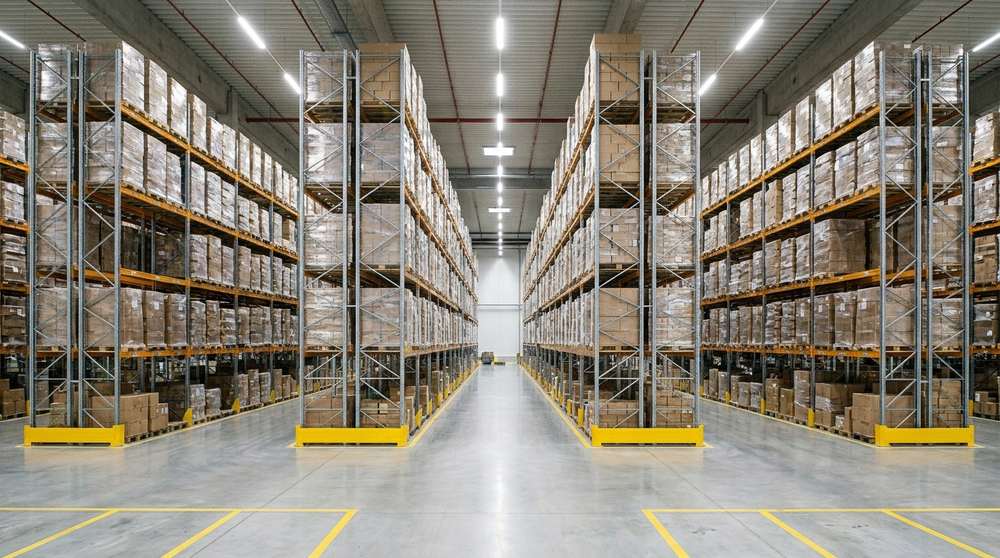
To organize a warehouse efficiently, map a one-way product flow, slot fast movers nearest packing, label every location, and hold the gains with 5S audits.
Travel is the main cost to cut. Order picking accounts for as much as 55% of a warehouse’s operating expense, and about half of a picker’s time goes to walking between locations (de Koster, Le-Duc and Roodbergen, European Journal of Operational Research, 2007, drawing on Tompkins et al.). Searching takes another 20%. Each of the 15 ideas below shortens that walk or removes the search.
Key Takeaways
- Layout and slotting pay back first, because travel and searching take about 70% of a picker’s time.
- Build in order: product flow, ABC slotting, location labels and barcodes, a WMS, then the right picking method.
- The 5S method (Sort, Set in Order, Shine, Standardize, Sustain) is what keeps the system from slipping.
- Track five KPIs to prove it works: picking accuracy, inventory accuracy, dock-to-stock time, order cycle time and space utilization.
- When volume outgrows your space or staff, a 3PL like IWS brings the layout, WMS and crews already in place.
What Is Warehouse Organization?
Warehouse organization is the planned arrangement of space, inventory, equipment and people so goods move from receiving to shipping with the least travel and no searching.
It is more than keeping things tidy. Good organization builds predictable processes: every SKU has one home, every home has an address, and every worker follows the same route and the same steps. That predictability is what lets a warehouse absorb seasonal spikes without adding labor or square footage.
What Is the 5S Method for Warehouse Organization?
5S is a lean method from Japanese manufacturing with five steps (Sort, Set in Order, Shine, Standardize, Sustain) that creates an orderly warehouse and keeps it that way.
- Sort (Seiri): remove everything that doesn’t belong in the work area, from obsolete stock to broken equipment.
- Set in Order (Seiton): give every item a fixed, labeled home so it is easy to find and return.
- Shine (Seiso): clean and inspect work areas on a schedule so damage and spills surface early.
- Standardize (Seiketsu): turn the first three steps into written procedures everyone follows.
- Sustain (Shitsuke): audit and reinforce the system so it holds under daily pressure.
The discipline is the point. The warehouses that stay organized keep auditing against the written standard. A cleanup with no audits behind it slides back to the old habits.
What are the 7S rules in a warehouse?
7S is the 5S method plus two steps, most often Safety (designing out hazards) and Sustainability (cutting waste and energy use). Some operations use Security or Spirit as the seventh S instead.
15 Warehouse Organization Ideas, in the Order to Do Them
The ideas run in build order. Ideas 1 to 4 set the physical layout, 5 to 8 make every location findable, 9 to 11 tune inventory and picking, 12 and 13 protect people and peak capacity, and 14 and 15 keep it all from slipping.
1. Design a one-way product flow
Map the floor so goods move in one direction: receiving, put-away, storage, picking, packing, shipping. A U-shaped flow puts receiving and shipping docks on the same wall so they share dock doors and staff. An I-shaped (straight-through) flow puts them at opposite ends, which suits high volume and cross-docking. Draw the full plan before you move a pallet, or you’ll move inventory twice.
2. Slot inventory with ABC analysis
ABC slotting ranks SKUs by how often they are picked and gives the best locations to the fastest movers. A items (the roughly 20% of SKUs that drive about 80% of picks) go nearest packing at easy-reach height, B items sit mid-tier, and C items go to the back or up high. Rank by pick frequency, not revenue, then adjust for weight, cube and items that ship together. Re-run the analysis every quarter and before peak, because this month’s A items can be next quarter’s C items.
3. Use vertical space with the right racking
You pay for the building’s cubic feet, not its floor area, so unused height is wasted rent. Match the rack to the inventory: selective racking for full access, double-deep or drive-in for density, pallet flow for first-in, first-out, cantilever for long items. Specify racks to ANSI MH16.1, the Rack Manufacturers Institute design standard, size beams for your pallets (a standard 48 x 40 in GMA pallet in most US operations), and post the load capacity on every bay. Mezzanines add a second level over existing operations without expanding the building.
4. Size aisles to your equipment
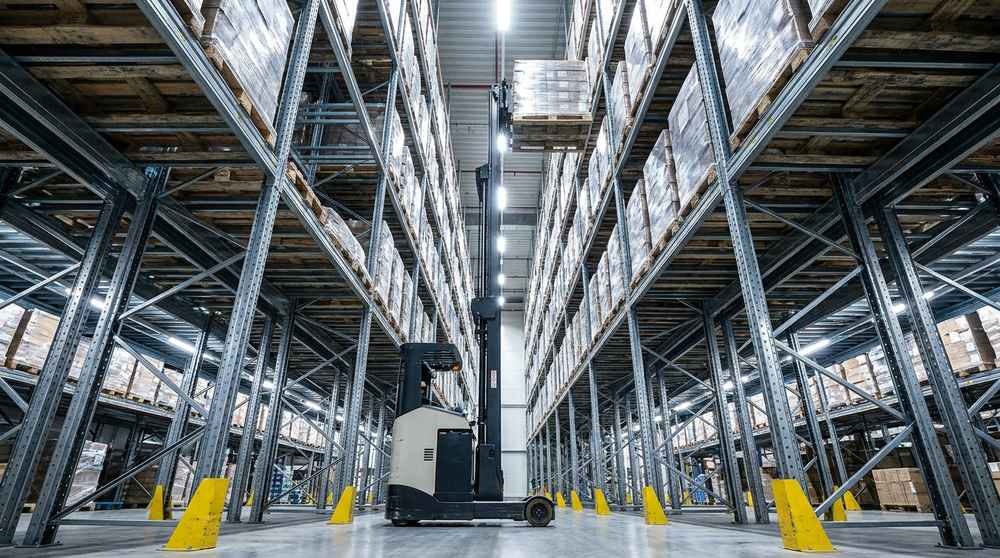
Aisle width should match the largest truck that uses the aisle, because every foot beyond that is storage you are not using. OSHA does not set a fixed width; its standard 1910.176(a) requires “sufficient safe clearances” wherever mechanical handling equipment runs. Material-handling integrator Cisco-Eagle gives these working minimums:
| Equipment | Typical aisle width | Best fit |
|---|---|---|
| Sit-down counterbalanced forklift | At least 12 ft | Docks, yards, mixed loads |
| Stand-up deep-reach truck | 9 to 11 ft | Double-deep pallet racking |
| Stand-up single-reach truck | As little as 8 ft | Selective pallet racking |
| Turret or swing-mast truck | Under 5 ft 6 in | Very narrow aisle, high density |
| Narrow-aisle order picker | 4 to 5 ft | Each and case picking from shelving |
Confirm the right-angle stacking figure with your equipment maker before you move racks, and keep main cross-aisles wide enough for two-way traffic.
5. Give every location a clear address
Label every storage position with one alphanumeric scheme that identifies zone, aisle, bay, level and position (for example, A-03-B-2). A new hire should learn it on day one, and it should still pinpoint a single bin.
6. Add color-coding and directional signage
Color-code zones, hang overhead signs at aisle intersections, and tape floor paths that keep foot traffic clear of trucks. Clear navigation shortens training and cuts the errors that come from staff guessing.
7. Barcode or QR-code every bin
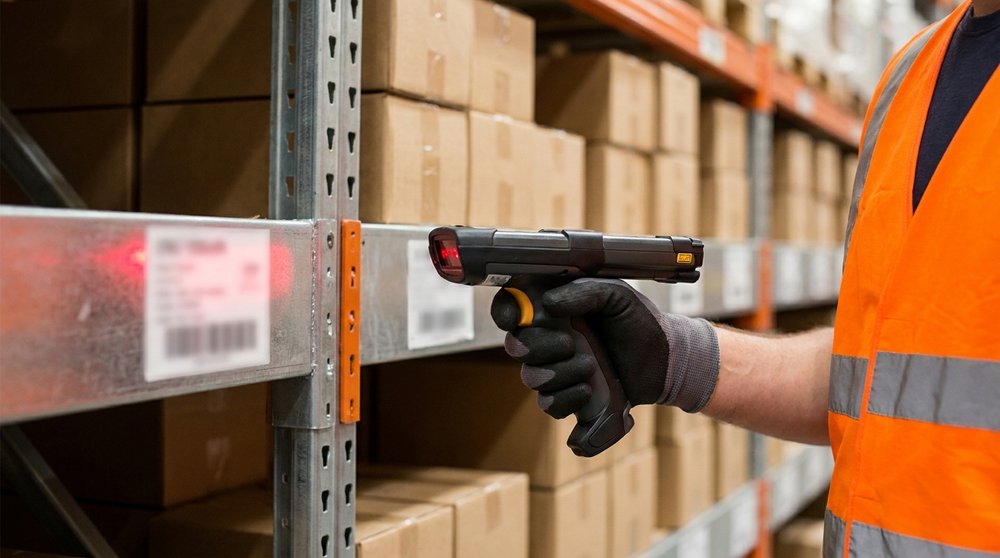
Scannable location labels turn put-away and picking into a verified step: the scanner confirms the right item is going to, or coming from, the right bin. Code 128 barcodes and QR codes cover most operations; RFID tags make sense for high-value items or pallet-level tracking.
8. Run your warehouse on a WMS
A warehouse management system (WMS) records every movement, directs put-away and picking to specific bins, and keeps counts accurate in real time. Even a basic WMS replaces paper pick lists and memory with scanner-directed tasks. It also produces the pick-frequency data that ABC slotting (idea 2) depends on.
9. Replace annual counts with cycle counting
Cycle counting checks a small set of locations every day or week instead of shutting down for one annual count. A common cadence counts A items monthly, B items quarterly and C items twice a year. It keeps accuracy high all year and catches discrepancies before they become stockouts or write-offs. See our guide to inventory reconciliation for the count-to-adjustment process.
10. Match your picking method to your orders
Picking is the most expensive activity in the building, so the method matters as much as the layout. Zone picking cuts travel by keeping each picker in one area. Batch picking pulls one SKU for many orders in a single trip. Wave picking releases orders in timed groups to match carrier cutoffs. Cluster picking fills several orders on one cart. Most warehouses blend methods by product type; our breakdown of pick and pack costs shows how each choice shows up in per-order fees.
11. Standardize and equip your packing stations
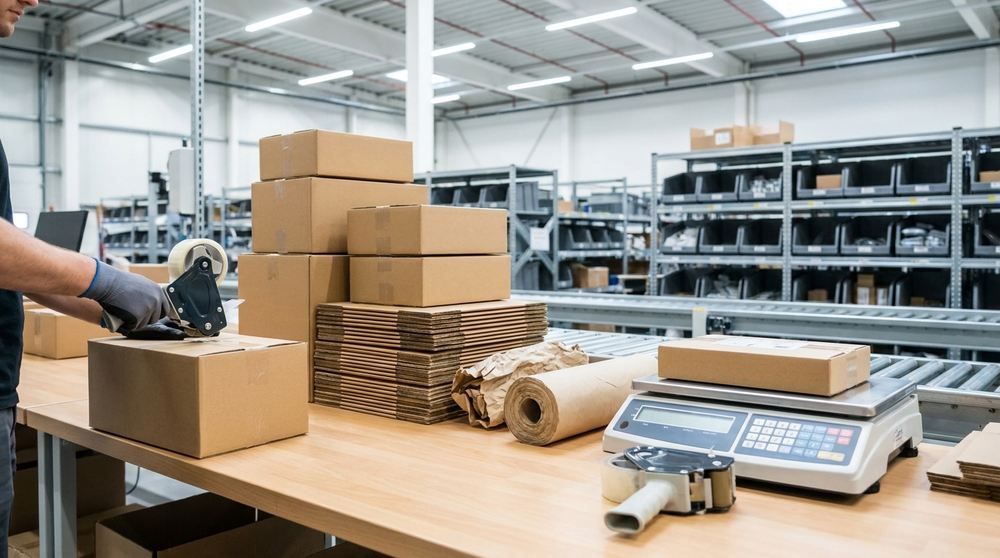
Keep packing materials and tools within arm’s reach and give each station a written, repeatable workflow. Check dimensional weight and the right box size at the station so every order goes out in the cheapest compliant carton.
12. Build ergonomics and safety into the layout
Put the fastest movers in the golden zone, roughly waist to shoulder height, where they can be picked without bending or reaching. OSHA’s warehousing guidance says to place heavier loads on lower or middle shelves, keep case weights to 35 pounds or less, and raise pallets so heavier cases are lifted between the knees and mid-chest. Add anti-fatigue mats at fixed stations and separate walking paths from truck lanes. Fewer injuries means less downtime and lower insurance costs.
13. Create overflow and seasonal zones
Set aside flexible overflow space so demand spikes don’t spill into the core layout. Move seasonal goods into prime locations during peak and back to secondary storage after, a discipline that pays off during crunch periods like Black Friday. If overflow keeps growing, the problem is stock, not space; our guide to excess inventory management covers what to clear.
14. Audit regularly with 5S walks
Schedule routine walks that check items are in their assigned bins, labels are readable, aisles are clear and racks are undamaged. OSHA’s guidance is explicit on racks: inspect them, and isolate any damaged section immediately. Photograph findings and log them so recurring problems surface and improvement is provable.
15. Review the data and keep adapting
Organization is never finished. Review the KPIs below every month, ask floor staff what slows them down, and test each change in one zone before rolling it out. Small, steady adjustments keep the system matched to how the business actually runs.
Which KPIs Show a Warehouse Is Well Organized?
Five KPIs show whether organization is working: order picking accuracy, inventory record accuracy, dock-to-stock time, order cycle time, and space utilization.
| KPI | How to calculate it | What a bad number points to |
|---|---|---|
| Order picking accuracy | Orders picked with no error ÷ total orders picked × 100 | Unclear addresses, missing scans, look-alike SKUs slotted side by side |
| Inventory record accuracy | Locations where system and physical counts match ÷ locations counted × 100 | Put-away without scanning, no cycle counts |
| Dock-to-stock time | Hours from truck arrival to inventory available to pick | Congested receiving, no staging lanes, put-away backlog |
| Order cycle time | Hours from order release to carrier pickup | Long travel paths, wrong picking method, packing bottleneck |
| Space utilization | Cubic feet occupied ÷ usable storage cubic feet × 100 | Unused height, oversized aisles, dead stock in prime slots |
Write the definition down before you start tracking. Consultant F. Curtis Barry & Co. makes the point in its 3PL contract checklist: a percentage only means something once the numerator, denominator, cutoffs and exclusions are fixed. The same rule applies when you hold a 3PL to these numbers in a service level agreement.
What Are the Most Common Warehouse Organization Mistakes?
The most common mistake is slotting by habit instead of pick data, which leaves fast movers far from packing and adds walking to every order.
- Maximizing storage density at the expense of movement, so every pick takes longer.
- Leaving vertical space empty while paying for cubic footage you never use.
- Labeling inconsistently, so the system only makes sense to veteran staff.
- Running one big cleanup and never auditing again.
- Growing order volume without growing the systems and space to support it.
When Should You Outsource Warehouse Organization to a 3PL?
Outsource when running your own warehouse costs more than a 3PL’s storage and fulfillment fees, usually once volume outgrows your space, staff or peak-season capacity.
Run the comparison with real numbers. Our warehouse cost breakdown covers what an in-house operation costs per square foot. Innovative Warehouse Solutions (IWS) publishes its rates instead: storage from $0.50 per small bin, $1.25 per standard bin and $8.75 per pallet per week, pick and pack at $2.50 for the first item and $0.40 for each additional item, and no onboarding fees. IWS runs with the layout, slotting, WMS and trained crews already in place, reports 99.98% order accuracy, and ships same day on orders received by 11 AM EST.
IWS fits brands shipping 300 or more orders a month. See how IWS 3PL fulfillment works, check full IWS pricing, or talk to our team about outsourcing your fulfillment.
Warehouse Organization FAQs
What are the 5 main activities in a warehouse?
The five core warehouse activities are receiving, put-away, storage, order picking, and packing and shipping. Good organization shortens the travel between each step so products move through with no wasted handling.
What is the golden zone in a warehouse?
The golden zone is the shelf band between roughly waist and shoulder height, where workers pick fastest without bending or reaching. Reserve it for your highest-velocity A items.
How often should you re-slot a warehouse?
Re-slot at least quarterly and before each peak season. Re-run ABC analysis on recent pick data, then move only the SKUs whose velocity class changed, starting with new A items.
What are the 7 types of warehouses?
The seven common warehouse types are private, public, bonded, distribution centers, cold storage, smart or automated, and third-party logistics (3PL) fulfillment warehouses. Each suits different storage, throughput and compliance needs.
How do you organize a small warehouse?
Organize a small warehouse by slotting with ABC analysis, building upward with racking or a mezzanine, narrowing aisles to your equipment, and labeling every bin. Small spaces gain the most from tight slotting and vertical storage because every square foot counts.
About the Author
Innovative Warehouse Solutions (IWS) is a U.S.-based third-party logistics (3PL) and order fulfillment provider. We help ecommerce and B2B brands with warehousing, pick and pack, kitting and assembly, and small parcel shipping. This article was written by the IWS operations team, drawing on hands-on experience running fulfillment for growing brands.