

Fulfillment solutions


Standard Shipping Box Sizes: Dimensions in Inches and CM
Updated September 2026 to reflect the USPS dimensional weight change of July 12, 2026.
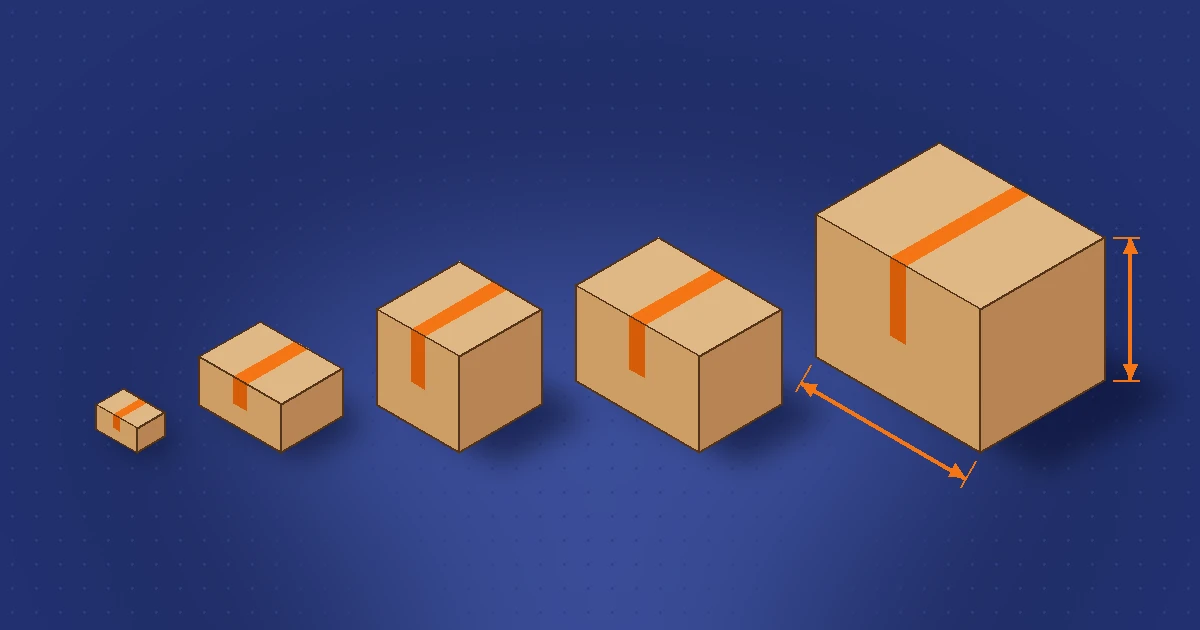
The most common shipping box is 12 × 12 × 12 inches (30.5 cm), exactly one cubic foot. Everyday e-commerce sizes run from 6 × 4 × 3 up to 24 × 18 × 18 inches.
Box size can move a shipping bill more than weight does. USPS, UPS and FedEx all bill large, light parcels by their volume, and on July 12, 2026 USPS moved to the same 139 divisor that UPS and FedEx already use. This guide lists the standard sizes in inches and centimeters, the free boxes each carrier supplies, and the dimensional weight each size is billed at.
What Are Standard Shipping Box Sizes?
Standard shipping boxes are stock corrugated sizes, running from 6 × 4 × 3 inches for small parts up to 24 × 18 × 18 inches for bulky goods.
No carrier or standards body defines a single “standard” box. The term covers two things: the stock sizes that packaging suppliers such as Uline keep in inventory, and the branded boxes USPS, UPS and FedEx hand out free for their own services. Stock sizes are what most shippers buy by the bundle, and they are what the table below lists.
One size matters more than the rest. At 1,728 cubic inches, a 12 × 12 × 12 box is exactly one cubic foot, the point where USPS starts billing by dimensional weight. UPS and FedEx bill by dimensional weight at every size.
Which Box Sizes Are Most Common?
The most used e-commerce boxes are 12 × 9 × 6 and 16 × 12 × 8 inches, and USPS bills both on actual weight.
| Category | Inches (L × W × H) | Centimeters | Best for |
| Small | 6 × 4 × 3 | 15.2 × 10.2 × 7.6 | Jewelry, cosmetics, small parts |
| Small | 8 × 6 × 4 | 20.3 × 15.2 × 10.2 | Mugs, small books, crafts |
| Small | 10 × 8 × 6 | 25.4 × 20.3 × 15.2 | Candles, paperbacks, small apparel |
| Medium | 12 × 9 × 6 | 30.5 × 22.9 × 15.2 | Books, shoes |
| Medium | 14 × 10 × 8 | 35.6 × 25.4 × 20.3 | Binders, gift bundles |
| Medium | 16 × 12 × 8 | 40.6 × 30.5 × 20.3 | Laptops, board games, folded clothing |
| Large | 18 × 12 × 12 | 45.7 × 30.5 × 30.5 | Kitchenware, small appliances |
| Large | 20 × 16 × 12 | 50.8 × 40.6 × 30.5 | Monitors, home decor |
| Extra large | 24 × 18 × 18 | 61.0 × 45.7 × 45.7 | Bulk goods, light bedding |
Centimeter figures are exact conversions (1 inch = 2.54 cm) rounded to one decimal place. Suppliers in metric markets sell their own rounded sizes, such as 30 × 20 × 15 cm, which are close to the inch sizes above but not identical.
How Does Dimensional Weight Change What Each Box Costs?
Dimensional weight is length × width × height in inches divided by 139, and carriers bill whichever is higher: that figure or the actual weight.
UPS and FedEx apply dimensional weight to every package. USPS applies it only to packages larger than one cubic foot, and until July 12, 2026 it divided by 166. The move to 139 raised the billable weight of every large USPS parcel by about 19%. USPS also now rounds each fractional inch up before it multiplies.
| Box (inches) | Cubic inches | UPS and FedEx | USPS before July 12, 2026 | USPS from July 12, 2026 |
| 6 × 4 × 3 | 72 | 1 lb | Actual weight | Actual weight |
| 10 × 8 × 6 | 480 | 4 lb | Actual weight | Actual weight |
| 12 × 9 × 6 | 648 | 5 lb | Actual weight | Actual weight |
| 16 × 12 × 8 | 1,536 | 12 lb | Actual weight | Actual weight |
| 12 × 12 × 12 | 1,728 | 13 lb | Actual weight | Actual weight |
| 18 × 12 × 12 | 2,592 | 19 lb | 16 lb | 19 lb |
| 20 × 16 × 12 | 3,840 | 28 lb | 24 lb | 28 lb |
| 24 × 18 × 18 | 7,776 | 56 lb | 47 lb | 56 lb |
Minimum billable weight at the 139 divisor (166 for USPS before July 12, 2026), rounded up to the next pound, for boxes measured in whole inches. The carrier charges the higher of this figure and the actual weight.
Take a 9-pound order that fits a 16 × 12 × 8 box. In that box, UPS bills 12 pounds. Pack the same order in the next size up, 18 × 12 × 12, and UPS bills 19 pounds. One size up costs seven billable pounds. Run your own sizes through our dimensional weight calculator before you stock a new box.
Which Box Size Should You Use for What?
Use 6 × 4 × 3 inches for jewelry and cosmetics, 12 × 9 × 6 for books and shoes, and 24 × 18 × 18 for bedding and bulk orders.
Small Boxes
Small boxes, up to about 10 × 8 × 6 inches, carry single items: cosmetics, jewelry, phone accessories. Their low volume keeps UPS and FedEx dimensional weight at 4 pounds or less. Liquids and glass need more than a small box, so read our guide to shipping nail polish and other cosmetics before you pack them.
Medium Boxes
Medium boxes, from 12 × 9 × 6 to 16 × 12 × 8 inches, carry multi-item orders and product bundles. They stay under one cubic foot, so USPS still prices them on actual weight. For most e-commerce catalogs, this is the working range.
Large and Extra-Large Boxes
Large boxes, from 18 × 12 × 12 inches up, carry bulky and light goods. Above one cubic foot every carrier bills on dimensional weight, which is why a large box of pillows can cost more to ship than a small box of books. Use double-wall corrugated for heavy loads, reinforce the corners, and fill voids so the contents cannot shift in transit. Orders that outgrow even extra-large boxes ship palletized instead; our guide to standard pallet sizes covers the 48 × 40 footprint and loaded height limits.
What Box Sizes Do USPS, UPS and FedEx Offer?
USPS supplies four free Priority Mail Flat Rate boxes, UPS three Express Boxes, and FedEx a Small, Medium and Large box plus Extra Large options.
Carrier boxes are free, but only for the services printed on them. A USPS Priority Mail box cannot go out as Ground Advantage, and a UPS Express Box cannot go out as UPS Ground.
USPS Priority Mail Flat Rate Boxes
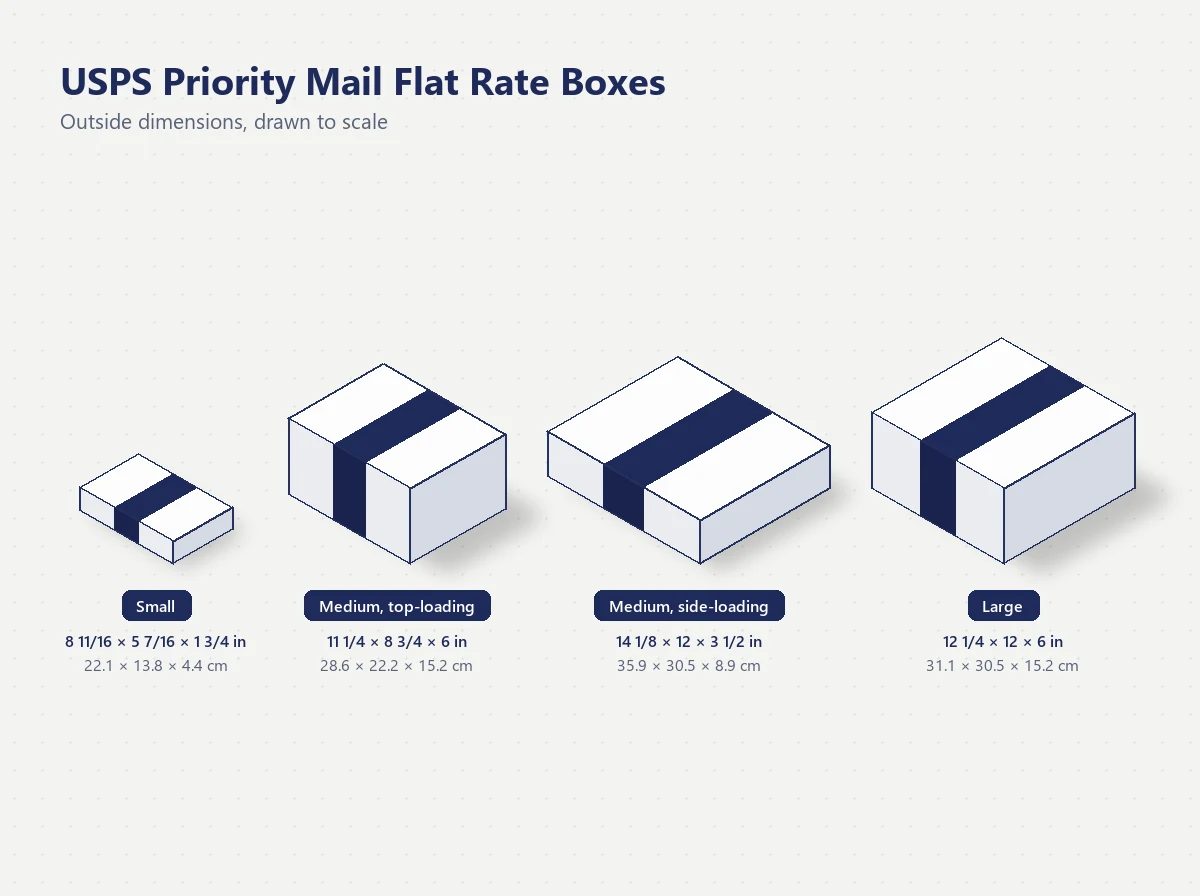
The illustration shows each box’s outside dimensions, drawn to scale.
USPS charges one price per Flat Rate box to any domestic address, whatever the contents weigh, up to 70 pounds (31.8 kg). USPS lists the inside and outside dimensions of each box on its Postal Explorer flat rate reference, on separate lines. They are set side by side here.
| Box | Outside (inches) | Inside (inches) | Inside (cm) |
| Small | 8 11/16 × 5 7/16 × 1 3/4 | 8 5/8 × 5 3/8 × 1 5/8 | 21.9 × 13.7 × 4.1 |
| Medium, top-loading | 11 1/4 × 8 3/4 × 6 | 11 × 8 1/2 × 5 1/2 | 27.9 × 21.6 × 14.0 |
| Medium, side-loading | 14 1/8 × 12 × 3 1/2 | 13 5/8 × 11 7/8 × 3 3/8 | 34.6 × 30.2 × 8.6 |
| Large | 12 1/4 × 12 × 6 | 12 × 11 3/4 × 5 1/2 | 30.5 × 29.8 × 14.0 |
Outside dimensions decide whether a box meets a carrier size limit. Inside dimensions decide whether your product fits.
Flat Rate boxes suit small, dense goods such as books, hardware and supplements, where weight would make standard pricing expensive. For a small, heavy item, the Small Flat Rate box is usually the cheapest free option of the three carriers.
UPS Express Boxes
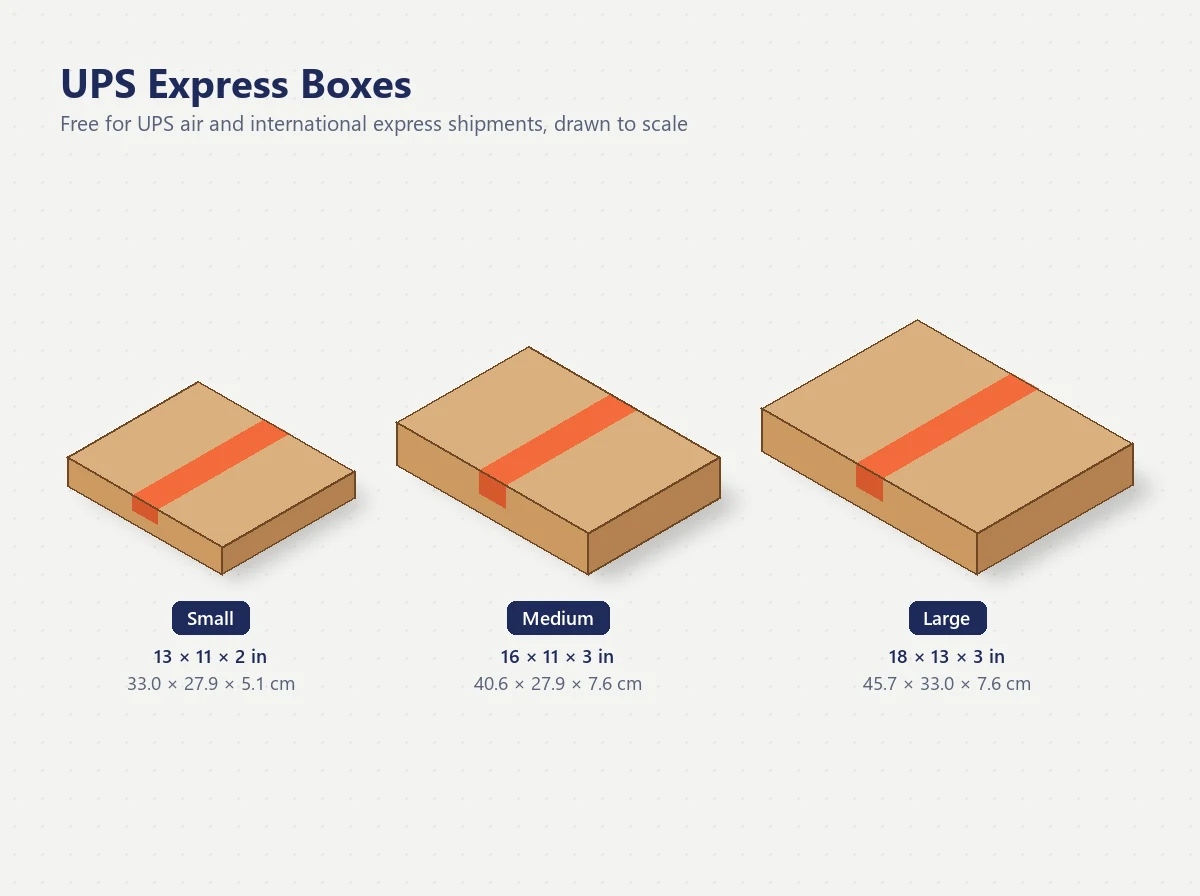
UPS Express Boxes are free for UPS air and international express shipments. They are built for flat, light goods.
| Box | Inches | Centimeters |
| Small | 13 × 11 × 2 | 33.0 × 27.9 × 5.1 |
| Medium | 16 × 11 × 3 | 40.6 × 27.9 × 7.6 |
| Large | 18 × 13 × 3 | 45.7 × 33.0 × 7.6 |
For UPS Ground you supply your own box, and any size works up to 150 pounds, 108 inches (274 cm) in length and 165 inches (419 cm) in length plus girth.
FedEx Boxes
FedEx supplies free boxes for FedEx Express services, including Priority Overnight, Standard Overnight, 2Day, Express Saver and International Priority.
| Box | Inside (inches) | Centimeters |
| Small | 12 3/8 × 10 7/8 × 1 1/2 | 31.4 × 27.6 × 3.8 |
| Medium | 13 1/4 × 11 1/2 × 2 3/8 | 33.7 × 29.2 × 6.0 |
| Large | 17 7/8 × 12 3/8 × 3 | 45.4 × 31.4 × 7.6 |
FedEx also stocks Extra Large boxes in more than one configuration, plus Paks and tubes. Confirm the current dimensions when you order them, since the Extra Large range has changed over time.
How Do You Choose the Right Box Size?
Choose the smallest box that holds the product and its protection, then check the dimensional weight before you order that size in bulk.
Measure the product first, not the box you already have. For fragile items, UPS packaging guidelines call for at least two inches of cushioning on every side, so a 10 × 6 × 4 inch glass item needs a box of at least 14 × 10 × 8 inches. Sturdy items that cannot shift or scuff need much less room.
Next, check the strength. Every corrugated box carries a Box Maker’s Certificate, the round stamp on the bottom flap, which states the board construction and the maximum gross weight the box is certified to carry. Stay under that number. Heavy items, and anything long enough to bend in transit, belong in double-wall corrugated.
Then check the size against the dimensional weight table above. If the next size down still fits with the right cushioning, it will almost always bill lighter.
For small valuables, the inner packing matters as much as the outer box. Our guide to the best way to ship a watch covers inner boxes and void fill, and the IWS fulfillment team works with each client to match box sizes to their products.
What Sizes Are Available for Oversize Shipments?
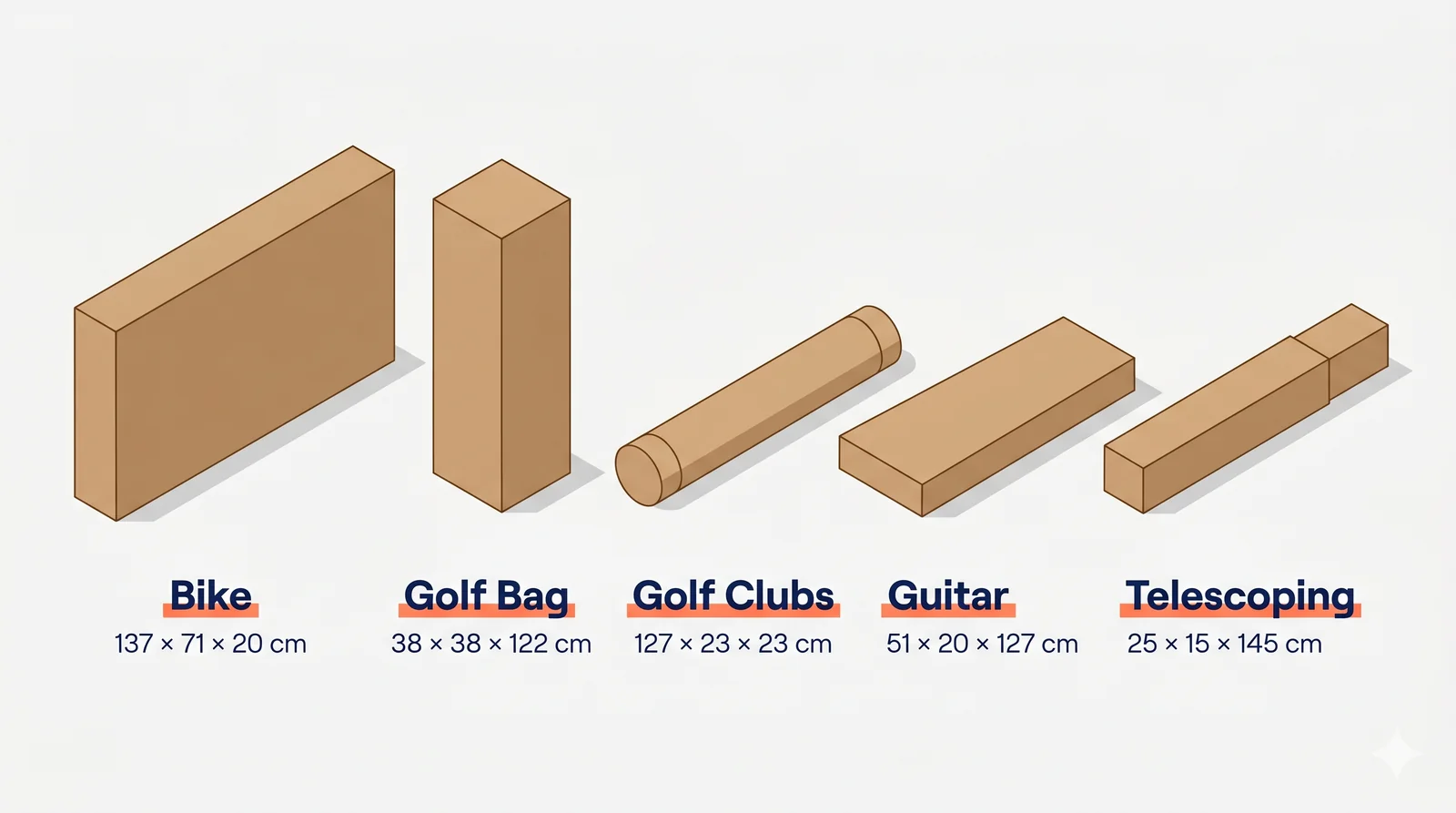
Specialty boxes cover long or awkward items: a bike box runs about 54 × 28 × 8 inches, and a guitar box about 20 × 8 × 50 inches.
| Specialty box | Typical inches | Centimeters | Common use |
| Bike box | 54 × 28 × 8 | 137 × 71 × 20 | Bicycles, large frame items |
| Golf bag box | 15 × 15 × 48 | 38 × 38 × 122 | Golf bags, ski equipment |
| Golf club tube | 50 × 9 × 9 | 127 × 23 × 23 | Golf clubs, fishing rods |
| Guitar box | 20 × 8 × 50 | 51 × 20 × 127 | Guitars, narrow instruments |
| Telescoping box (2-piece) | 10 × 6 × 57 and up | 25 × 15 × 145 and up | Posters, blinds, long flat items |
| Mirror or artwork carton | Made to order | Made to order | Framed art, large mirrors |
Every carrier caps size by length plus girth: the longest side plus twice the width plus twice the height.
| Carrier and service | Maximum weight | Maximum length | Maximum length plus girth |
| USPS Priority Mail | 70 lb (31.8 kg) | Set by length plus girth | 108 in (274 cm) |
| USPS Ground Advantage | 70 lb (31.8 kg) | Set by length plus girth | 130 in (330 cm) |
| UPS | 150 lb (68 kg) | 108 in (274 cm) | 165 in (419 cm) |
| FedEx | 150 lb (68 kg) | 108 in (274 cm) | 165 in (419 cm) |
Surcharges start well below those ceilings. FedEx adds an oversize charge once a package passes 96 inches in length, 130 inches in length plus girth, 17,280 cubic inches, or 110 pounds actual weight. UPS applies its Large Package Surcharge above 130 inches in length plus girth. Both carriers revise these thresholds with their rate updates, so confirm them before you ship anything oversize.
For artwork, antiques or scientific instruments, a custom wooden crate protects better than any cardboard box. It costs more, and it is worth it whenever the replacement cost is high.
Frequently Asked Questions
How do you measure a box for shipping?
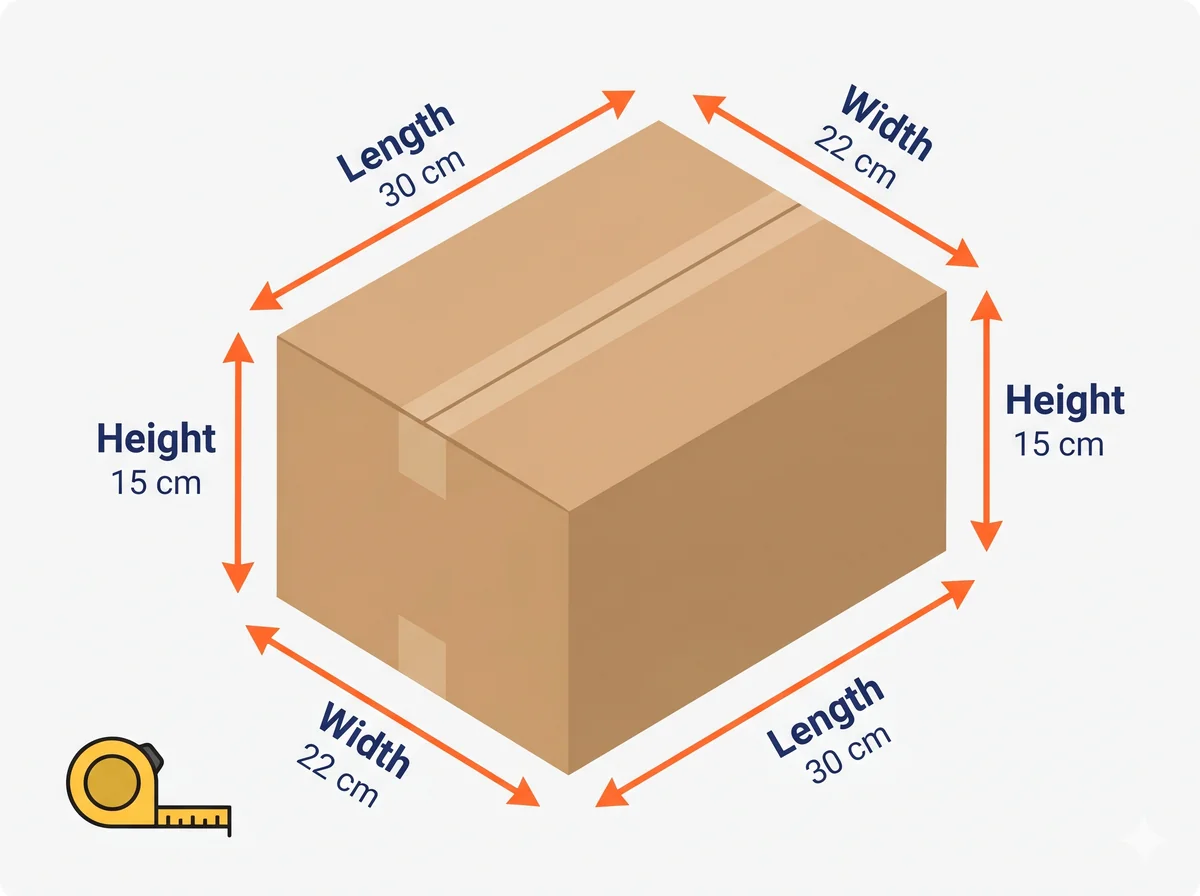
Measure the outside of the box in inches, in this order: length × width × height. Length is the longest side, width is the next side, and height runs from the base to the top. Measure the package as it will ship, including any bulge, and round each figure up to the next whole inch; USPS has required rounding up since July 12, 2026. Multiply the three for cubic inches, then divide by 139 for dimensional weight, or use our dimensional weight calculator.
What size is a standard shipping box?
There is no single standard. The most common general-purpose box is 12 × 12 × 12 inches, one cubic foot. Stock sizes run from 6 × 4 × 3 inches for accessories to 24 × 18 × 18 inches for bulky goods, and 12 × 9 × 6 and 16 × 12 × 8 inches are the most used for e-commerce orders.
What are standard USPS, UPS and FedEx shipping box sizes?
Measured on the outside, USPS Priority Mail Flat Rate boxes are 8 11/16 × 5 7/16 × 1 3/4 inches (Small) and 11 1/4 × 8 3/4 × 6 inches (Medium, top-loading). The side-loading Medium is 14 1/8 × 12 × 3 1/2 inches and the Large is 12 1/4 × 12 × 6 inches. UPS Express Boxes come in Small (13 × 11 × 2), Medium (16 × 11 × 3) and Large (18 × 13 × 3). FedEx offers Small, Medium, Large and Extra Large boxes, plus Paks and tubes.
How big is an 8x8x8 box?
An 8 × 8 × 8 inch box (20.3 cm per side) holds 512 cubic inches, a little under a third of a cubic foot. It suits mugs, candles, small electronics or a bundle of apparel. USPS bills it on actual weight because it is under one cubic foot. UPS and FedEx bill it at 4 pounds or its actual weight, whichever is higher.
Is a 12x12x12 box considered a large box?
No. A 12 × 12 × 12 inch box is exactly one cubic foot (1,728 cubic inches), and carriers treat it as medium. It sits right on the USPS dimensional weight threshold: at exactly 12 inches per side USPS bills actual weight, but a quarter inch more on any side rounds up to 13 and moves it into dimensional pricing. UPS and FedEx bill it at 13 pounds or its actual weight, whichever is higher. Large boxes start around 18 × 18 × 18 inches.
Can you ship a 20x20x20 box?
Yes. A 20 × 20 × 20 inch box holds 8,000 cubic inches and measures 100 inches in length plus girth, inside the limits for USPS Priority Mail (108 inches), USPS Ground Advantage (130 inches), UPS and FedEx (165 inches). All three carriers bill it on dimensional weight: 58 pounds at the 139 divisor, unless the contents weigh more.
Does USPS still give free shipping boxes?
Yes. USPS supplies free Priority Mail and Priority Mail Flat Rate boxes when you ship with those services. It does not supply boxes for USPS Ground Advantage, so ground shipments go in standard corrugated boxes you buy yourself.
How to Pick the Right Box Size, in Short
Start from the product, add the protection it needs, and buy the smallest stock box that holds both. Check the dimensional weight at 139 for every carrier, now that USPS has joined UPS and FedEx on that divisor. Keep USPS Flat Rate boxes for small, heavy items, and remember that above one cubic foot you are paying for volume.
If you ship hundreds of orders a month and want a second opinion on your box lineup, talk to our team.
About the Author
Innovative Warehouse Solutions (IWS) is a U.S.-based third-party logistics (3PL) and order fulfillment provider. We help ecommerce and B2B brands with warehousing, pick and pack, kitting and assembly, and small parcel shipping. This article was written by the IWS operations team, drawing on hands-on experience running fulfillment for growing brands.