

Fulfillment solutions


Standard Pallet Sizes and Dimensions: US, Euro, and ISO Charts
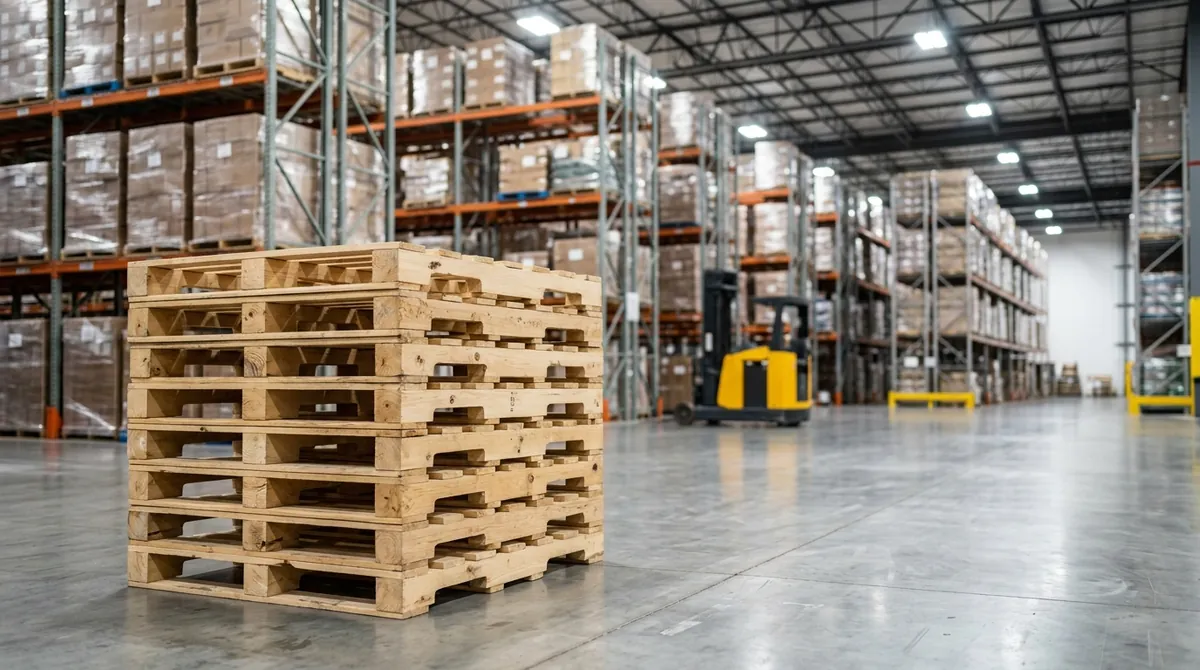
The standard pallet in North America is 48 x 40 inches (121.9 x 101.6 cm), known as the GMA pallet, with an unloaded height of 4.5 to 6.5 inches. Most of the world outside North America builds on the Euro pallet instead, at 1200 x 800 mm.
Those two footprints cover most freight you will ever ship, but the details decide your costs: loaded height limits, weight ratings, and how well your cartons cube out on the deck. This guide covers every standard size in inches and centimeters, then shows how pallet dimensions turn into storage and freight charges.
What Is the Standard Pallet Size?
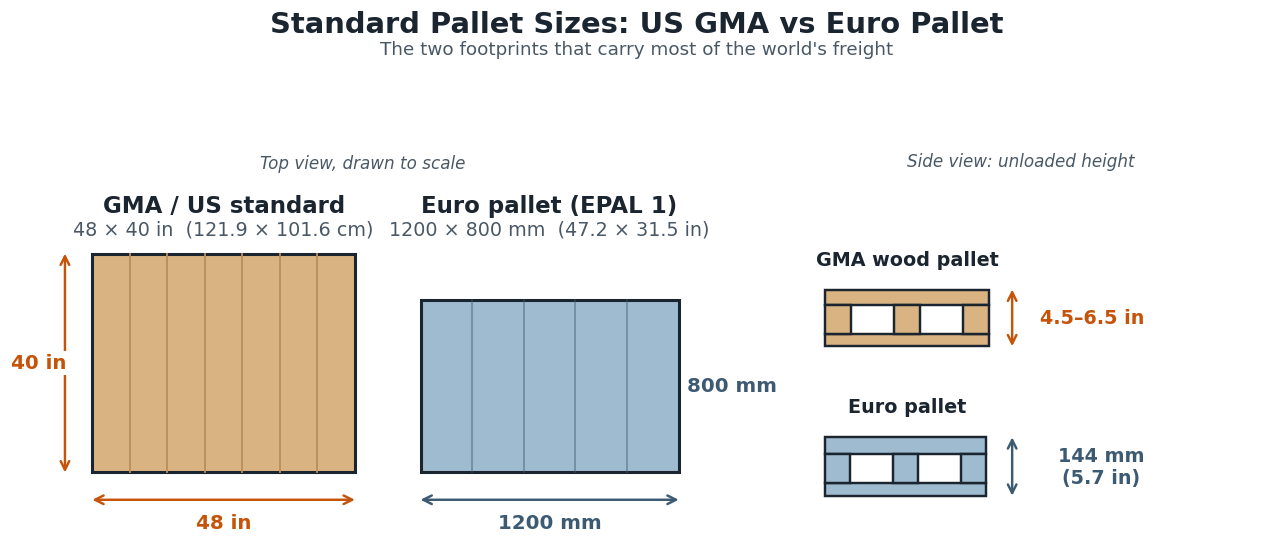
The standard US pallet measures 48 inches long by 40 inches wide. The Grocery Manufacturers Association standardized this footprint decades ago, which is why it is still called the GMA pallet, and it remains the most common pallet in North American warehousing and retail distribution.
A typical GMA wood pallet weighs 30 to 48 lb depending on lumber and moisture, and is commonly rated to carry around 4,600 lb. Grocery, consumer goods, and general retail freight all assume this footprint; rack systems, trailers, and warehouse slots are engineered around it.
Other North American sizes serve specific industries:
| Pallet size (in) | Size (cm) | Common use |
|---|---|---|
| 48 x 40 (GMA) | 121.9 x 101.6 | Grocery, retail, general freight |
| 42 x 42 | 106.7 x 106.7 | Telecom, paint |
| 48 x 48 | 121.9 x 121.9 | Drums, barrels |
| 40 x 40 | 101.6 x 101.6 | Dairy |
| 48 x 45 | 121.9 x 114.3 | Automotive |
| 36 x 36 | 91.4 x 91.4 | Beverages |
Shipping drinks on 36 x 36 decks is one of the quirks that makes beverage fulfillment its own discipline: bottles are dense, so a smaller footprint keeps loads inside weight ratings.
How Tall Is a Pallet?
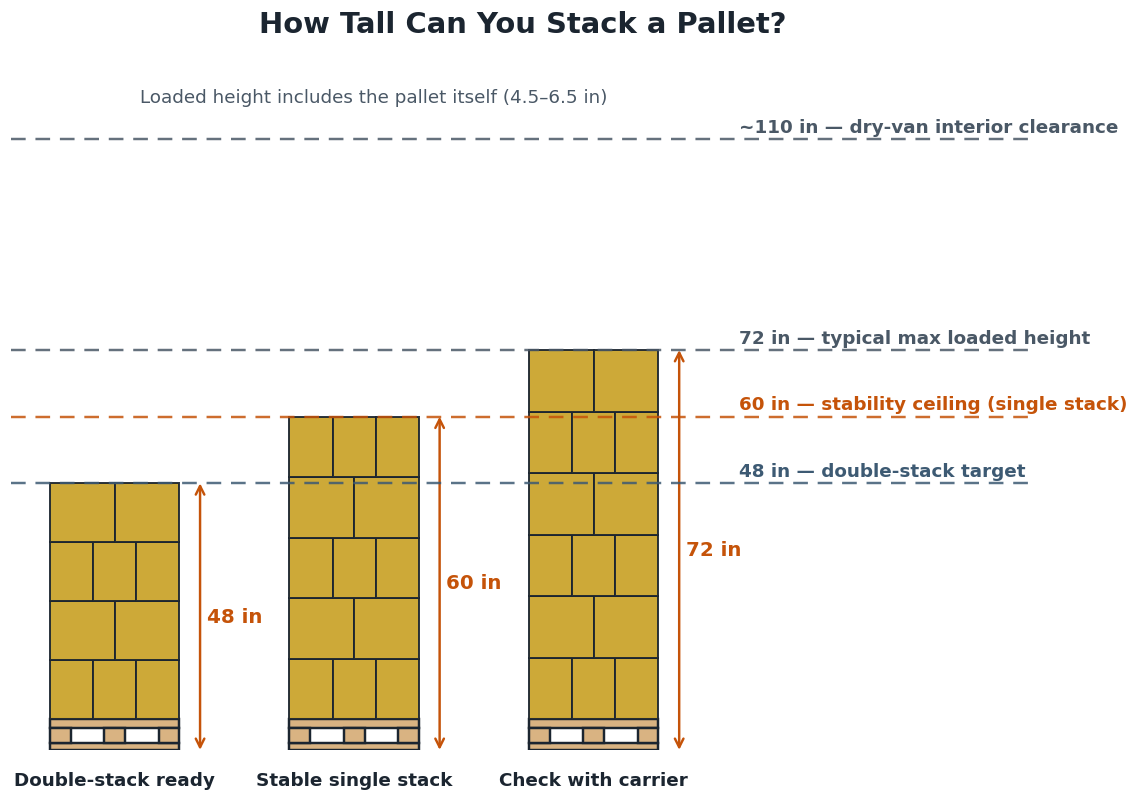
An empty wooden pallet stands 4.5 to 6.5 inches tall. The common GMA build is half-inch deck boards over 3.5-inch stringers, and heavier-duty designs add height; the Euro pallet is fixed at 144 mm, about 5.7 inches.
Loaded height is the number that matters for freight quotes. Most palletized loads finish between 48 and 72 inches including the pallet, and many carriers and warehouses treat 60 inches as the practical ceiling for a stable single-stack load. Plan for about 48 inches when your freight must double-stack in a trailer, because two 48-inch loads clear a standard dry van and two 60-inch loads do not.
What Are Euro Pallet Dimensions?
The Euro pallet (EPAL 1) measures 1200 x 800 mm, which is 47.2 x 31.5 inches, and stands 144 mm tall. It weighs roughly 20 to 25 kg (44 to 55 lb) and EPAL rates it for 1,500 kg (about 3,300 lb) in normal handling.
Euro pallets are pooled and exchanged across Europe under the EPAL system, with the half-size EUR 6 at 800 x 600 mm for retail displays. If you export palletized freight to Europe, plan on re-palletizing or specifying Euro decks up front; a 48 x 40 pallet wastes space in trucks and racking built for the 1200 x 800 grid.
What Are the ISO Standard Pallet Sizes?
ISO 6780 recognizes six pallet footprints, one per major trading region. If you ship internationally, these are the six sizes the world’s racking and containers are built around:
| Size (mm) | Size (in) | Region |
|---|---|---|
| 1219 x 1016 | 48.0 x 40.0 | North America |
| 1200 x 800 | 47.2 x 31.5 | Europe (Euro pallet) |
| 1200 x 1000 | 47.2 x 39.4 | Europe, Asia |
| 1165 x 1165 | 45.9 x 45.9 | Australia |
| 1100 x 1100 | 43.3 x 43.3 | Asia |
| 1067 x 1067 | 42.0 x 42.0 | North America, Europe, Asia |
How Much Weight Can a Pallet Hold?
A standard GMA wood pallet is commonly rated around 4,600 lb, and a Euro pallet at 1,500 kg. Real capacity depends on the pallet’s condition, how evenly the load is distributed, and whether it sits on racking beams or a flat floor.
Weight limits usually bite from the other direction: trailers cube out or weigh out before pallets fail. A dense beverage or supplement load can hit a trailer’s legal weight limit with pallets stacked barely waist-high, which is why dense products ship on smaller footprints and why freight quotes always ask for weight and dimensions together.
How Do Pallet Dimensions Affect Shipping and Storage Costs?
Pallet dimensions set two of your biggest logistics costs: the storage you rent and the trailer space you buy.
Warehouse storage bills by the pallet position, and a position assumes a standard 48 x 40 footprint within a height limit. IWS charges $8.75 per pallet per week, and one oversized or overhanging pallet can occupy two positions, doubling its storage cost while exposing cartons to rack damage. Right-sized pallets also load cleanly: a 53-foot trailer takes 26 single-stacked standard pallets in two rows of thirteen, and up to 52 when loads are built low enough to double-stack.
The same logic drives LTL freight pricing, where carriers quote against density and freight class: a tall, light pallet books expensive cube while a compact one rides cheap. Overhang is the silent killer on both counts, because cartons past the pallet edge absorb impacts, void some carrier damage claims, and break the clean cube math that keeps rates down. Our flat-rate pallet shipping program exists precisely to make these costs predictable, and for parcel-sized shipments the same size-versus-weight tradeoff shows up as dimensional weight, which you can model on our dimensional weight calculator.
If you are comparing providers, our 3PL pricing guide breaks down how pallet storage, receiving, and handling fees fit together.
Which Pallet Type Should You Use?
Wood stringer pallets are the default: cheap, repairable, and everywhere. The three common types are stringer pallets (boards over two-by-four rails, the standard GMA build), block pallets (nine blocks, forklift entry from all four sides, the Euro pallet design), and plastic pallets, which cost more but last longer and meet hygiene rules for food and pharma.
For most brands the practical answer is: ship on 48 x 40 wood unless your product is dense enough to need a smaller deck, your buyer specifies otherwise, or export rules require heat-treated (ISPM 15 stamped) or plastic pallets. Retailers increasingly require block pallets for their distribution centers, so check routing guides before you commit to a pallet spec, the same way you would check a carton size chart before ordering boxes.
Pallet Size FAQs
What is the standard pallet size?
The standard pallet in North America is 48 x 40 inches, the GMA footprint. Europe standardizes on the Euro pallet at 1200 x 800 mm, and ISO 6780 recognizes six regional sizes in total.
How tall is a standard pallet?
An empty wooden pallet stands 4.5 to 6.5 inches tall; the Euro pallet is fixed at 144 mm, about 5.7 inches. Loaded pallets typically finish between 48 and 72 inches including the deck.
What is the height of a 48 x 40 pallet?
A standard 48 x 40 GMA pallet is about 4.5 to 6.5 inches tall unloaded, built from half-inch deck boards over 3.5-inch stringers, with heavier designs at the taller end.
What is the standard pallet size in cm?
The US standard pallet is 121.9 x 101.6 cm (48 x 40 inches) with an unloaded height around 12 to 16 cm. The Euro pallet is 120 x 80 cm with a fixed 14.4 cm height.
How heavy is a pallet?
An empty GMA wood pallet weighs 30 to 48 lb depending on lumber and moisture. A Euro pallet weighs roughly 44 to 55 lb, and plastic pallets vary widely by design.
How tall can you stack a pallet?
Keep single-stack loads at or under about 60 inches including the pallet for stability, and near 48 inches when freight must double-stack in a trailer. Warehouses and carriers publish their own limits, so confirm before building loads.
How many pallets fit in a 53-foot trailer?
A 53-foot dry van holds 26 single-stacked standard 48 x 40 pallets in two rows of thirteen, and up to 52 when loads are low and sturdy enough to double-stack.
What are the three types of pallets?
Stringer pallets (boards over rails, the standard US build), block pallets (four-way forklift entry, the Euro design), and plastic pallets, which cost more but meet hygiene requirements for food and pharmaceutical freight.
Is a Euro pallet the same as a US pallet?
No. The Euro pallet is 1200 x 800 mm (47.2 x 31.5 inches), smaller than the US 48 x 40 standard, and uses a four-way block design. Freight moving between regions is often re-palletized to match local racking and trucks.
Palletizing is where fulfillment meets freight. If your orders are outgrowing parcel shipping, our B2B fulfillment team builds retail-ready pallets to your buyer’s routing guide. Get a quote to see what palletized shipping costs on your actual order profile.
About the Author
Innovative Warehouse Solutions (IWS) is a U.S.-based third-party logistics (3PL) and order fulfillment provider. We help ecommerce and B2B brands with warehousing, pick and pack, kitting and assembly, and small parcel shipping. This article was written by the IWS operations team, drawing on hands-on experience running fulfillment for growing brands.