

Fulfillment solutions


3PL for Beverage Companies: A Guide to Alcohol and Non-Alcoholic Fulfillment
A beverage 3PL stores, packs and ships drinks for brands. Compared with a general warehouse, it adds expiry rotation, glass-safe packing and, for alcohol, the state licenses that direct shipping requires.
Updated September 2026. State shipping rules below come from sources dated 2023 to 2026 and change often, so confirm them before you ship to a new state.
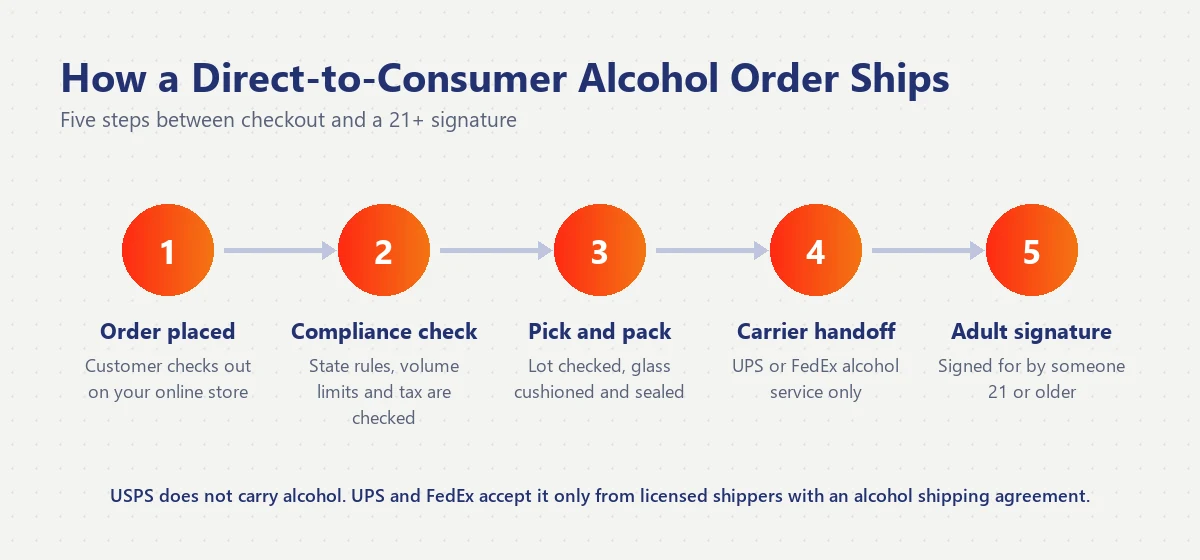
Drinks are heavy, breakable and date-coded. Alcohol also changes the rules at every state line: wine can ship directly to consumers in 48 states and Washington, D.C., beer in 11 states and D.C., and spirits in far fewer. This guide covers what fulfillment costs, what the law requires and how to pick a provider.
What Is a Beverage 3PL?
A beverage 3PL is a fulfillment warehouse built around drinks, handling the expiry dates, glass and alcohol law that a general warehouse skips.
Its clients run from wineries and craft breweries to makers of energy drinks, ready-to-drink cocktails, cold-pressed juice, drink mixes and bottled water, plus importers bringing foreign wine and beer into the US. For the supply chain beyond the warehouse, from production to the retail shelf, read about drinks logistics.
How Much Does Beverage 3PL Fulfillment Cost?
At IWS, pick and pack costs $2.50 for the first item and $0.40 for each additional one, and pallet storage costs $8.75 a week.
That puts a three-bottle wine order at $3.30 to pick and pack before shipping, and a stored pallet at about $38 a month. Packing materials are included, and IWS pricing has no onboarding fees. Across the industry, first-item fees run from $1.50 to $4.00; our breakdowns of pick and pack costs and receiving and storage fees show where each charge comes from.
Drinks carry extra costs of their own. Liquids are dense, so carriers bill them on actual weight and dimensional weight rarely comes into play. Glass needs protective inserts. Climate-controlled space costs more than ambient racking. Every alcohol parcel adds a carrier adult-signature fee.
What Does It Take to Ship Alcohol Direct to Consumers?
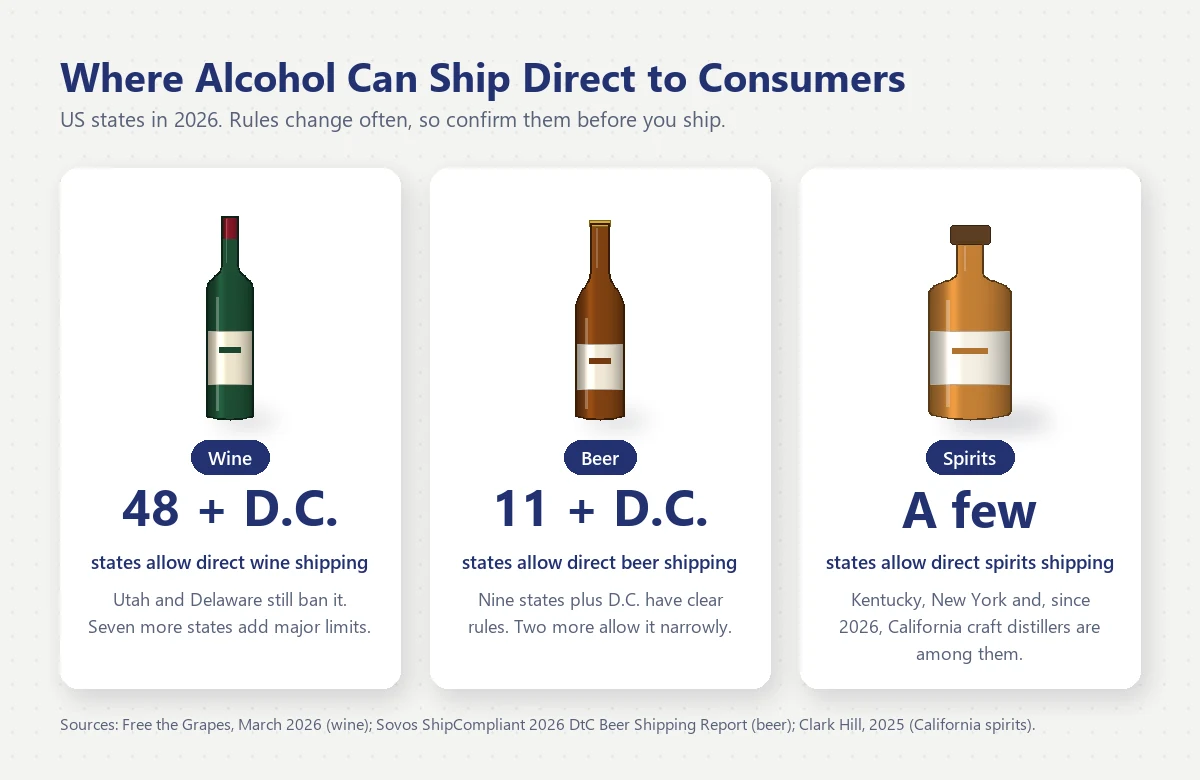
A brand needs a federal TTB permit, a permit for every destination state, a UPS or FedEx alcohol agreement, and an adult signature on each delivery.
Alcohol normally moves through a three-tier system of producers, wholesalers and retailers. Direct-to-consumer (DTC) shipping is an exception that each state grants on its own terms, which is why the answer to “can we ship there?” changes at every border.
Where Can Each Beverage Ship?
Utah and Delaware still ban direct wine shipping, seven more states restrict it, and most states still bar breweries and distillers from shipping direct.
| Beverage | Where direct shipping is allowed | Main exceptions | Source |
|---|---|---|---|
| Wine | 48 states and Washington, D.C. | Utah and Delaware ban it; seven more states restrict it (below) | Free the Grapes, March 2026 |
| Beer | 11 states and Washington, D.C. | Clear rules in Alaska, Kentucky, Nebraska, New Hampshire, North Dakota, Ohio, Oregon, Vermont, Virginia and D.C.; narrower rules in two more, including Pennsylvania | Sovos ShipCompliant, 2026 beer report |
| Spirits | A small group, including Kentucky, New York and, since January 2026, California craft distillers | Most states prohibit it | Clark Hill, 2025 |
| Restricted wine state | Rule |
|---|---|
| Indiana | No direct shipping if the winery’s wine is in wholesale distribution |
| Louisiana | Only wines not already in distribution may ship direct |
| Mississippi | Wines in distribution may not ship direct unless deemed “highly allocated” |
| New Jersey | Only wineries producing 250,000 gallons a year or less may ship direct |
| Oklahoma | Wineries may not use fulfillment houses |
| Rhode Island | The buyer must first purchase in person at the winery |
| Wyoming | Only wines not already in distribution may ship direct |
Many states also cap how much one customer can receive. Pennsylvania allows up to 36 nine-liter cases a year from a licensed direct wine shipper; Oklahoma allows six. At 12 standard bottles a case, that gap is 360 bottles.
The map keeps changing. Arkansas dropped its on-site purchase rule in August 2025, Mississippi opened to direct wine shipping on July 1, 2025, and California began allowing craft spirits shipments on January 1, 2026. Sources: Free the Grapes for wine and the restrictions above, the Sovos ShipCompliant beer report, and Clark Hill on California. Spirits get a fuller treatment in our state-by-state liquor shipping guide.
Which Licenses Does the Warehouse Need?
In at least 16 states, the warehouse shipping for a winery needs its own license, permit or registration, and Oklahoma bans fulfillment houses outright.
Alabama, Kansas, North Dakota, Tennessee and Virginia license fulfillment houses. Illinois and Louisiana make wineries register every address they ship from, and Maine, Nevada and Wisconsin added rules for 2025. Most of these states also want an annual report of the shipments a warehouse handled. A winery shipping through an unlicensed warehouse puts its own permit at risk, so get the license list before moving inventory. Sovos ShipCompliant tracks the states, and a December 2024 review in The Digest of Wine and Spirits Law counted 16.
Who Carries Alcohol, and How Are Orders Checked?
Only UPS and FedEx carry alcohol, for licensed shippers with an alcohol agreement. USPS refuses it, and every parcel needs a signature from someone 21 or older.
Before an order reaches the warehouse, compliance software such as Sovos ShipCompliant or Avalara for Beverage Alcohol checks it against the destination state’s rules, tracks each customer’s annual volume and calculates excise and sales tax. It also files the state reports. The warehouse ships only orders that clear that check, ideally through an integration that passes the compliance status along with each order. FedEx’s alcohol requirements set out the carrier terms.
What Federal Rules Apply Before a Drink Ships?
Alcohol labels need TTB approval before crossing state lines, food and drink warehouses must register with the FDA, and kombucha can fall under alcohol rules.
Label Approval (COLA)
The TTB’s Certificate of Label Approval (COLA) is required before bottling for spirits, and for wine at 7% alcohol by volume or more that will cross state lines. Beer needs one before it leaves the bottling premises, and imports before release from Customs. Products sold only in the state where they are bottled can use an exemption. A 3PL cannot fix a missing COLA, so confirm it before inventory arrives; TTB’s label approval basics have the details.
FDA Food Facility Registration
Any facility that manufactures, processes, packs or holds food for US consumption, drinks included, must register with the FDA. Registration is free and renews every other year between October 1 and December 31 of even-numbered years, so the current window closes December 31, 2026. In the FDA’s words, a registration number “does NOT convey FDA approval or endorsement of the facility or its products.”
Kombucha and Non-Alcoholic Beer
The federal line is 0.5% alcohol by volume. Kombucha falls under TTB alcohol rules if it reaches that level at any point, including through fermentation after bottling, so its storage temperature matters. Non-alcoholic beer and wine below the line generally ship like soft drinks. Their labels may say “non-alcoholic” only alongside a statement such as “contains less than 0.5% alcohol by volume,” and “alcohol free” is reserved for 0.0%. State rules can differ.
How Should Each Type of Drink Be Stored and Packed?
Wine needs steady 55°F storage, beer needs cold storage and fast turnover, spirits tolerate room temperature, and non-alcoholic drinks need strict expiry rotation.
Wine
Wine keeps best at about 55°F (13°C) and 50 to 70% humidity, and steadiness matters more than the exact figure: temperature swings push corks in and out and let air reach the wine. An ambient building that hits 90°F in July will damage it, so wine needs a climate-controlled zone.
Beer and Spirits
Hop-forward craft beer fades noticeably when warm, which rewards cold storage and short dwell times. Spirits are the most stable product and keep well at room temperature. Because most states bar distillers from shipping direct, a 3PL serving them mostly handles B2B fulfillment and wholesale freight.
Non-Alcoholic Drinks
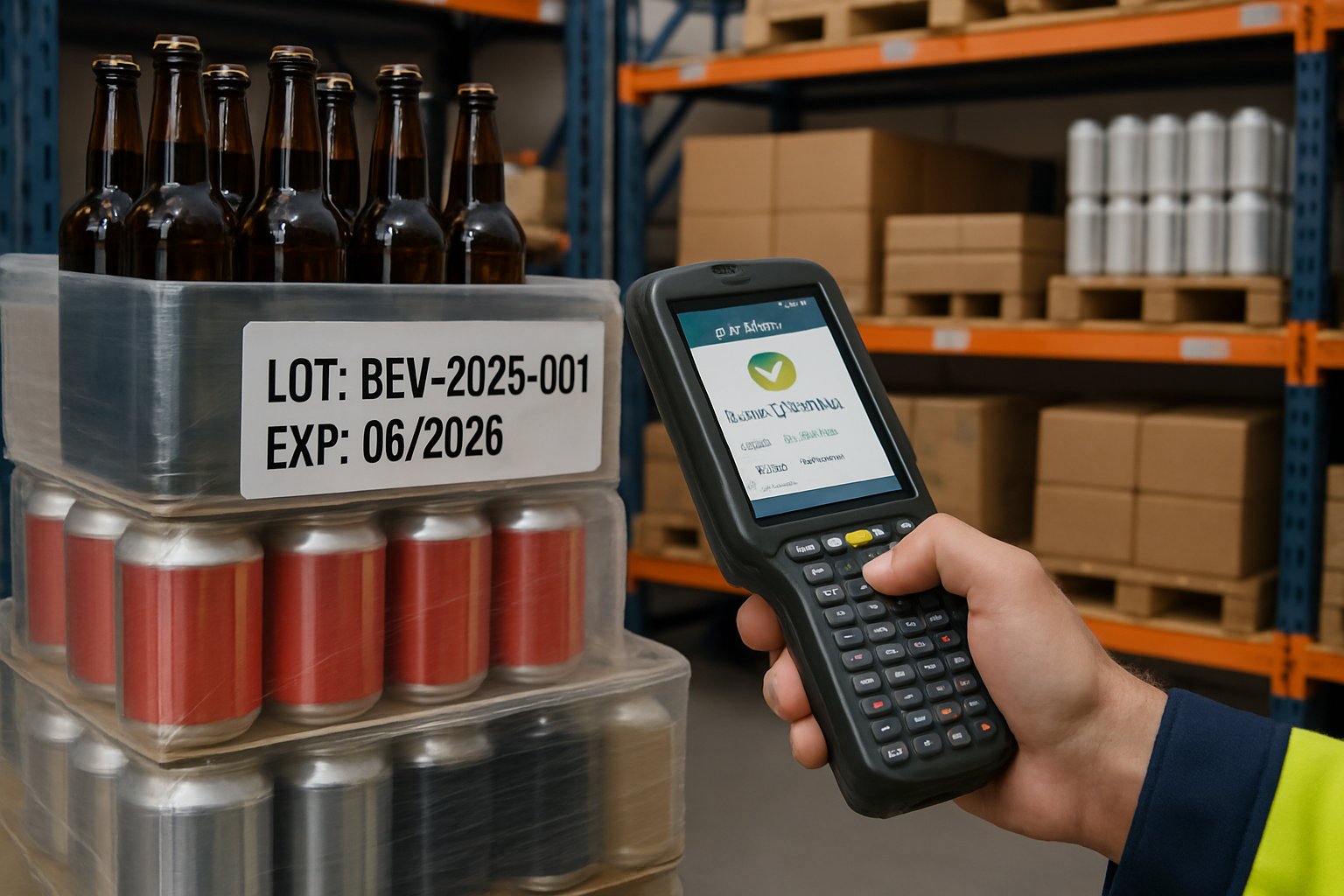
Energy drinks, ready-to-drink coffee, cold-pressed juice and kombucha carry expiry dates, some only weeks out. First-expired-first-out (FEFO) rotation ships the oldest date first. Scanning each case in with its lot number means a quality problem pulls one batch instead of the whole line, which is the point of batch tracking. Carbonated drinks can burst if they freeze, so winter shipments to cold states need insulation or a hold.
Glass Bottles
Hold each bottle in a molded pulp or foam insert away from the carton walls, keep bottles apart with dividers, and fill every void. Multi-bottle orders go in double-wall cartons. Before a new pack-out goes live, ship a few orders to yourself and open them. Our walkthrough on shipping glass bottles of liquid covers each step, and kitting handles the variety packs and gift sets drink brands sell.
How Do You Choose a Beverage 3PL?
Compare beverage 3PLs on licensing, carrier agreements, temperature control and lot tracking before price. Shipping orders yourself only makes sense at low volume.
| What to check | General 3PL | Beverage 3PL | Question to ask |
|---|---|---|---|
| Alcohol direct shipping | Often not offered | Offered through UPS and FedEx alcohol services | Do you have alcohol agreements with UPS and FedEx? |
| State fulfillment house licenses | Ask before signing | Held for the states it ships to | Which licenses do you hold, and can I see them? |
| Temperature control | Mostly ambient | Climate-controlled zones | What temperature is the wine zone, and how is it logged? |
| Lot and expiry rotation | Basic | FEFO with lot tracking | Do you track lots at pallet and case level? |
| Glass packaging | Standard void fill | Inserts, dividers, double-wall cartons | What is your breakage rate on glass? |
| Compliance software | Varies | Connects to ShipCompliant or Avalara | How does compliance status reach your system? |
| Peak season | Shared with every client | Planned for seasonal spikes | How much extra volume can you take in Q4? |
Typical setups; individual providers vary. Put the same questions to every candidate, as in any 3PL selection process, and weigh the answers against the true cost of self-fulfillment.
How IWS Supports Beverage Brands
IWS’s 3PL fulfillment service works with brands doing $1M or more in annual revenue and shipping at least 300 orders a month. For drink brands, that means lot numbers and expiry dates recorded on every outbound order, FDA-registered warehousing, 99.98% order accuracy, and same-day shipping for orders placed by 11 AM Eastern.
Retail accounts are covered too. IWS ships everything from single parcels to LTL and full-truckload pallet freight, and builds retail-ready pallets for store delivery. Read how it works, or talk to our team about your products.
About the Author
Innovative Warehouse Solutions (IWS) is a U.S.-based third-party logistics (3PL) and order fulfillment provider. We help ecommerce and B2B brands with warehousing, pick and pack, kitting and assembly, and small parcel shipping. This article was written by the IWS operations team, drawing on hands-on experience running fulfillment for growing brands.