

Fulfillment solutions


3PL Contracts, SLAs, and Switching Providers: Managing Your Fulfillment Partnership
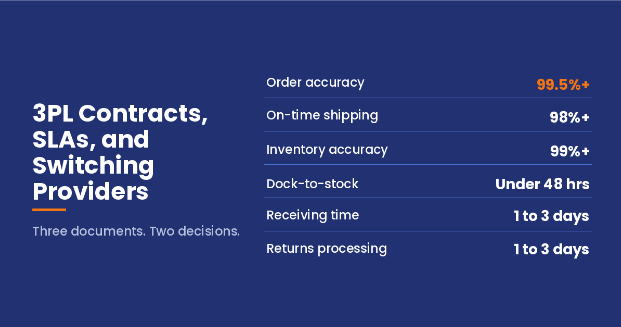
A 3PL partnership runs on three documents and two decisions. The documents are the contract, the service level agreement (SLA), and the ongoing performance dashboard. The decisions are when to bring a new provider in and, eventually, when to move on from one that isn’t working.
This article covers what belongs in a 3PL contract beyond pricing, which SLA commitments matter most, the performance metrics worth tracking after go-live, a realistic onboarding timeline with a new provider, signs it’s time to switch, and how to run a migration without disrupting customer shipments.
What Should a 3PL Contract Cover?
A 3PL contract should define scope of services, term and renewal, termination and inventory release, liability caps, data handling, and how rates can rise. The rest of the document defines what services you are actually paying for, who is responsible when things go wrong, and how the relationship ends. A well-written contract treats the 3PL as a long-term partnership rather than a transactional vendor relationship.
- Scope of services (Statement of Work). The exact services included: receiving, storage, pick and pack, shipping, returns, and value-added services. Generic language here creates disputes later.
- Term and renewal. Initial contract length, usually 1 to 3 years, plus auto-renewal clauses and notice periods of 30, 60, or 90 days.
- Termination clauses. Conditions under which either party can exit, fees tied to early termination, and inventory release procedures.
- Liability and insurance. Who is responsible for damaged, lost, or stolen inventory. Typical per-pallet or per-unit liability caps, plus cargo insurance and general liability coverage.
- Data security and confidentiality. Treatment of customer data, SKU data, and order information, plus GDPR or CCPA compliance where it applies.
- Intellectual property. Ownership of branded packaging designs, inserts, and marketing materials.
- Price adjustment clauses. Most 3PLs guarantee rates for the first year, then raise them by a fixed percentage or based on carrier rate increases.
Rates belong in the contract, and how 3PL quotes are structured decides what you are comparing.
What Is an SLA in Logistics?
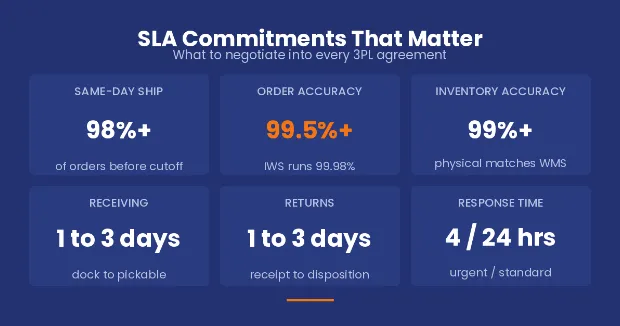
A service level agreement is the section of a 3PL contract that sets measurable performance targets, such as order accuracy and ship cutoffs, with penalties when they are missed. Vague language here means no real recourse when service slips. The table below shows the commitments worth negotiating into every SLA.
| Commitment | Typical Target | Notes |
| Same-day ship cutoff | 98% of orders received before 11 AM to 2 PM local shipped same day | Cutoff time should be stated explicitly |
| Order accuracy | 99.5% or higher (IWS runs 99.98%) | Measured as orders without pick, quantity, or address errors |
| Inventory accuracy | 99% or higher | Physical counts match WMS records |
| Receiving turnaround | 1 to 3 business days from dock arrival to pickable | Slower during peak season unless stated otherwise |
| Returns processing | 1 to 3 business days from receipt to inspection and disposition | Best-in-class providers commit to 24 to 48 hours |
| Response times | 4 hours for urgent issues, 24 hours for standard | Should include named escalation contacts |
The targets above only mean something if the contract says how each one is measured. Five clauses decide that:
- Define the metric, not just the number. An SLA percentage means nothing until the contract states its numerator, denominator, cutoff, exclusions and reporting period. Otherwise a provider can post a strong number by excluding the hardest orders. Order accuracy is usually measured monthly, not daily.
- Read the exclusions before the targets. Peak-season carve-outs, weather language that never defines “extreme”, and “commercially reasonable efforts” all weaken a commitment. The clause to hunt for is “sole and exclusive remedy”, which can bar claims for actual damages.
- Remember that an SLA measures shipping, not delivery. The 3PL commits to hitting the cutoff and usually disclaims what the carrier does next. A provider can report full compliance in a month when your customers received late parcels.
- Check the ramp clause. Many agreements suspend SLA remedies for the first 30 to 90 days while the operation stabilizes. That part is fair. Suspending measurement is not, because it leaves you with no baseline for the first quarter.
- Push credits off the transaction and onto the invoice. Credits of 5% to 15% of the affected order’s fee are common, which on a $2.50 pick fee is a few cents. Tie them to 3% to 5% of the monthly fee instead, capped at 5% to 20%.
Measurement and credit provisions follow F. Curtis Barry & Company’s 3PL contract checklist. The exclusions and the shipping-versus-delivery distinction follow Cahoot’s 2026 guide to logistics SLAs.
Beyond the targets, set the review cadence in the contract. Monthly or quarterly business reviews give both sides a chance to surface issues before they become reasons to terminate.
Which 3PL Metrics Should You Track After Go-Live?
Track perfect order rate, on-time shipping and dock-to-stock weekly, then cost per order and inventory accuracy monthly. SLAs set the target; metrics prove it held. Think of these as the numbers that should live on a dashboard you check weekly.
| Metric | What it measures | Typical target | Source |
| Perfect order rate | Orders shipped with no picking, packing or delivery error | Median around 90%, best-in-class 95% or higher | Cahoot, Feb 2026 |
| On-time shipping | Orders shipped by the agreed cutoff | 95% to 98% acceptable, 99.5% to 99.8% best-in-class | Cahoot, Feb 2026 |
| Pick accuracy | Items picked without error | Industry average 97% to 98%, best-in-class 99.5% to 99.9%. IWS runs 99.98% | Cahoot, Feb 2026; IWS figure is our own |
| Inventory accuracy | Physical counts matching the WMS | SLAs typically require 97% or better | Cahoot, Feb 2026 |
| Returns processing | Receipt to inspection and disposition | 24 to 48 hours standard, within 24 hours best-in-class | Cahoot, Feb 2026 |
| Shrinkage allowance | Loss the client absorbs before the 3PL pays | Around 0.5%, though the denominator varies a lot | F. Curtis Barry & Co and Cahoot, independently |
| Dock-to-stock | Inbound arrival to pickable inventory | Under 48 hours is commonly written into SLAs | NO SOURCE FOUND. Keep the figure, label it as a typical contract target, not a benchmark |
A 3PL should share these numbers proactively, not only when asked. The IWS software surfaces each of these metrics in real time, along with inventory photos and replenishment alerts. Providers that hide behind “on request” reporting rarely have numbers worth showing.
How Long Does 3PL Onboarding Take?
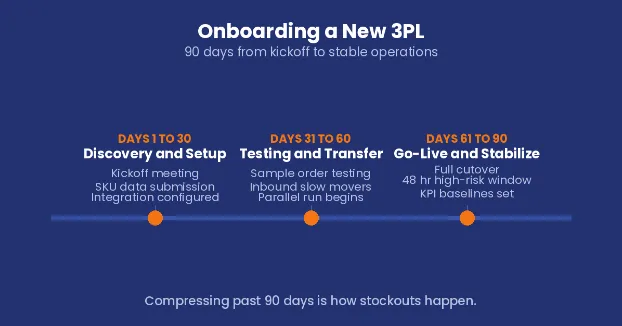
Onboarding a new 3PL takes 30 to 90 days: discovery and setup in month one, integration testing and inventory transfer in month two, go-live and stabilization in month three. A standard 90-day plan runs through three phases.
Days 1 to 30: Discovery and Setup
The kickoff meeting brings together operations, IT, and customer service stakeholders from both sides. Your 3PL requests SKU data (product names, dimensions, weights, UPC codes, and any lot or expiration tracking requirements), sales channel details, and a typical order profile. See how the IWS warehouse process works for an example of what the discovery phase should feel like. By day 30, WMS integration and packaging rules should be fully configured.
Days 31 to 60: Integration Testing and Inventory Transfer
Your ecommerce platform, ERP, and marketplace connections are tested with sample orders during this phase. Look for providers with broad integration coverage so there’s no custom development delay. Inbound inventory begins moving to the new facility, starting with slow-moving SKUs. A parallel run period of 2 to 4 weeks has both providers operating at the same time.
Days 61 to 90: Go-Live and Stabilization
Full cutover to the new provider. The first 24 to 48 hours are the highest-risk window, so monitor every order closely and keep the outgoing 3PL on standby for issue resolution. By the end of day 90, KPI baselines are established and a quarterly business review schedule is set.
When Should You Switch 3PL Providers?
Switch when order accuracy sits below 98% for two months running, ship cutoffs are missed weekly, or cost per order has crept 20% to 30% above year-one rates. These are the triggers that usually mean staying put costs more than moving:
- Order accuracy below 98 percent for two or more months running
- Same-day ship cutoff misses more than once per week
- Support response times over 24 hours on urgent issues, or escalations that go unanswered
- Account manager turnover of three or more reps in 12 months
- Cost-per-order creep of 20 to 30 percent above year-one rates, driven by minimums and surcharges
- Technology gaps blocking new sales channel launches or limiting inventory visibility
- Communication breakdowns where you learn about problems from customers, not your 3PL
- Peak season failures that cost revenue and brand reputation
Several of these overlap with common order fulfillment mistakes that start small and compound quickly. The earlier you catch them, the cleaner the exit.
How Do You Switch 3PLs Without Disrupting Orders?
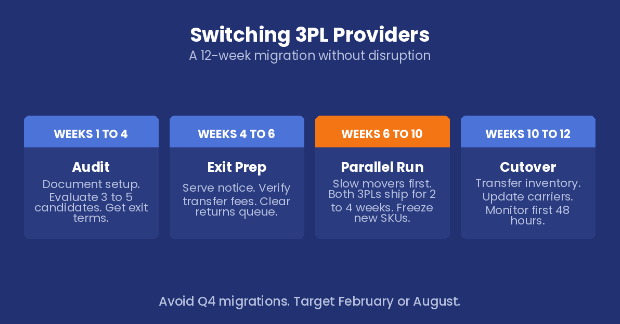
Run both providers in parallel for two to four weeks, moving slow SKUs first and never splitting a single order across two warehouses.
- Audit and selection (weeks 1 to 4). Document your current setup: SKU counts, order volume, SLA performance, contract exit obligations. Use a structured selection process to evaluate 3 to 5 candidates. Get termination terms from your current provider in writing before giving notice.
- Exit preparation (weeks 4 to 6). Serve notice to the current provider. Verify inventory release fees and outbound transfer procedures. Clear the returns queue. Clean up SKU discrepancies in the existing system since they won’t fix themselves at the new provider.
- Parallel run (weeks 6 to 10). Ship slow-moving SKUs to the new provider first. Run real orders through both facilities for 2 to 4 weeks. Freeze new SKU migrations during overlap. Never split a single order across two providers.
- Full cutover (weeks 10 to 12). Transfer remaining inventory. Update carriers with the new pickup address and update sales channels with new warehouse details. Monitor the first 24 to 48 hours of solo operation closely.
Timing matters too. Avoid Q4 migrations since holiday volume kills bandwidth on both sides. Target February through March or August through September, when both your team and the new 3PL have capacity. Stay 60 to 90 days clear of your peak season. If you are comparing replacements, IWS publishes its rates and onboarding timeline for 3PL fulfillment.
Frequently Asked Questions
How long should a 3PL contract be?
Most initial terms run 1 to 3 years with auto-renewal clauses. The notice period to exit usually sits at 30, 60, or 90 days before the renewal date. Shorter terms give you flexibility; longer terms often come with better rates.
What happens to my inventory if I terminate a 3PL contract?
Your inventory stays physically at the old facility until transfer. Most contracts call for an outbound transfer fee per pallet or per unit, plus a window of 30 to 60 days to remove it. Some providers reserve the right to hold inventory during billing disputes, so settle outstanding invoices before serving notice.
Can I negotiate SLA penalties?
Yes. Service credits (future services at no cost) are the most common and easiest form to negotiate. Financial penalties are harder but possible at larger volumes. Tier penalties by breach severity: minor misses get service credits, repeated failures trigger termination rights.
How often should I review 3PL performance?
Operational metrics like order accuracy and on-time shipping warrant weekly review. Cost per order and inventory accuracy can be monthly. Schedule a formal business review with your 3PL quarterly to cover trends, upcoming volume, and process improvements.
How long does it take to switch 3PL providers?
Plan for 60 to 90 days minimum. Compressing to 30 days creates stockouts and angry customers. The parallel-run method with 2 to 4 weeks of overlap protects against cutover disasters and gives both teams time to work through issues before the old provider is offline.
What SLA clauses protect against bait and switch?
Define each SLA by its numerator, denominator, cutoff time, exclusions and reporting period, cap year-two rate rises at a fixed percentage, and tie repeated misses to termination rights rather than service credits alone.
What is the difference between an SLA and a KPI?
An SLA is a contractual promise with consequences attached. A KPI is a number you track. Every SLA target should be a KPI, but most KPIs on a dashboard carry no penalty.
What happens if a 3PL misses its SLA?
Most contracts issue service credits, which are free future services rather than cash. Credits are usually graduated by severity and capped as a share of the monthly fee, so a large commercial loss rarely produces a matching refund.
About the Author
Innovative Warehouse Solutions (IWS) is a U.S.-based third-party logistics (3PL) and order fulfillment provider. We help ecommerce and B2B brands with warehousing, pick and pack, kitting and assembly, and small parcel shipping. This article was written by the IWS operations team, drawing on hands-on experience running fulfillment for growing brands.