

Fulfillment solutions


3PL Pricing Models Compared: How to Read a Quote and Spot Hidden Fees
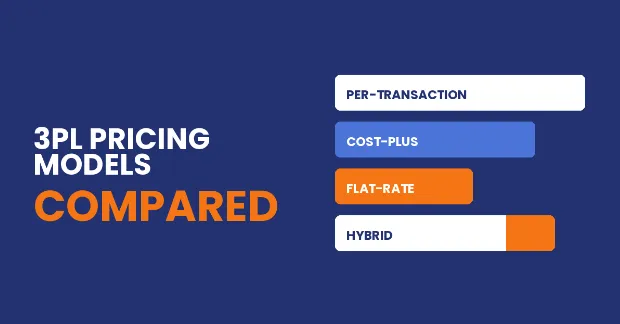
3PL pricing breaks down into four main structures: per-transaction, cost-plus, flat-rate, and hybrid. Each charges differently, which is why two quotes for the same order volume can vary by 40 to 60 percent. Reading a 3PL quote correctly means knowing which structure the provider uses, what fees should appear as line items, and which charges tend to live in contract appendices rather than the first proposal.
why
This article covers the four pricing models, the fee categories that belong on every quote, the hidden charges worth watching for, how 3PL and 4PL pricing compare, how IWS structures its own pricing, and a simple formula for putting any two quotes side by side.
What 3PL Pricing Actually Covers
Every 3PL pays for the same underlying costs: storage, labor for receiving and picking and packing, carrier fees, software, and value-added services like kitting or inserts. The variance between providers isn’t about whether these costs exist. It’s about how they are bundled. For a wider look at how fulfillment costs break down for online sellers, it helps to see each fee category on its own.
One provider rolls storage, handling, and technology into one monthly fee. Another itemizes all three separately. A third hides some costs in surcharges that only appear during Q4. The pricing model a 3PL uses decides how your bill behaves as order volume rises or falls.
The Four Main 3PL Pricing Models
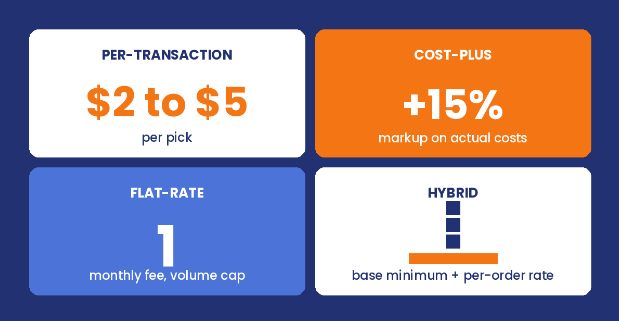
Most 3PLs fall into one of four structures.
Per-Transaction Pricing
Known as per-unit or activity-based pricing. You pay separately for each event: receiving, storage, picking, packing, and shipping. Typical ranges run $0.30 to $0.60 per unit received, $5 to $20 per pallet per month, and $2 to $5 per pick. Fits brands with fluctuating volume since costs rise and fall with actual activity. The tradeoff: your bill swings month to month.
Cost-Plus Pricing
The 3PL passes through actual operational costs and adds a fixed markup, usually around 15 percent. Gives full visibility into expenses but requires open-book accounting. More common for larger accounts.
Flat-Rate or All-In Pricing
A single monthly fee covers all services up to a set volume cap, often around 5,000 orders per month. Budgeting becomes simple. Low volume means you pay for capacity you don’t use; exceeding the cap triggers steep overage fees.
Hybrid Pricing
Combines a base monthly minimum with per-transaction rates above the threshold. A $2,000 monthly minimum might cover the first 500 orders, then $4.50 per order after that. Fits brands with predictable baseline volume and seasonal spikes.
The Fee Categories Inside a 3PL Quote
Pricing models tell you how you are charged. Fee categories tell you what you are charged for. The table below lists the items that should appear as separate lines in any solid quote, with industry benchmarks alongside real IWS rates.
| Fee Category | What It Covers | Typical Range | IWS Rate |
| Setup and onboarding | Channel integration, SKU creation, WMS configuration | $500 to $5,000 | None |
| Receiving | Unloading, counting, inspecting, stowing inbound | $5 to $15 per pallet, $0.25 to $1 per carton, or hourly | Included |
| Storage | Priced per bin, pallet, or cubic foot | Varies widely | $0.50 to $8.75 per week by tier |
| Pick and pack | Core fulfillment labor | $2 to $3.50 first item, $0.30 to $0.75 additional | $2.50 first item, $0.40 additional |
| Shipping | Carrier fees for outbound orders | 50 to 70 percent of total fulfillment spend | Pass-through at actual rate |
| Returns processing | Receiving, inspection, restocking | Around $4 per item on average | $2.40 first item, $0.40 additional |
| Value-added services | Kitting, subscription box assembly, inserts, labeling | Varies by service | $0.40 per insert |
| Technology / account management | WMS access, reporting, integrations | $200 to $2,500 per month | Bundled into base pricing |
The full IWS rate card, including all four storage tiers, lives on the pricing page. For the labor side of fulfillment, see our walkthrough of pick and pack services for small business owners. Reverse logistics has its own line item worth knowing, which is why returns processing gets a separate breakdown.
Hidden Fees and Red Flags in 3PL Contracts
These charges don’t appear in the first quote. They show up in contract appendices or on your second invoice.
- Long-term storage penalties. About 48 percent of warehouses charge 1.5 to 3 times standard rates after inventory sits 30, 60, or 90 days. Seasonal sellers get hit hardest. Careful excess inventory management keeps this small.
- Monthly minimums. A $500 to $3,000 floor you pay regardless of volume. Slow months get expensive fast.
- Peak season surcharges. Rate increases during Q4 or promotional periods. Ask which dates apply and get the percentage in writing.
- Carrier rate markups. Some 3PLs quote attractive pick fees, then mark up carrier invoices 5 to 20 percent. Ask whether carrier costs pass through at actual rate.
- Fee stacking. Separate pick fee, pack fee, materials fee, and a “fulfillment fee” on top. You are paying four times for related work. Published rate cards should be the minimum expectation, which is the approach IWS takes on its pricing page.
- Inventory holds and long notice periods. Contract language letting the 3PL hold your inventory during billing disputes, plus 30, 60, or 90 day notice requirements that trap you past the contract term.
- Vague accessorial charges. Terms like “special handling” or “non-compliant freight” without defined rates. Get those in writing before signing.
3PL vs 4PL Pricing: How the Costs Differ
A 3PL handles operational work: storing inventory, picking orders, packing, and shipping. A 4PL sits a layer above, coordinating multiple 3PLs and managing your supply chain at a higher level.
4PL costs typically run 15 to 25 percent above comparable 3PL pricing since the management fee stacks on top of the underlying 3PL rates. For brands shipping under 10,000 orders per month from one region, a direct 3PL relationship almost always costs less. 4PL pricing makes financial sense once annual logistics spend exceeds $2 to $3 million or when you are coordinating multiple 3PLs across regions.
How IWS Structures Its 3PL Pricing
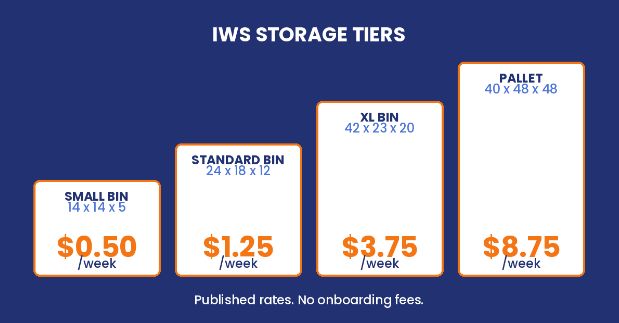
Every rate IWS charges for its 3PL fulfillment services is published online. Pick fees sit at $2.50 for the first item and $0.40 per additional item. Returns run $2.40 plus $0.40 per additional item. Promotional inserts are $0.40 each. Storage uses four tiers: small bin at $0.50 per week, standard bin at $1.25, XL bin at $3.75, and full pallet at $8.75.
This model removes three of the most common sources of surprise on a 3PL invoice. Onboarding is free, so there is no first-month spike from channel integration or WMS configuration. Carrier costs pass through at actual rate, which means shipping fees match what the carrier invoices. And the published rate card covers every billable line, so there is no “fulfillment fee” stacked on top of pick and pack labor. Monthly bills track actual activity: slow months cost less, busy months cost more, without hidden minimums or overage penalties.
A Practical Way to Compare 3PL Quotes
Reducing different quote formats to a single number makes comparison straightforward. Use this formula:
(Receiving + storage + pick/pack + materials + shipping + monthly fees) ÷ orders per month = true cost per order
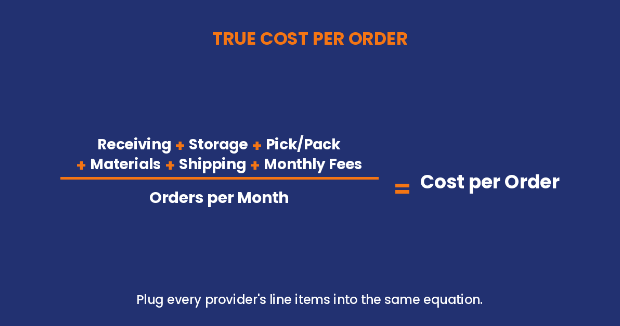
Plug each provider’s line items into the same equation, then sharpen the comparison with these four steps:
- Model month 1 separately from months 2 through 12. Setup fees distort year-one totals, and steady-state costs matter more for planning.
- Run the math at 50, 100, and 150 percent of projected volume. A quote cheap at 500 orders per month can get expensive at 5,000 if volume discounts don’t kick in.
- Ask for a sample invoice based on your SKU list and order profile. Generic rate cards hide category surcharges tied to product type.
- Get what isn’t included in writing: peak surcharges, long-term storage triggers, carrier markup percentages, monthly minimums, and contract notice periods.
A provider willing to publish full rates and produce sample invoices without pressure is showing you what a transparent partnership looks like.
Frequently Asked Questions
What is the average cost of a 3PL?
For brands shipping 1,000 to 5,000 orders per month, typical all-in rates run $3 to $8 per order covering pick, pack, storage, and domestic shipping. Total 3PL spend usually lands at 8 to 12 percent of gross revenue at this scale.
Is per-order or flat-rate pricing better for a small brand?
Per-order pricing fits brands under 500 orders per month or with unpredictable volume since you pay only for actual activity. Flat-rate pricing gets attractive once monthly volume stabilizes near the cap.
Can I negotiate 3PL rates?
Yes. Volume commitments, longer contract terms, and reduced service burden give you room to negotiate. Brands committing to 5,000-plus orders per month can often cut per-order rates by 10 to 25 percent.
What is a reasonable pick and pack fee?
Expect $2 to $3.50 for the first item and $0.30 to $0.75 per additional item at volumes under 2,000 orders monthly. Rates drop at higher tiers. IWS publishes $2.50 and $0.40 as base rates.
How do setup fees affect total cost in year one?
Setup and onboarding add $3,000 to $8,000 to first-year costs at conventional 3PLs, distorting year-one cost-per-order calculations. Providers charging zero onboarding fees remove the distortion.
About the Author
Innovative Warehouse Solutions (IWS) is a U.S.-based third-party logistics (3PL) and order fulfillment provider. We help ecommerce and B2B brands with warehousing, pick and pack, kitting and assembly, and small parcel shipping. This article was written by the IWS operations team, drawing on hands-on experience running fulfillment for growing brands.