

Fulfillment solutions


What Is a 3PL? How Third-Party Logistics Works and What It Costs
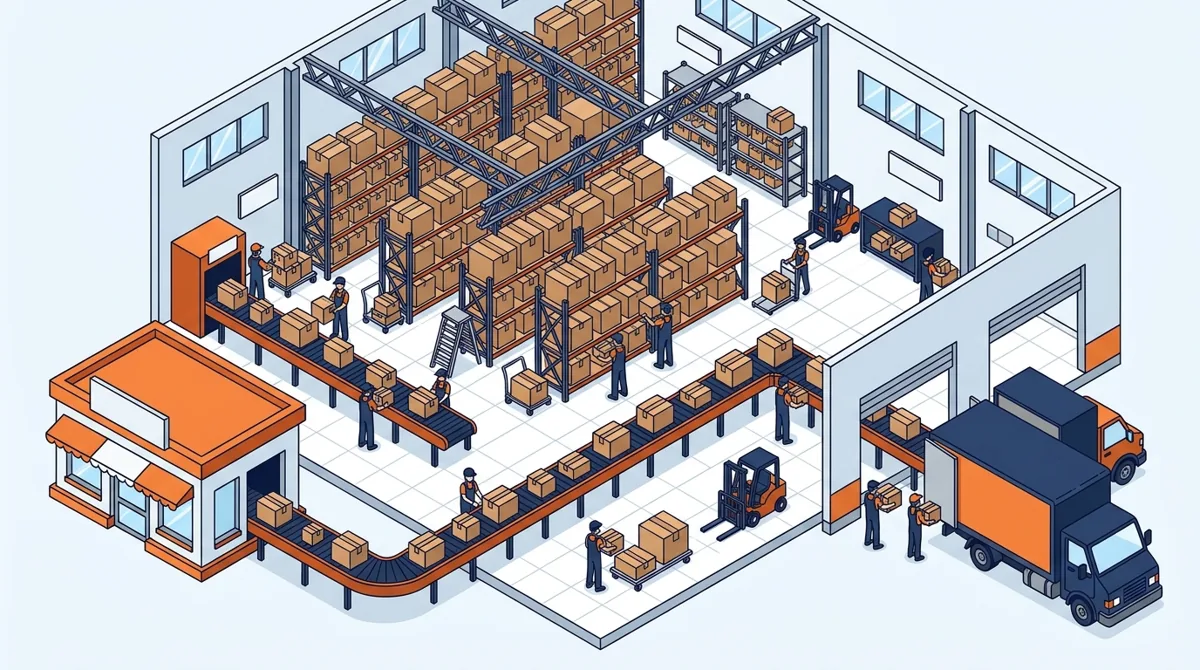
A 3PL, or third-party logistics provider, is a company a business hires to store its inventory and to pick, pack and ship its orders. Most 3PLs also process returns and connect directly to online stores, so a brand can sell without running its own warehouse. Fees are usually charged per order and per unit of storage.
Handing fulfillment to a 3PL trades some direct control for capacity you don’t have to build yourself. This guide covers what a 3PL does, how an order moves through one, what it costs, and how it compares with a 4PL, in-house fulfillment and dropshipping.
What Does a 3PL Do?
A 3PL receives your inventory, stores it, picks and packs each order, ships it through carriers, and handles the returns that come back.
- Receiving: counting inbound stock and recording it in the warehouse system.
- Storage: holding inventory in bins or on pallets.
- Pick and pack: pulling each order’s items and boxing them.
- Shipping: buying postage, often at negotiated carrier rates.
- Returns: inspecting returned items and restocking the ones that can be sold.
- Extras: kitting, inserts, and B2B and retail orders.
Services vary by provider. Some 3PLs focus on ecommerce parcels, others on freight or retail distribution, so check that a provider actually handles your order type.
How Does a 3PL Work?
A 3PL connects to your store, holds your stock, and receives each order automatically, then ships it and sends tracking back to your customer.
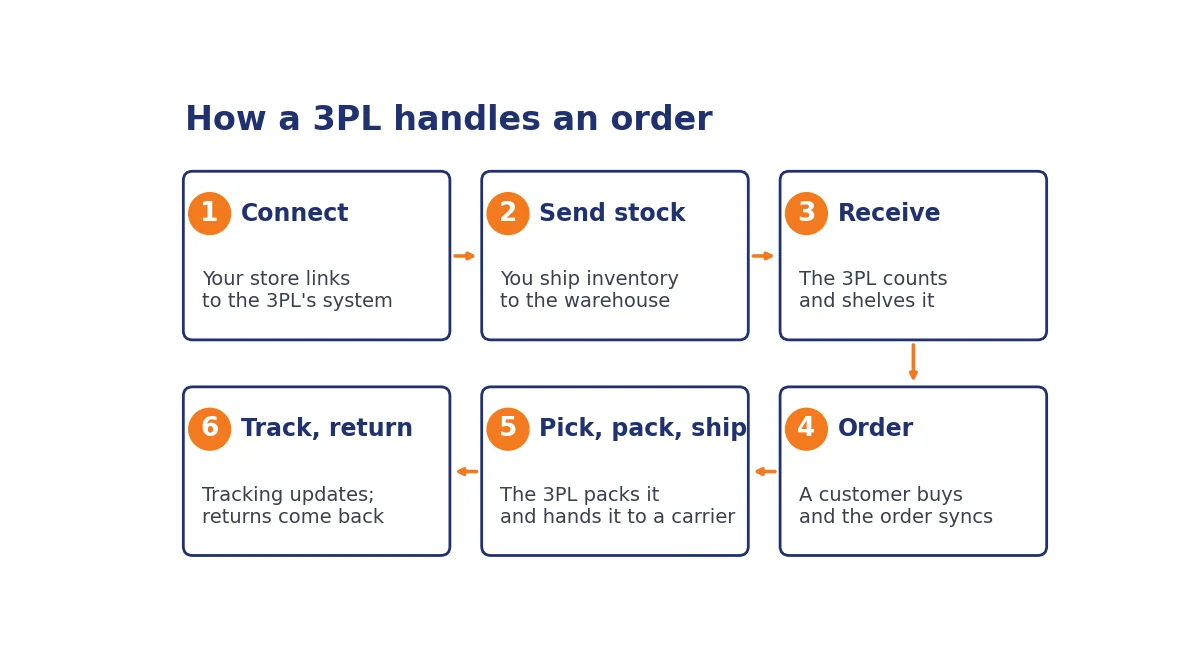
Most of the setup happens once. After the store is connected and stock is on the shelves, orders flow to the warehouse without anyone re-entering them, and your team reorders stock and watches inventory levels. Onboarding commonly takes a few weeks; IWS reports 2 to 3 weeks for most clients.
What Is the Difference Between 1PL, 2PL, 3PL and 4PL?
The number shows how much logistics work is handed to someone else, from a seller shipping its own goods to a partner managing the whole chain.
| Level | Who it is | What it does | Example |
|---|---|---|---|
| 1PL | The seller or manufacturer | Owns the product and moves it itself | A brand delivering in its own vans |
| 2PL | A carrier | Moves goods from one point to another | A parcel carrier or trucking company |
| 3PL | An outsourced logistics provider | Stores, packs and ships for the seller | A fulfillment warehouse |
| 4PL | A supply chain manager | Runs the whole chain, often coordinating several 3PLs | A lead logistics partner for a large company |
How Does a 3PL Compare With a 4PL, In-House Fulfillment and Dropshipping?
A 3PL suits brands that own inventory and want shipping handled, while in-house, dropshipping and 4PLs fit different volumes and levels of control.
| Model | Who holds inventory | Who ships | Main trade-off | Best fit |
|---|---|---|---|---|
| 3PL | The 3PL, but you own it | The 3PL | Less direct control, per-order fees | Growing brands with steady order volume |
| 4PL | Usually several 3PLs | Those 3PLs, managed by the 4PL | Extra management layer and cost | Large companies with complex supply chains |
| In-house | You | You | You pay for space, staff and software even in slow months | Very low volume, or products needing constant hands-on work |
| Dropshipping | The supplier | The supplier | Lower margins and little say over packing or speed | Testing products without buying stock |
How Much Does a 3PL Cost?
A 3PL typically charges for receiving, storage, pick and pack, and shipping, with first-item pick and pack fees commonly from $1.50 to $4.00.
| Fee | How it is billed | IWS published rate |
|---|---|---|
| Pick and pack | Per order, plus per additional item | From $2.50 first item, $0.40 each additional |
| Storage | Per bin or pallet | From $0.50 a week per small bin, $1.25 standard bin, $8.75 pallet |
| Receiving | Per pallet, carton or hour at many 3PLs | Published as no receiving fee |
| Shipping | Carrier cost, sometimes with a markup | Negotiated rates, passed through without markup |
| Returns | Per return | Priced in tiers |
IWS’s homepage example puts 300 orders a month, with 6 pallets and 40 bins stored, at about $1,254 before postage and packaging, or $4.18 an order. Compare quotes on the same order profile, because 3PL pricing models bundle these fees differently. Our breakdown of pick and pack costs goes further.
When Should a Business Use a 3PL?
A business should consider a 3PL when packing orders takes time from growth, storage runs short, or shipping costs and errors keep climbing.
- Founders or staff spend a large part of the week packing boxes.
- You are paying for space you only need at peak, or have run out of it.
- Late or wrong orders are costing you repeat customers.
- Your postage is at retail rates because your volume is too small to negotiate.
A 3PL is a weaker fit if you ship only a handful of orders, or each order needs custom work that is hard to write down. Our look at the true cost of self-fulfillment helps you compare the two.
What Are the Pros and Cons of Using a 3PL?
A 3PL adds capacity and carrier discounts without a warehouse lease, but you give up day-to-day control and take on a contract and fees.
| Pros | Cons |
|---|---|
| No warehouse, staff or software to run yourself | Less direct control over each order |
| Costs rise and fall with order volume | Storage fees continue even when sales are slow |
| Access to negotiated carrier rates | Switching providers later takes planning |
| Room to grow through peak season | A shared warehouse means your orders sit alongside other brands’ |
How Do You Choose a 3PL?
Choose a 3PL by matching its location, product experience, integrations and written service levels to your orders, then compare quotes on one order profile.
Location decides transit time and postage. A single-warehouse 3PL can work well if most customers are within a few days’ ground transit. IWS, for example, runs one warehouse in Farmingdale on Long Island, which suits brands selling heavily in the Northeast. Ask for service levels in writing, using our guide to 3PL contracts and SLAs, and work through the 3PL selection checklist before you sign.
3PL FAQs
What does 3PL stand for?
3PL stands for third-party logistics. The third party is the outside company that stores, packs and ships products for a seller, which sits between the seller and the customer.
What is the difference between a 3PL and a fulfillment center?
A fulfillment center is the building where orders are packed. A 3PL is the company providing the service, and it may run one fulfillment center or many.
Is Amazon a 3PL?
Not in the traditional sense. Amazon is a marketplace, but Fulfillment by Amazon and Multi-Channel Fulfillment do offer storage and shipping to sellers, which overlaps with what a 3PL provides.
Is FedEx or UPS a 3PL?
FedEx and UPS are mainly carriers, which makes them 2PLs. Both also run logistics divisions that offer warehousing and supply chain services closer to what a 3PL does.
What is a 3PL warehouse?
A 3PL warehouse holds inventory for several client brands at once. Each brand’s stock is tracked separately, and staff pick and pack orders as they arrive from each brand’s sales channels.
Comparing 3PLs for your brand? IWS publishes pick and pack from $2.50 for an order’s first item from its Farmingdale, NY warehouse. See the rate card or talk to our team.
About the Author
Innovative Warehouse Solutions (IWS) is a U.S.-based third-party logistics (3PL) and order fulfillment provider. We help ecommerce and B2B brands with warehousing, pick and pack, kitting and assembly, and small parcel shipping. This article was written by the IWS operations team, drawing on hands-on experience running fulfillment for growing brands.