







Minimum Order Charges: What They Cost You and How to Avoid Overpaying
Minimum order charges can cost growing e-commerce brands anywhere from $225 to $3,000 or more per year in fees that don’t match any actual fulfillment work. These are charges your 3PL applies when your monthly order volume or billing total falls below a set threshold. And for brands shipping 300 to 2,000 orders per month with seasonal or uneven demand, they are one of the fastest ways to lose margin without realizing it.
The good news is that not every 3PL structures pricing this way. Avoiding overpayment starts with knowing the three types of minimum fees, what they cost in real dollars, and which questions to ask before you sign any fulfillment contract.
What Are Minimum Order Charges and Why Do 3PLs Use Them?
Minimum order charges fall into three categories. Each one works differently and affects your monthly bill in its own way.
| Type | How It Works | Example |
| Minimum order volume | Your 3PL requires a set number of orders per month. Fall short and you face a penalty fee, or the provider may decline your business entirely. | 500 orders/month required |
| Minimum monthly billing | Your total fulfillment fees must reach a dollar floor each month. If actual charges fall below it, you pay the minimum anyway. | $500/month billing floor |
| Minimum storage volume | You must occupy a set amount of warehouse space regardless of how many orders you ship. | 5 pallets minimum |
Some 3PLs apply just one of these. Others stack two or three together in the same contract.
The reason behind these charges is simple. Warehouse space is a finite resource, and every client account carries fixed costs for system integrations, account management, and inventory monitoring. Minimums help 3PLs predict labor needs and protect their margins.
For you, this means a cost model that looks variable on paper can quietly become a fixed monthly expense. That is especially true during slow months when your order count dips but the minimum stays the same. Large national providers tend to set higher floors at 500 to 5,000 or more orders per month, creating a real barrier for brands still building consistent volume.
What Do 3PL Minimums Cost? A Real-World Breakdown
The cost of 3PL minimums depends on the type of minimum, your provider’s threshold, and how often your order volume dips below it. Here is what the industry data shows and how those numbers play out for a real business scenario.
Current Industry Benchmarks
Monthly minimum billing thresholds have been rising across the fulfillment industry. According to warehousing surveys, the average monthly minimum climbed from $337 in 2024 to over $500 in 2025. Minimum order volume penalties can range from $500 to $2,000 per month when order counts drop below contracted floors. Some providers add minimum parcel charges of $8 to $9 per package on top of negotiated carrier rates.
These numbers shift depending on provider size, location, and contract terms. The real impact comes down to how those charges compare with your actual monthly spend.
Three Scenarios for a Growing Brand
Here is what that looks like in practice. A health and beauty company ships an average of 400 orders per month, with a slow Q1 month that dips to 250 orders.
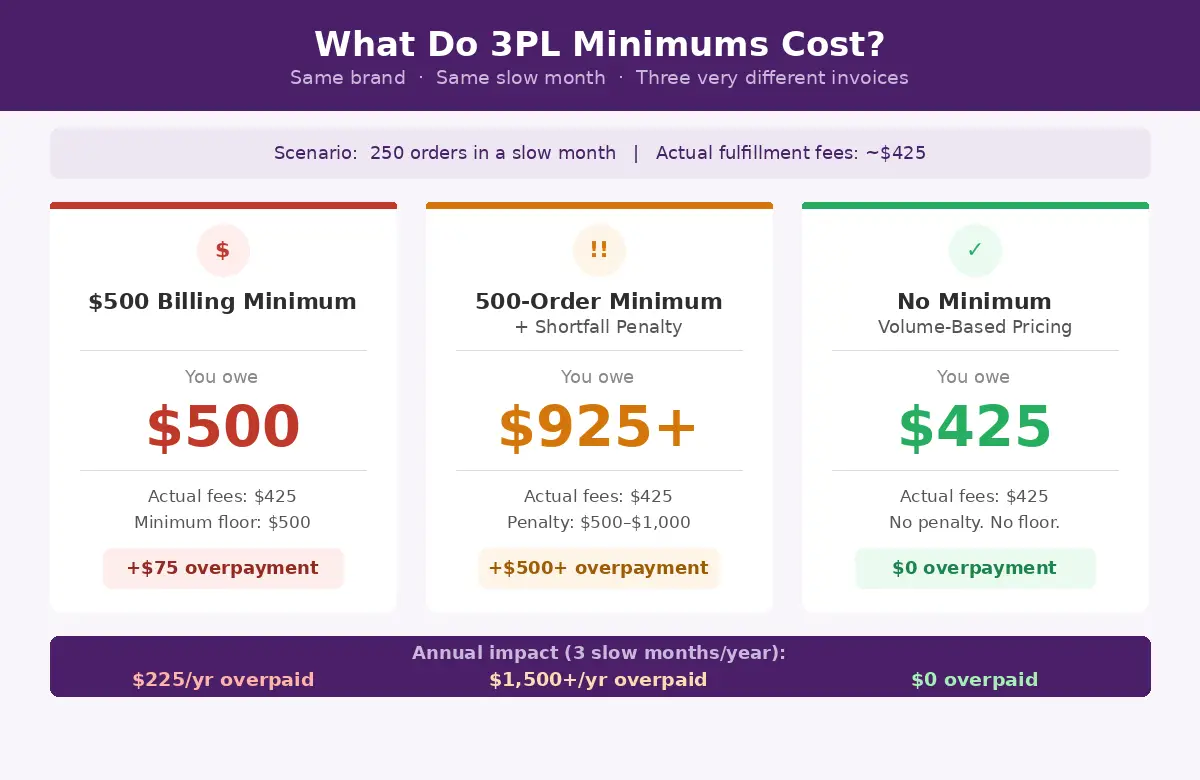
With a $500 monthly billing minimum: In a normal month at 400 orders, actual pick-and-pack and storage fees total around $1,100. The minimum does not apply. In the slow month at 250 orders, actual fees drop to roughly $425. The invoice still reads $500, a $75 overpayment for work that was never performed.
With a 500-order volume minimum and shortfall penalty: At 250 orders, the brand faces a penalty of $500 to $1,000 on top of its existing fees. One slow month can wipe out weeks of margin.
With volume-based pricing and no minimum: At a provider like IWS that publishes its pick-and-pack rates and bills based on actual activity, a 250-order month costs exactly what the volume warrants. No floor. No penalty. You pay $2.50 per first-item pick, $0.40 per additional item, plus weekly storage for the space your products occupy.
The Annual Impact
The gap adds up fast. If your 3PL charges a $500 minimum and you fall short just three months per year, that is $225 to $3,000 or more in fees that do not match any actual fulfillment work. Over time, those charges eat directly into the margins you are trying to grow. That is money better spent on product development, marketing, or inventory, not fulfillment overhead that does not move a single package.
How Minimum Charges Hit Seasonal and Industry-Specific Brands
Minimum charges do not affect every business the same way. The impact depends on how steady your order volume stays from month to month.
Health and beauty brands often see order spikes around product launches followed by quieter settling periods. Minimums penalize those quiet stretches, turning a natural sales rhythm into a billing problem.
Beverage companies ship heavier products, so per-order costs tend to run higher. That can make dollar-based minimums easier to reach. But order volume minimums still create problems during off-season months when unit counts drop.
Brands that earn 60% or more of their revenue in Q4 face the sharpest edge. For these businesses, minimums act as a fixed overhead cost across the remaining nine months when order activity is slower.
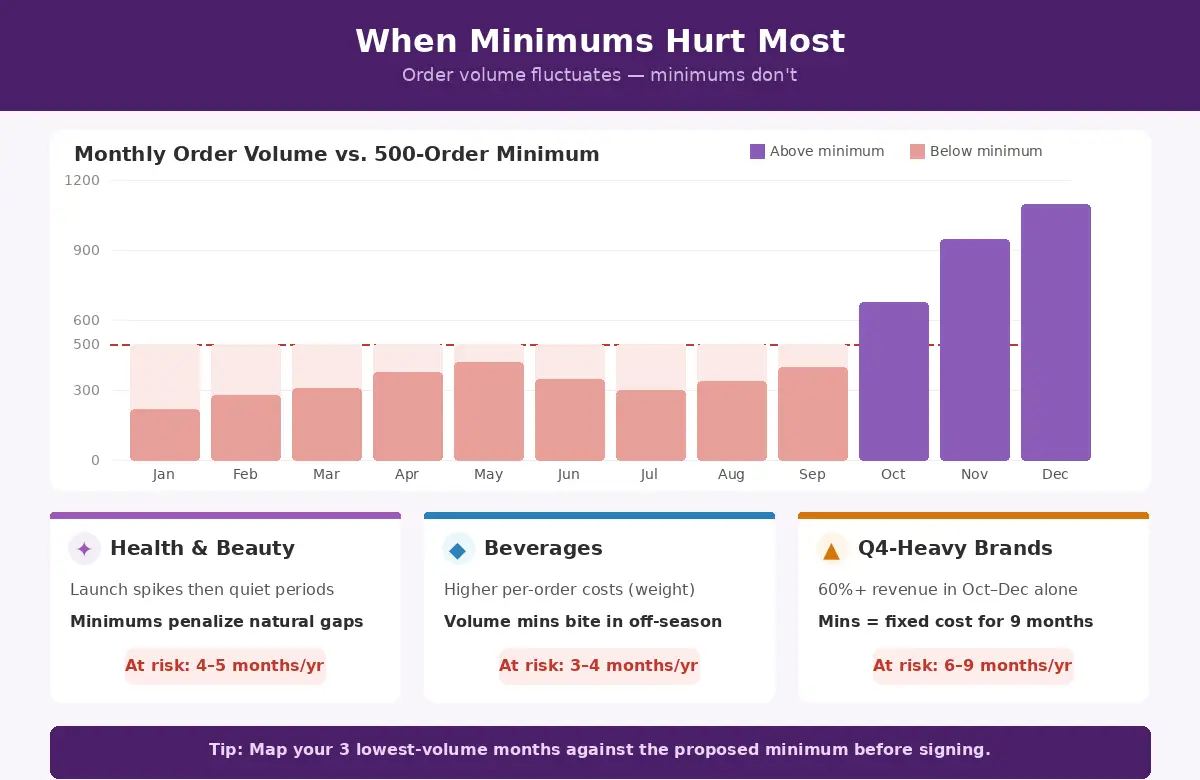
Before signing with any 3PL, map your three lowest-volume months from the past year against the proposed minimum. Multiply the monthly gap by 12. That number is the true annual cost of that minimum to your business.
6 Questions to Ask Any 3PL About Minimum Order Charges
Before you sign a fulfillment contract, get clear answers to these questions:
- Do you require a minimum number of orders per month? What is the threshold?
- Is there a minimum monthly billing amount, and what happens if my fees fall below it?
- Is there a ramp-up period where minimums are waived or reduced for new accounts?
- Do minimums apply per warehouse location or across my total account?
- Are minimum requirements different during peak season versus off-peak months?
- Can I see a sample invoice that shows how minimums appear on the bill?
A 3PL that answers these questions openly and publishes its pricing for anyone to review is already showing the kind of billing transparency you want in a fulfillment partner.
Frequently Asked Questions About Minimum Order Charges
What is a typical 3PL minimum order requirement?
Most mid-to-large 3PLs set minimums between 200 and 5,000 orders per month. Monthly billing minimums average around $500 as of 2025. Smaller, growth-focused providers may set lower thresholds or charge no minimums at all.
Do all fulfillment centers charge minimum fees?
No. Some 3PLs built for small and mid-sized brands operate without monthly minimums. Others offer ramp-up periods where minimums are waived during the first few months of a new account.
Are 3PL minimums negotiable?
In many cases, yes. You can negotiate reduced minimums in exchange for longer contract terms. You can request tiered minimums that increase gradually as your volume grows. The best time to negotiate is Q1, when most 3PLs have open capacity.
What happens if I don’t meet my 3PL’s minimum order volume?
It depends on the contract. You may be charged a shortfall fee covering the gap between your actual fees and the minimum. Some providers bill the full minimum regardless of activity. In other cases, you may be asked to find a new provider.
