

Fulfillment solutions


Subscription Box Fulfillment: Costs, Process and How to Choose a 3PL
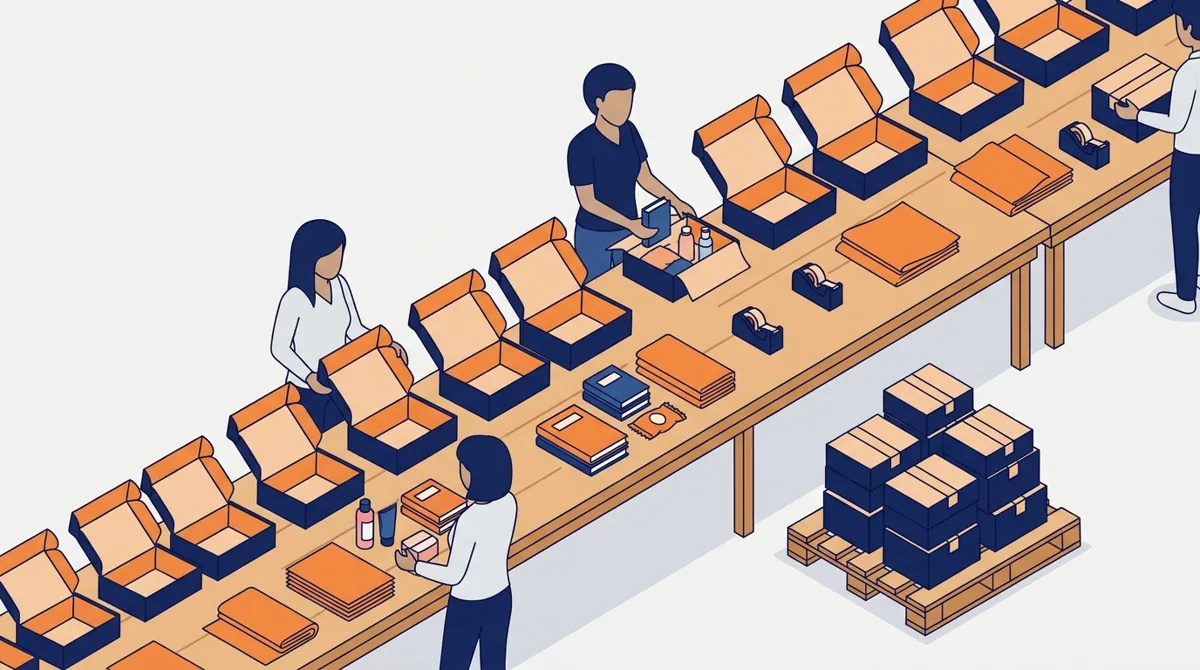
Subscription box fulfillment is the recurring work of receiving products, assembling each cycle’s box and shipping every order in one planned batch. It differs from everyday ecommerce because the whole month’s volume lands at once, so inventory, assembly labor and carrier pickups all have to be scheduled around one shipping window.
Updated November 2026.
Most of the cost and most of the risk sit in that window. This guide covers how a run works, what a box costs, when to outsource, and what to ask a 3PL before you hand over a program.
How Is Subscription Box Fulfillment Different From Regular Ecommerce?
Subscription fulfillment ships one planned batch on a fixed schedule, while regular ecommerce ships orders continuously as customers place them through the day.
| What changes | Regular ecommerce | Subscription boxes |
|---|---|---|
| Order flow | Steady, order by order | One batch per cycle |
| Inventory | Replenished by sales velocity | Bought for a known subscriber count, plus spares |
| Labor | Spread across the week | Concentrated into the assembly and shipping window |
| Biggest risk | A stockout on one product | One late component holding up every box |
The kind of box you sell changes the work behind it.
| Box type | Fulfillment work | What subscribers expect |
|---|---|---|
| Curated | Several box versions, each with its own recipe | A box that matches their stated preferences |
| Replenishment | Predictable reorders and tight date control | No gap between shipments |
| Discovery | New products to receive and check every cycle | Something different each time |
How Does a Subscription Box Get Fulfilled, Step by Step?
A subscription run has six steps: forecast the count, receive components, set the recipe, assemble, close renewals, and ship the batch.
- Forecast. Start from active subscribers, add expected new sign-ups, subtract expected cancellations, and hold spares for damages and replacements.
- Receive. Components arrive by a set date. Each one is counted and checked, because a shortage found on assembly day stops the line.
- Set the recipe. Write down the bill of materials, insert cards, box size and packing layout for every version, with a photo of the finished box.
- Assemble. Kitting turns loose components into finished boxes, either ahead of the run or as orders are released.
- Close renewals. Billing runs in your subscription platform, such as Shopify with a subscription app, Cratejoy or Subbly. Orders lock at a cutoff, and failed payments drop out.
- Ship the batch. Labels print after the cutoff, and the run goes to the carriers over a planned window.
The recipe step gets skipped most often, and it is the cheapest error to prevent. A warehouse crew building thousands of boxes will follow the written recipe exactly, including its mistakes.
How Much Does Subscription Box Fulfillment Cost?
A subscription box costs assembly labor, storage, packaging and postage, and postage is usually the largest line on the per-box bill.
IWS publishes pick and pack from $2.50 for the first item and $0.40 for each additional item, so a five-item box picked item by item comes to $4.10 before postage and packaging. Pre-assembled kits are quoted per project, and promotional inserts are published at $0.40 each. Compare that with postage: USPS Ground Advantage starts at $7.90 retail in 2026, before any commercial discount. Our guide to pick and pack costs shows how those fees compare across 3PLs.
Box size decides the postage. UPS and FedEx bill the higher of actual weight and dimensional weight on every parcel, so a light box in a roomy carton pays for air.
| Box (inches) | Cubic inches | UPS and FedEx minimum billable weight | USPS |
|---|---|---|---|
| 8 × 6 × 4 | 192 | 2 lb | Actual weight |
| 10 × 8 × 6 | 480 | 4 lb | Actual weight |
| 12 × 9 × 6 | 648 | 5 lb | Actual weight |
| 14 × 10 × 8 | 1,120 | 9 lb | Actual weight |
Length × width × height divided by 139, rounded up to the next pound. USPS applies dimensional weight only above one cubic foot.
Going from 12 × 9 × 6 to 14 × 10 × 8 adds four billable pounds on UPS and FedEx. Test next cycle’s contents in the smallest box that protects them, and run the size through our dimensional weight calculator before you order a pallet of cartons.
When Should You Outsource Subscription Box Fulfillment?
Outsource when assembly takes over your team’s month, or when one missed shipping window would cost more than a 3PL’s fees.
| In-house | 3PL | |
|---|---|---|
| Best fit | Small runs and products that change constantly | Runs too big to build between other work |
| Control | Full control of every box | Control through written recipes and sample approvals |
| Costs | Space, labor and supplies you carry all month | Per-box fees, storage and setup work you pay as used |
| Weak spot | Assembly week pulls people off everything else | Less flexibility for last-minute changes |
Price your own time honestly before deciding. Our breakdown of the true cost of self-fulfillment lists the expenses that rarely show up in a spreadsheet.
What Should You Ask a Subscription Box 3PL?
Ask how a 3PL schedules batch assembly, handles renewal cutoffs, checks quality and protects your window during peak, then get those answers in writing.
- How far ahead do you need components and the recipe?
- How many boxes can you assemble per day, and what happens if a component arrives late?
- Do you connect to our subscription platform, and when do orders lock?
- Who approves the first box off the line?
- How do you charge for kitting, inserts and special services?
- How are damaged boxes and missed deliveries replaced, and who pays?
Our 3PL selection guide covers the wider checks, including contracts and references.
Should You Ship Subscription Boxes From One Warehouse or Several?
One warehouse works when most subscribers sit within a few days of ground transit, and splitting inventory pays off only when postage savings cover it.
Subscription runs have an advantage that everyday orders lack: you pick the ship date. A brand shipping from one warehouse can release its farthest zones first and its nearest zones last, so boxes reach both coasts in the same week. Splitting a run across warehouses doubles the receiving, forecasting and quality checks for every cycle. The FedEx, UPS and USPS delivery times guide shows how transit changes by zone.
How Do You Keep Subscription Boxes on Time During Peak Season?
Move December’s run earlier, close renewals before carrier deadlines, and get components in first, because inbound and outbound freight both slow at peak.
USPS Ground Advantage and FedEx Ground at five days in transit both close on December 17 for Christmas delivery in 2026, so a box promised for the holidays needs its renewal cutoff well before that. Check every date in our 2026 holiday shipping deadlines guide, then tell subscribers the December ship date early.
Subscription Box Fulfillment FAQs
What is a fulfillment fee?
A fulfillment fee is what a warehouse charges to pick, pack and prepare an order. First-item pick and pack fees commonly run from $1.50 to $4.00, and storage, packaging and postage are usually billed on top.
How do you ship a subscription box?
Build the boxes in one batch, buy labels only after renewals close, and hand the run to the carrier over a planned window. Ship the farthest zones first so boxes arrive in the same week.
What is the difference between kitting and subscription box fulfillment?
Kitting is the assembly step that combines several items into one unit. Subscription box fulfillment covers the whole cycle, including receiving, kitting, renewal cutoffs, batch shipping and replacements.
Can a 3PL handle personalized subscription boxes?
Yes, as long as each variation has its own recipe and SKU. Every extra variation adds picking complexity and a chance of error, so most brands cap the number of box versions in a run.
What happens if a subscriber’s payment fails before the run?
That order should drop out of the batch until the payment clears. Set a renewal cutoff before labels are bought, and ship late recoveries in a smaller follow-up batch.
Planning your next subscription run? IWS builds subscription boxes at its Farmingdale, NY warehouse and publishes pick and pack from $2.50 for an order’s first item. See the rate card or talk to our team.
About the Author
Innovative Warehouse Solutions (IWS) is a U.S.-based third-party logistics (3PL) and order fulfillment provider. We help ecommerce and B2B brands with warehousing, pick and pack, kitting and assembly, and small parcel shipping. This article was written by the IWS operations team, drawing on hands-on experience running fulfillment for growing brands.