

Fulfillment solutions


3PL Special Services Fees: What They Cost and When You’ll Pay Them
You request a quote from a 3PL. The base pick fee looks reasonable. Then the full rate card arrives and you spot a list of additional line items you did not expect.
Those are special services fees: charges a 3PL applies when it performs tasks outside of standard pick-and-pack fulfillment. Standard fulfillment covers picking a single-SKU order, packing it, and shipping it out. Special services cover everything beyond that: assembling bundles, adding inserts, prepping for Amazon, tracking lot numbers, and more.
These fees are not inherently unfair or hidden. Most are predictable once you know what triggers them. The problem shows up when a 3PL does not disclose them upfront and they appear on your first invoice instead.
If your business ships 300 or more orders per month and uses branded inserts, product bundles, subscription boxes, or lot-tracked inventory, you will encounter special services fees. Knowing each one before you sign a contract puts you in control of your fulfillment budget.
The Full Breakdown of Special Services Fees
Here is every major special service fee type, what it covers, and what it typically costs.
| Fee Type | What It Covers | How It’s Billed |
| Kitting and Assembly | Combining multiple SKUs into one shippable unit | Per touch/item or hourly |
| Promotional Inserts | Adding flyers, coupons, or cards to orders | Per insert, per order |
| Special Projects | One-off tasks like relabeling or repackaging | Hourly labor rate |
| FBA Prep | Prepping inventory to meet Amazon’s requirements | Per unit, per service |
| Lot and Expiration Tracking | Recording batch numbers and expiration dates | Included or per SKU |
| Subscription Box Assembly | Recurring curated box assembly at volume | Per box, quoted by scope |
| Quality Control | Inspecting inventory for damage or compliance | Per unit, per SKU, or hourly |
| Peak Season Surcharges | Temporary rate increases during Q4 | Percentage increase on services |
| Minimum Monthly Fees | Baseline charge when volume falls below threshold | Flat monthly rate |
Kitting and Assembly Fees
Kitting is the process of combining multiple individual SKUs into one ready-to-ship unit. A common example is a skincare set that groups a cleanser, toner, and moisturizer into a single package. The 3PL pulls each component separately, assembles the kit, and packs it out following the same pick and pack process used for standard orders, with additional steps for assembly. Benchmark cost: approximately $0.38 per touch per item, or $35-$45 per hour on average, though rates vary by provider and kit complexity.
Promotional Insert Fees
A promotional insert is anything added to an outbound order that was not part of the original product: a thank-you card, a coupon, a product sample, or a brand flyer. This fee is billed per insert, per order.
At IWS, the insert fee is $0.40 per insert and is published on the pricing page. At many other 3PLs, this fee is not listed on the initial rate card. It shows up on the first invoice.
Special Project Fees
Special projects are one-off labor tasks that fall outside the standard fulfillment workflow. Common examples include relabeling inventory that arrived with incorrect barcodes, repackaging items that do not meet a retailer’s requirements, or counting and reconciling inventory after a discrepancy.
These fees are typically billed at an hourly labor rate. At a reputable 3PL, any special project should be scoped and priced in writing before work begins. If a 3PL starts work without a written scope, ask for one.
FBA Prep Fees
If you sell on Amazon and ship inventory through a 3PL as an FBA seller, FBA prep fees cover the work needed to meet Amazon’s inbound requirements: poly-wrapping, bagging, applying FNSKU labels, and bundling. Rates vary by service type and are typically charged per unit. Labeling, poly-bagging, and bubble-wrapping are each priced separately, with individual services generally ranging from $0.20 to $2.55 per unit depending on product type and what the prep involves. Ask your 3PL for an itemized FBA prep rate card before committing.
Lot and Expiration Date Tracking Fees
Lot and expiration tracking means the 3PL records batch numbers and expiration dates at receiving and links that data to each outgoing order. This creates a traceability chain from your supplier to your customer.
This tracking is non-negotiable for supplement brands, beverage companies, and personal care products where regulatory compliance or recall readiness matters. Not every 3PL offers it, and those that do require proper WMS configuration. If your products fall into any of these categories, understanding batch tracking before evaluating providers will save you time.
Subscription Box Assembly Fees
Subscription box assembly differs from standard kitting in scope: boxes are assembled on a recurring cycle, often in large volumes, with multiple inserts, tiered product configurations, and strict timelines. Most 3PLs price subscription box assembly separately from pick-and-pack and quote it after reviewing the box configuration and cycle frequency. If you are building out this channel, see how subscription box fulfillment works at scale before locking in a pricing structure.
Quality Control Fees
Quality control fees cover the inspection of inbound or outbound inventory for damage, defects, or packaging compliance. QC is billed per unit, per SKU, or hourly. The billing method and trigger should be defined in your contract before it applies.
Peak Season Surcharges
Most 3PLs apply temporary rate increases during high-demand periods, most commonly Q4 from October through December. These surcharges cover higher labor costs and carrier capacity pressure during the holiday season. Before signing, ask which months carry a surcharge and whether it applies to all services or only specific ones. For a closer look at how brands manage this pressure, see the breakdown of Black Friday supply chain challenges and how to plan ahead.
Minimum Monthly Fees
Some 3PLs charge a baseline monthly fee if your order volume falls below a contracted threshold. This fee covers fixed operational costs during slow months.
Industry survey data shows these fees have risen sharply in recent years, reaching an average of over $500 per month in 2025, up from $130 in 2020. Confirm whether a minimum monthly fee exists, what volume level triggers it, and whether it applies year-round or only during off-peak periods.
When These Fees Get Triggered and Why Your Product Type Matters
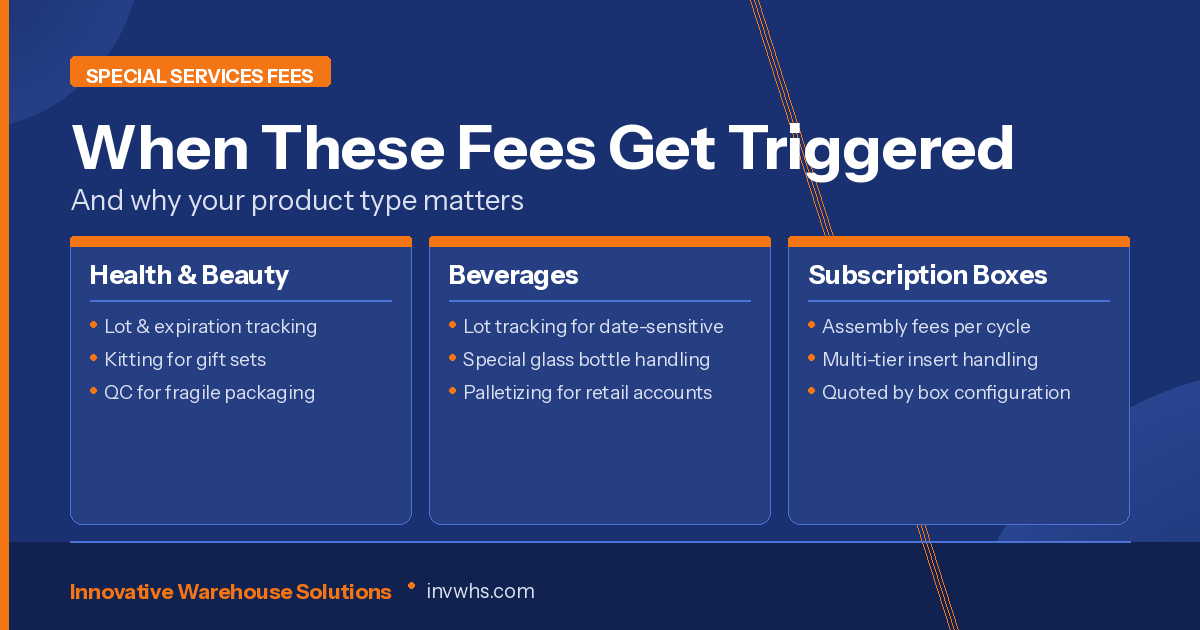
- Health and beauty and supplement brands: lot and expiration tracking is a standard operating need, not an optional upgrade. Kitting comes up frequently for gift sets and bundles. Quality control inspections matter when products ship in glass or with fragile components like pumps and droppers. IWS’s health and beauty logistics service is built around these requirements.
- Beverage brands: lot tracking applies across date-sensitive products. Special handling is common for glass bottle packaging. Palletizing fees apply when products go to retail or wholesale accounts requiring specific pallet configurations. IWS’s drinks logistics service covers each of these scenarios.
- Consumer goods brands running subscription boxes: assembly fees are often the largest special services line item each month. When box tiers carry different insert combinations, labor time per box increases fast.
A practical example: a brand shipping 500 orders per month with inserts in 300 of those orders pays $120 per month at the per-insert rate. That is predictable and budgetable. It only becomes a problem when no one disclosed the fee before launch.
What Transparency Looks Like and How to Evaluate Your 3PL
Before signing with any 3PL, ask three questions:
- Which special services fees are on your published rate card versus quoted only when they arise?
- Are special project fees billed at a fixed agreed scope or open-ended hourly labor?
- Do you charge a minimum monthly fee and what order volume triggers it?
The mock invoice test is one of the best tools for evaluating a 3PL’s pricing honesty. Ask the 3PL to generate a sample invoice using your actual order projections. It will surface fees that do not appear on a standard rate card but will show up every month once you are live.
At IWS, our pricing is published rather than quoted on request:
- No onboarding fees
- No platform access fees
- WMS software included for all clients
- Pick fees, insert fees, and return processing rates listed on our pricing page
One thing we do not offer: climate-controlled storage. If your products require temperature control, that capability should be part of your 3PL search criteria from the start. You can also review what is included in our WMS software before your first conversation with us.
Frequently Asked Questions
What is a special project fee at a 3PL?
A special project fee covers one-off labor tasks outside the standard workflow, such as relabeling, repackaging, or inventory reconciliation. See the full breakdown above for what qualifies and how billing is typically structured.
How much does kitting cost at a fulfillment center?
Kitting typically costs around $0.38 per touch per item or $35-$45 per hour on average. Costs rise with kit complexity and the number of components per assembly.
Do 3PLs charge extra for promotional inserts?
Yes. Most 3PLs bill per insert per order. At IWS, this fee is $0.40 per insert, listed on the public pricing page.
What triggers a peak season surcharge?
Most 3PLs apply surcharges during Q4. Ask your 3PL upfront which months are affected and what percentage increase to expect.
Does my 3PL charge a minimum monthly fee?
Many do when order volume drops below a contracted threshold. Confirm whether a minimum exists and what triggers it before signing.
About the Author
Innovative Warehouse Solutions (IWS) is a U.S.-based third-party logistics (3PL) and order fulfillment provider. We help ecommerce and B2B brands with warehousing, pick and pack, kitting and assembly, and small parcel shipping. This article was written by the IWS operations team, drawing on hands-on experience running fulfillment for growing brands.