






Why Apparel Fulfillment Is Not “One-Size-Fits-All”
Apparel fulfillment is not one-size-fits-all for two reasons. First, clothing has operational demands that other product categories don’t. A single t-shirt design can generate dozens of SKUs across sizes and colors. Return rates run double the e-commerce average. And customers expect their order to arrive looking like it came straight off a store shelf, not tossed into a box. A fulfillment process built for supplements or general merchandise can’t keep up with that level of complexity.
Second, even within apparel, different business models need completely different fulfillment setups. A direct-to-consumer fashion label needs speed and branded packaging. A wholesale operation needs retail-compliant labeling and EDI routing. A subscription box brand needs kitting and flexible storage. No single fulfillment process can serve all three well, which is why a generic 3PL that treats every clothing brand the same way will create problems that cost you customers and margin.
Here’s what makes apparel fulfillment different, how needs vary across clothing business models, and what to prioritize when choosing a 3PL for your brand.
Key Takeaways
- Apparel fulfillment is different from standard fulfillment. SKU complexity, high return rates, and packaging standards demand a specialized approach.
- Generic 3PLs create costly errors for clothing brands, from wrong-size shipments to damaged product presentation.
- DTC, wholesale, and subscription apparel brands each need different fulfillment setups. One process can’t serve all three.
- The right apparel 3PL offers variant-level accuracy, real-time inventory sync, and transparent pricing.
What Makes Apparel Fulfillment Different From Standard Order Fulfillment?
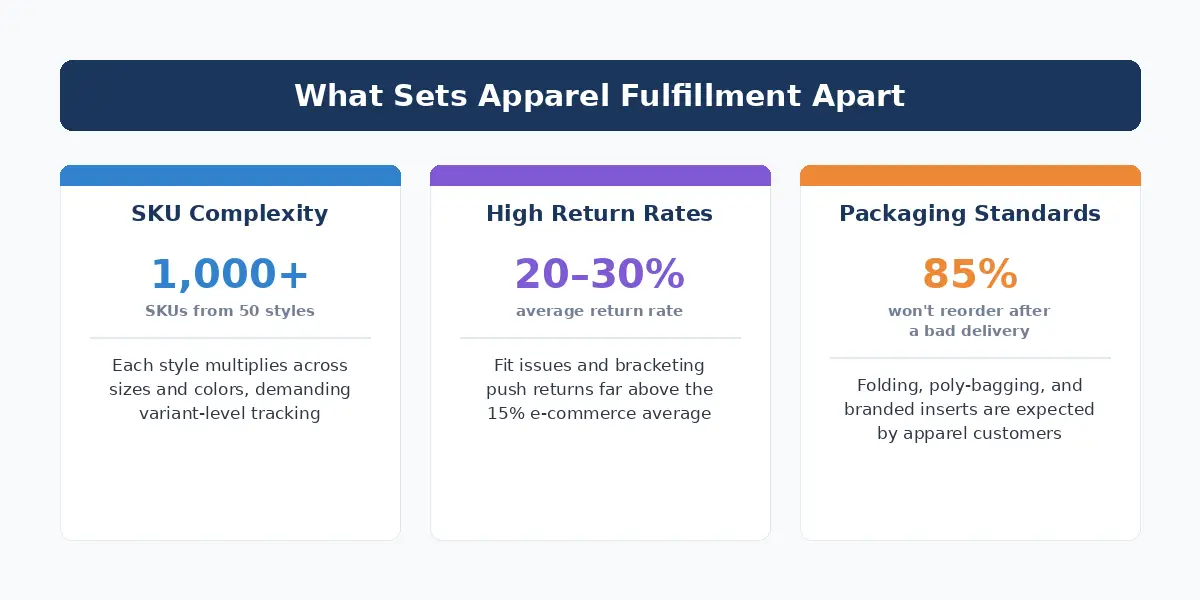
Apparel fulfillment stands apart in three major ways: SKU volume, return frequency, and presentation standards. Each creates operational demands that generic fulfillment centers are not built to handle.
SKU Complexity Multiplies Fast
Every clothing product carries multiple variants. A single design in five sizes and four colors creates 20 separate SKUs. Scale that across 50 styles, and your warehouse is tracking over 1,000 individual items.
Each variant needs its own bin location, barcode, and inventory count. Mispicks between visually similar items, like navy versus black or size S versus XS, happen often when scanning systems aren’t designed for clothing fulfillment.
Here’s how quickly SKU counts grow for apparel brands compared to other product types.
| Product Type | Variations | Example SKU Count |
| Candles (3 scents, 2 sizes) | Scent + Size | 6 SKUs |
| Supplements (4 formulas) | Formula | 4 SKUs |
| T-Shirts (10 designs × 5 sizes × 4 colors) | Design + Size + Color | 200 SKUs |
| Full Apparel Line (50 styles × 5 sizes × 4 colors) | Style + Size + Color | 1,000+ SKUs |
This kind of growth means your fulfillment partner needs a system built for variant-level inventory management. A scalable SKU system is not optional for apparel brands. It’s the foundation of accurate order fulfillment.
Return Rates Outpace Every Other Product Category
Online apparel return rates average 20 to 30 percent, far above the e-commerce average of roughly 15 percent. Fit issues, color discrepancies, and bracketing (ordering multiple sizes to try at home) push these numbers even higher.
Each return costs money. Return shipping, inspection, refolding or rebagging, restocking, and possible write-offs all add up. A brand processing 500 orders per month with a 25 percent return rate handles 125 returns monthly, each requiring hands-on attention.
A 3PL without a structured apparel returns workflow turns every one of those into a margin drain. Returns need to be inspected, graded, and either restocked or flagged within a defined process that keeps your inventory accurate.
Packaging Is Part of the Product Experience
Customers judge clothing brands by how their order arrives. Wrinkled garments, crushed boxes, or generic poly bags trigger returns and negative reviews. For apparel, the unboxing moment is a direct extension of your brand.
Clothing needs folding standards, poly-bagging, tissue paper, or garment-specific packing procedures. Branded packaging like custom mailers, inserts, and thank-you cards reinforces your brand identity at the exact moment a customer forms their first physical impression. A fulfillment partner that handles t-shirts the same way it handles phone cases is damaging your brand without you seeing it.
The Cost of Getting It Wrong
These three challenges are exactly where generic 3PLs break down for apparel brands. Wrong sizes shipped. Garments arriving creased. Slow returns processing. No capacity for seasonal volume spikes. Research shows that 85 percent of consumers won’t reorder after a poor delivery experience.
Brands shipping 300 to 1,000 orders per month are the most vulnerable. They’ve outgrown self-fulfillment but often get treated as low-priority accounts at oversized 3PLs. That gap is where the most damage happens.
Different Apparel Brands Need Different Fulfillment Setups
The challenges above apply to all clothing brands. But the way you solve them depends on your business model. A DTC label, a wholesale operation, and a subscription box company all sell apparel, yet their fulfillment needs look nothing alike.
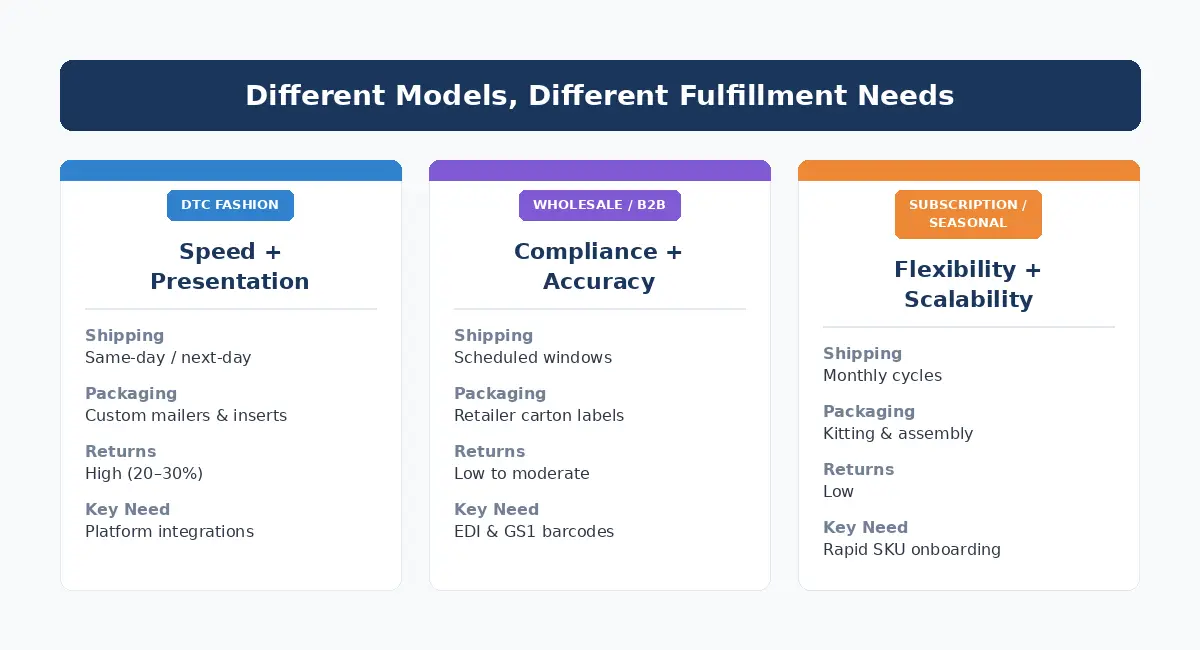
DTC fashion brands prioritize speed and presentation. Same-day shipping, branded unboxing, and fast returns turnaround drive repeat purchases. These brands need a fulfillment partner with direct integrations into platforms like Shopify, WooCommerce, and social selling channels so orders flow in automatically.
Wholesale and B2B apparel come with a completely different set of demands. Palletizing, retail-compliant labeling with GS1/UCC barcodes, and EDI routing that meets each retailer’s specifications are standard expectations. A 3PL that only handles DTC shipments can’t serve brands selling into both channels from the same inventory pool.
Seasonal collections and subscription models need flexibility above all else. Seasonal drops require rapid SKU onboarding and scalable warehouse capacity. Subscription brands need kitting, assembly, and predictable monthly cycles. A rigid fulfillment setup that charges the same storage rate year-round creates cost problems that eat into margins.
Here’s how fulfillment priorities shift across these three models.
| Fulfillment Need | DTC Fashion | Wholesale / B2B | Subscription / Seasonal |
| Top Priority | Speed + branded presentation | Retail compliance + accuracy | Flexibility + scalability |
| Shipping Speed | Same-day / next-day | Scheduled delivery windows | Predictable monthly cycles |
| Packaging | Custom mailers, inserts, tissue | Retailer-specific carton labels | Kitting and assembly |
| Returns Volume | High (20-30%) | Low to moderate | Low |
| SKU Turnover | Moderate | Moderate to high | High (seasonal launches) |
What to Look for in an Apparel Fulfillment Partner
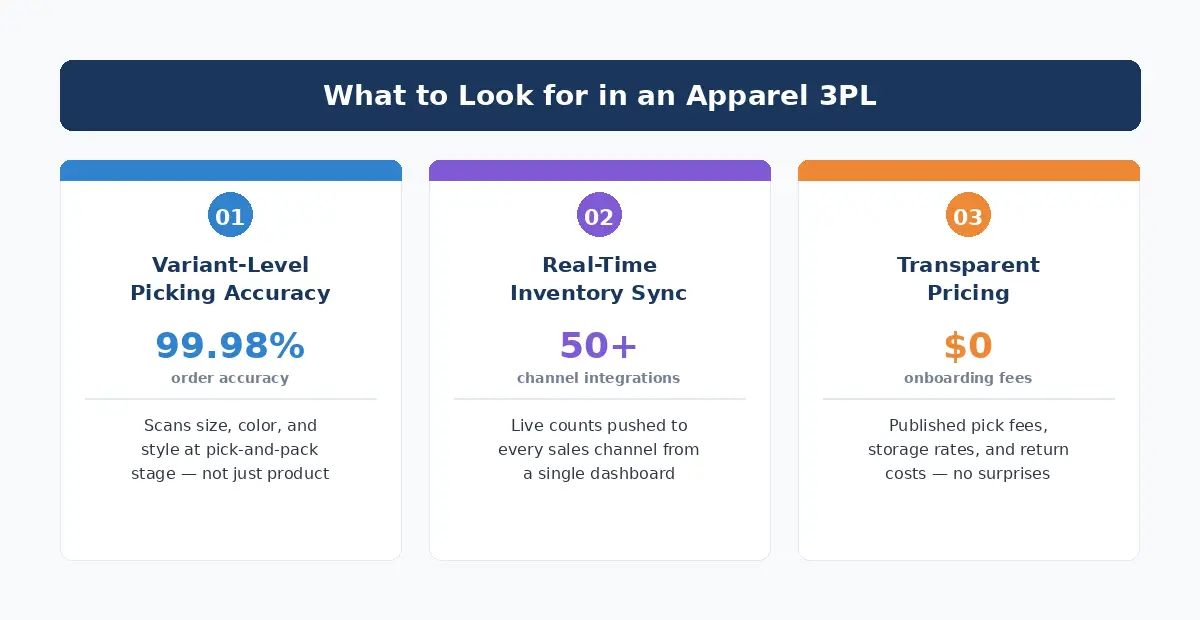
Knowing what makes apparel fulfillment different is the first step. The next is finding a 3PL built for these demands. Three capabilities matter most.
Variant-Level Picking Accuracy
The single most important capability for any apparel 3PL is scanning at the variant level. This means verifying size, color, and style at the pick-and-pack stage, not just the product level.
Standard barcode scanning confirms the right product was picked. Variant-level scanning confirms the right version of that product was picked. That distinction is what catches the “Medium Blue versus Large Blue” error that generic warehouses miss.
At IWS, variant-level scanning supports a 99.98% order accuracy rate, placing us among the most accurate pick and pack operations in the industry.
Real-Time Inventory Visibility Across Channels
With 1,000-plus SKUs spread across Shopify, Amazon, and wholesale accounts, manual inventory tracking leads to overselling, stockouts, and backorders. You need a fulfillment partner whose software pushes live inventory counts to every connected sales channel automatically.
The system should let you monitor stock levels, track orders, and make replenishment decisions from a single dashboard. IWS software connects with over 50 sales channels and updates inventory in real time as items are received and shipped.
Transparent Costs With No Setup Surprises
Apparel brands carry more SKUs and process more returns than most product categories. Your fulfillment costs need to reflect that reality upfront. Avoid 3PLs that hide pricing behind “request a custom quote” with no published rates. That’s where unexpected surcharges for storage overages, return processing, and seasonal volume tend to show up.
Look for clear pick fees, storage rates by bin or pallet size, and defined return processing costs. At IWS, we publish our pricing directly on our website: first-item pick fees starting at $2.50 per order, storage from $0.50 per week for a small bin to $8.75 per week for a full pallet, and zero onboarding fees. That’s how we work, and it’s how we believe every 3PL should operate.
Frequently Asked Questions
What makes apparel fulfillment different from regular fulfillment?
Apparel involves higher SKU counts from size, color, and style variations, return rates averaging 20 to 30 percent, and stricter packaging standards. These factors demand variant-level scanning, defined packing procedures, and structured returns processes that standard fulfillment doesn’t provide.
How much does apparel fulfillment cost?
Costs depend on your order volume, SKU count, and storage needs. At IWS, pick fees start at $2.50 per order for the first item, with additional items at $0.40 each. Storage ranges from $0.50 to $8.75 per week depending on bin or pallet size.
What should I look for in an apparel 3PL?
Prioritize variant-level order accuracy, real-time inventory tracking across all sales channels, and transparent published pricing. Experience with clothing-specific processes like folding, poly-bagging, and returns inspection matters too. Platform integrations and no onboarding fees are strong indicators.
When should an apparel brand switch to a 3PL?
Most brands hit the tipping point around 300-plus monthly orders, when self-fulfillment starts causing delays and mispicks. Other signals include rising return rates from fulfillment errors and running out of storage space.
