

Fulfillment solutions


After Section 321: Landed-Cost Math for Importing in Bulk and Fulfilling From the U.S.
Section 321 de minimis has been suspended for every country since August 29, 2025, which makes bulk import plus U.S. fulfillment cheaper than per-parcel shipping for most steady sellers.
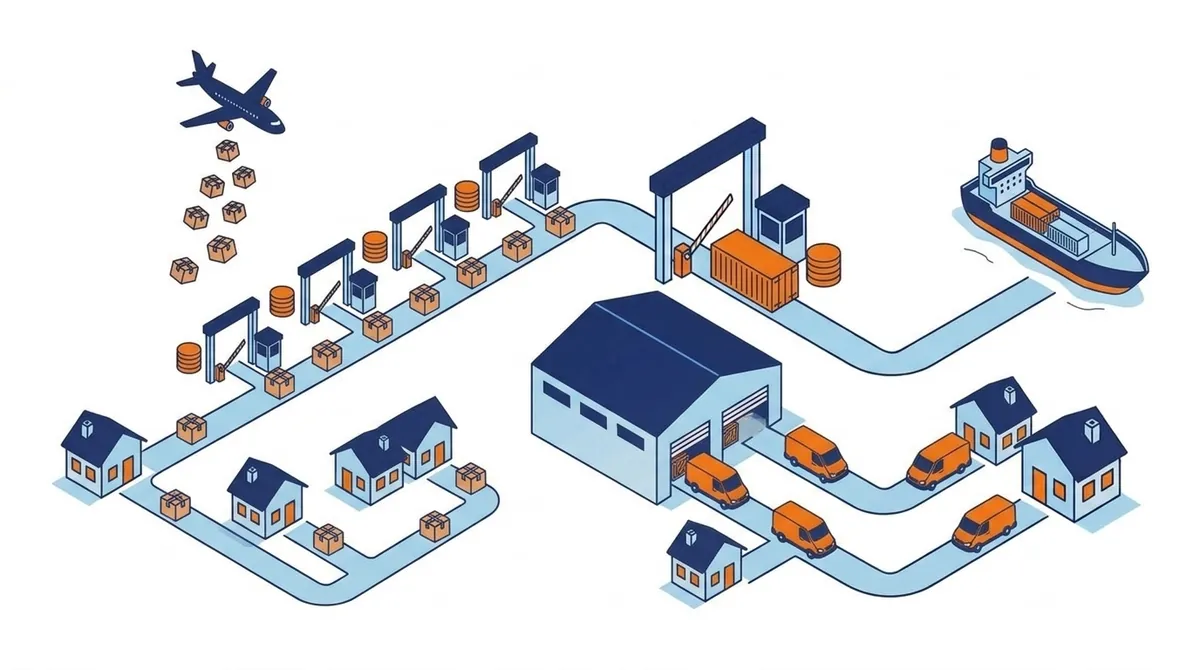
Each low-value parcel shipped from overseas now needs its own customs entry and owes any applicable duty. A bulk shipment pays entry fees and clearance charges once, then ships domestically. The worked example below shows how to run that comparison with your own numbers.
What happened to Section 321 de minimis?
Section 321 de minimis, which let shipments of $800 or less enter the U.S. duty-free, is suspended indefinitely and ends by law on July 1, 2027. It was switched off in stages:
- July 4, 2025: The One Big Beautiful Bill Act was enacted, terminating the de minimis exemption effective July 1, 2027.
- August 29, 2025: Following a July 30, 2025 executive order, CBP stopped granting duty-free de minimis treatment to goods from all countries.
- February 20, 2026: The Supreme Court held in Learning Resources, Inc. v. Trump that the International Emergency Economic Powers Act does not authorize the President to impose tariffs. The de minimis suspension remained in effect after the ruling.
- June 24, 2026: CBP published an interim final rule indefinitely suspending the de minimis exemption for imports of $800 or less arriving by all modes other than the international postal network. Those shipments must use formal or informal entry procedures. Postal shipments are handled under separate CBP procedures.
The practical result: no commercial shipment qualifies for duty-free de minimis today, and the statute itself ends in July 2027. Planning around its return is not a strategy.
What does each import option cost now?
Every import now carries the same core cost categories. What changes between models is how many times you pay the per-shipment ones.
| Cost line | Paid per parcel (direct from overseas) | Paid per bulk shipment (import, then U.S. fulfillment) |
|---|---|---|
| Duty | On every parcel | Once, on the whole shipment |
| CBP merchandise processing fee (MPF) | Informal entry fee on every entry, $2.77 for an automated informal entry in fiscal 2027 | Formal entries (over $2,500): 0.3464% of value, minimum $34.58, maximum $670.86 in fiscal 2027 |
| Harbor maintenance fee | Not applicable to air parcels | 0.125% of cargo value for ocean freight through covered ports |
| Brokerage or carrier clearance charges | Often charged per parcel | Once per entry |
| International transport | International parcel rate on every order | Ocean or air freight per shipment, plus drayage to the warehouse |
| U.S. fulfillment | None | Receiving, storage, pick and pack |
| Domestic postage | None | Domestic parcel rate per order |
Formal entry procedures generally apply to shipments valued over $2,500, and informal entry procedures are available at $2,500 or less, according to CBP’s June 2026 rule.
How much does bulk import plus U.S. fulfillment save per unit?
In the worked example below, bulk import plus U.S. fulfillment lands each unit at $21.64, against $30.77 when each order ships direct from overseas.
This is an illustrative example, not a quote or a duty ruling. The duty rate, freight, clearance charges and postage below are assumptions chosen to show the method. CBP fees use the published fiscal 2027 figures, and the fulfillment line uses IWS’s published pick and pack rate. Replace every assumption with your own numbers, or see our guide to landed cost for the full formula.
Example assumptions: 1,000 units of one SKU at a product cost of $10 per unit ($10,000 total), an assumed 10% duty rate, and every order contains one unit.
Option A: ship each order directly from overseas (1,000 parcels)
| Line (per unit) | Example amount |
|---|---|
| Product cost | $10.00 |
| Duty at an assumed 10% | $1.00 |
| CBP informal entry fee (automated, fiscal 2027) | $2.77 |
| Assumed carrier clearance or brokerage charge per parcel | $5.00 |
| Assumed international parcel postage | $12.00 |
| Example landed cost per unit delivered | $30.77 |
Option B: import 1,000 units in bulk by ocean, then fulfill from the U.S.
| Line (whole shipment) | Example amount |
|---|---|
| Duty at an assumed 10% of $10,000 | $1,000.00 |
| MPF, 0.3464% of $10,000 (within the $34.58 to $670.86 range) | $34.64 |
| Harbor maintenance fee, 0.125% of $10,000 | $12.50 |
| Assumed customs broker and bond charges | $250.00 |
| Assumed ocean freight and drayage to the warehouse | $1,200.00 |
| Import cost for the shipment | $2,497.14 ($2.50 per unit) |
| Line (per unit) | Example amount |
|---|---|
| Product cost | $10.00 |
| Import cost from the table above | $2.50 |
| Receiving (IWS publishes no receiving fee) | $0.00 |
| Storage: assumed 2 pallets for 8 weeks at IWS’s published $8.75 per pallet per week ($140 / 1,000 units) | $0.14 |
| Pick and pack, single-item order (IWS published rate) | $2.50 |
| Assumed domestic postage | $6.50 |
| Example landed cost per unit delivered | $21.64 |
The gap of about $9 per unit comes mainly from entry fees and clearance charges paid once instead of 1,000 times, and from domestic postage replacing international postage. Your result will depend heavily on your duty rate, the value declared, freight and postage, so treat the structure, not the totals, as the takeaway.
When does bulk import not win?
Bulk import loses when volume is low or unpredictable, cash is tight, products are untested, or items are very high in value and light. In those cases a per-parcel model can still make sense:
- Low or unpredictable volume. If you sell a few units of many SKUs, the inventory you would have to buy and store in advance may outweigh the savings.
- Cash flow. Bulk import means paying duty and freight on the whole shipment up front, before any of it sells.
- Test products. New items with uncertain demand carry overstock risk if you import a full container.
- Very high-value, light items. When international postage is low relative to value, the per-parcel gap narrows.
Many brands run a hybrid: proven sellers imported in bulk and fulfilled domestically, with tests or long-tail items shipped differently until demand is clear.
How does U.S. fulfillment change delivery and customer experience?
Domestic fulfillment also removes the border from the customer’s delivery. Once inventory has cleared customs, orders ship on domestic services, and the customer does not face a clearance delay or an unexpected duty bill at the door, the main risk of shipping DDU.
Innovative Warehouse Solutions (IWS) positions its Section 321 alternative around this model: import inventory in bulk, clear it once, store it in the U.S. and ship domestically. IWS fulfills from Farmingdale, Long Island, New York, with same-day shipping on orders in by 11 AM EST, and its published rates include pick and pack from $2.50 per order plus $0.40 per additional item, with no receiving or onboarding fees.
What should you ask a 3PL and a customs broker before switching?
Ask the broker about classification, declared value and bonds, and ask the 3PL about receiving, storage, cutoffs and product handling. For cross-border orders that still ship from the U.S., see international fulfillment.
- What is the HTS classification and duty rate for each SKU, including any additional duties that apply to my country of origin? (Ask a licensed customs broker.)
- What value will be declared on the entry, and who acts as importer of record?
- Do I need a single-entry or continuous customs bond?
- Does the 3PL charge to receive containers or palletized freight, and how fast is dock-to-stock?
- How is storage billed, and are there long-term storage fees on slow-moving stock?
- What is the same-day shipping cutoff, and which carriers and services are available?
- Can the 3PL handle FDA-regulated products, lot tracking or kitting if my catalog needs it?
Frequently asked questions
Is Section 321 de minimis coming back?
Not on current law. The One Big Beautiful Bill Act terminates the exemption effective July 1, 2027, and CBP’s June 24, 2026 rule suspends it indefinitely for non-postal shipments until then.
Did the Supreme Court tariff ruling restore de minimis?
No. The February 20, 2026 decision addressed IEEPA tariffs. The de minimis suspension remained in effect, and CBP’s June 24, 2026 rule made it indefinite for non-postal shipments.
Do I need a formal entry for a bulk shipment?
Formal entry generally applies to shipments valued over $2,500. Most commercial bulk shipments exceed that, but your broker will confirm the entry type.
What is the MPF on a formal entry in fiscal 2027?
0.3464% of the merchandise value, with a minimum of $34.58 and a maximum of $670.86, effective October 1, 2026.
Is the example in this article a quote?
No. The duty rate, freight, clearance and postage figures are assumptions for illustration. Only the CBP fee figures and IWS’s published fulfillment rates are sourced.
Moving from cross-border parcels to U.S. inventory? Send IWS your SKU list and monthly order volume and get a quote for bulk receiving, storage and domestic fulfillment from Long Island. Request a quote.
About the Author
Innovative Warehouse Solutions (IWS) is a U.S.-based third-party logistics (3PL) and order fulfillment provider. We help ecommerce and B2B brands with warehousing, pick and pack, kitting and assembly, and small parcel shipping. This article was written by the IWS operations team, drawing on hands-on experience running fulfillment for growing brands.