







Standard Shipping Box Sizes in CM: A Complete Guide to Box Dimensions
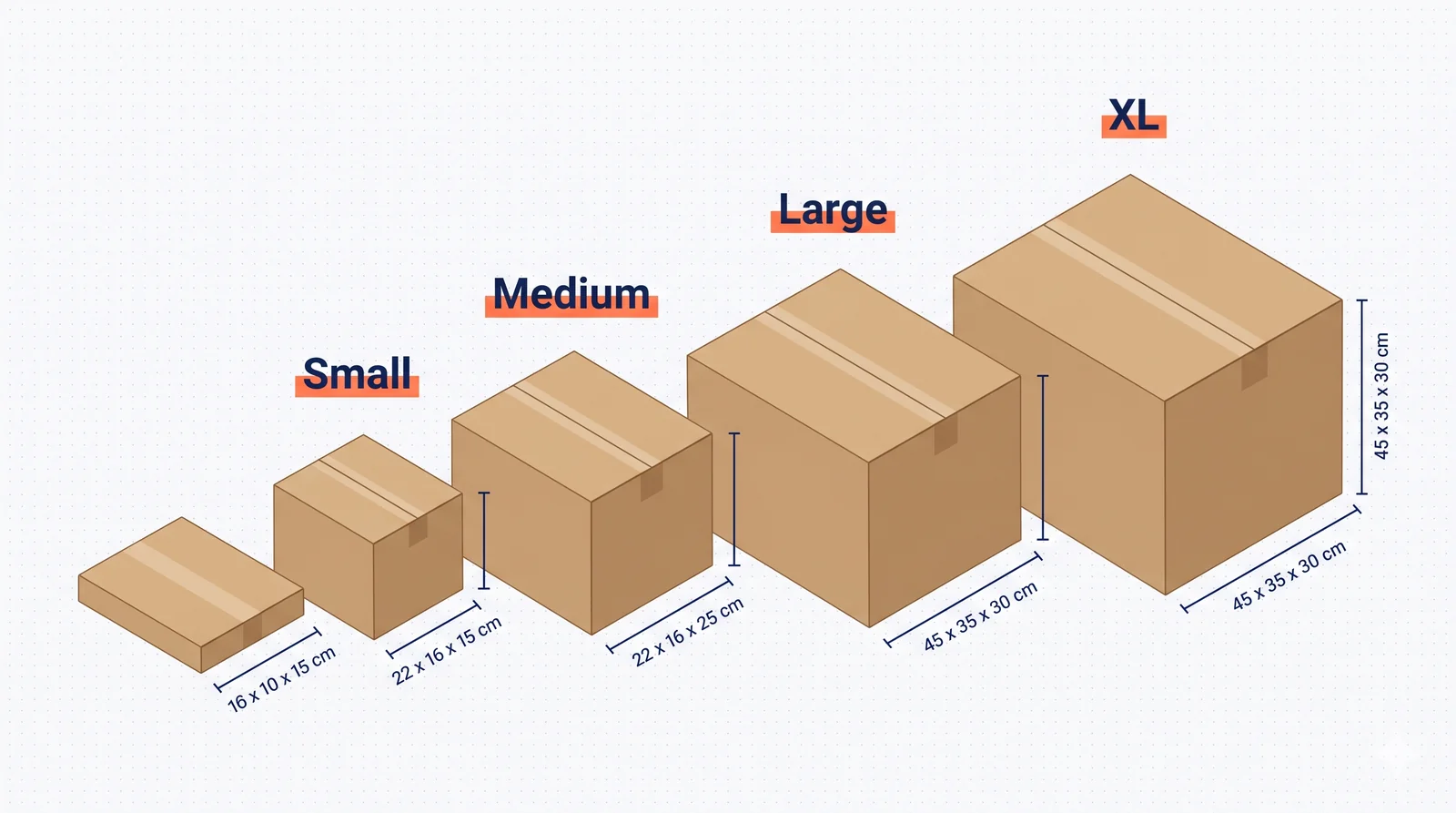
Is your business losing money on shipping costs? Many companies overspend thousands of dollars annually by using incorrect box sizes for their products. When packages arrive damaged or shipping fees unexpectedly increase, both your profits and customer relationships suffer.
At IWS, we specialize in helping businesses select optimal box dimensions through personalized support and transparent pricing. Our team analyzes your specific product requirements to recommend packaging solutions that reduce costs while ensuring safe delivery. This guide shares our expertise on choosing the right box sizes to protect your products and your bottom line.
Understanding Standard Box Sizes
Standard box dimensions form the basis of efficient shipping and storage operations. These measurements help businesses calculate volumetric weight accurately and select packaging that protects products while controlling costs. At IWS, our team works with clients individually to determine effective box sizes based on their specific product requirements.
Common Box Dimensions for Shipping
| Size Category | Length (cm) | Width (cm) | Height (cm) | Common Uses |
|---|---|---|---|---|
| Small | 20 | 15 | 10 | Health and beauty products |
| Medium | 30 | 20 | 15 | Beverage multi-packs |
| Large | 40 | 30 | 20 | Bundled consumer goods |
| Extra Large | 60 | 40 | 30 | Bulk retail orders |
Typical Box Dimensions and Their Applications
Small Box Applications
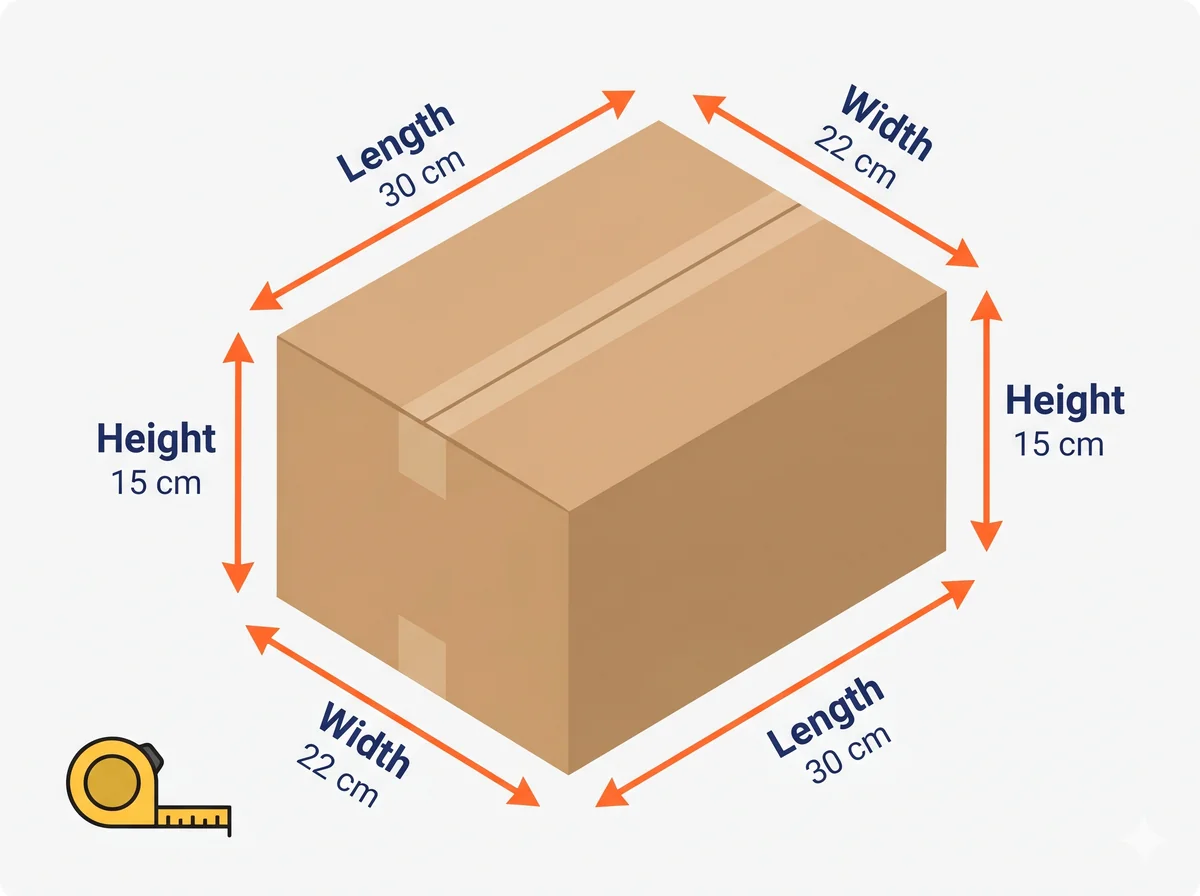
Small boxes (20 x 15 x 10 cm) suit lightweight personal care items (including shipping nail polish), small accessories, and individual product shipments. These compact dimensions help reduce shipping costs while providing sufficient protection for appropriately sized items.
Medium Box Applications
Medium boxes (30 x 20 x 15 cm) suit product bundles and multi-item orders. The balanced dimensions provide flexibility for various product combinations while maintaining cost-effective shipping rates.
Large and Extra-Large Box Solutions
Large boxes (40 x 30 x 20 cm) and extra-large options (60 x 40 x 30 cm) support substantial orders requiring additional protection. Key considerations include:
- Strategic weight distribution
- Protection for corners and edges
- Proper interior stabilization
- Structural reinforcement
Specialized Dimensions
Some products perform better with specific box configurations:
- Rigid-wall containers: 50 x 5 x 40 cm
- Product sets: 35 x 25 x 3 cm
- Multi-unit packages: 40 x 10 x 10 cm
Specialty items often require unique packaging considerations – for example, learning the best way to ship a watch can help prevent damage to valuable timepieces while optimizing box space.
Standard Box Sizes by Carrier (USPS, UPS, FedEx)
When shipping in the US, the box size choice often comes down to which carrier you’re using. USPS, UPS, and FedEx each offer their own free or branded box sizes alongside accepting standard custom packaging. Knowing each carrier’s standard dimensions in cm helps you match your product to the most cost-effective option.
USPS Priority Mail Flat Rate Boxes
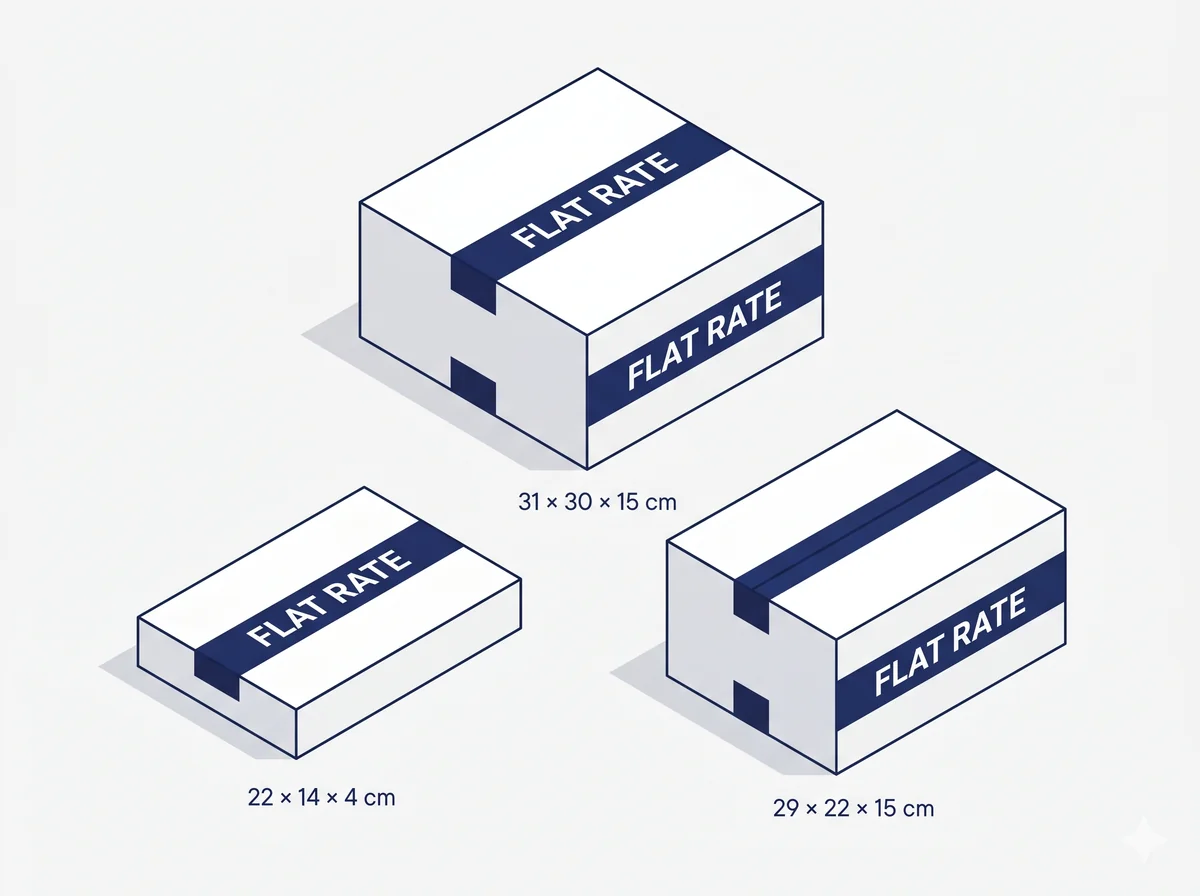
USPS provides free Priority Mail flat-rate boxes through usps.com and at post offices. The fixed price applies regardless of weight up to 70 lb (31.7 kg) within the US.
| Box | Interior Dimensions (inches) | Centimeters |
|---|---|---|
| Small Flat Rate | 8-11/16 × 5-7/16 × 1-3/4 | 22 × 14 × 4 cm |
| Medium Flat Rate (top-loading) | 11-1/4 × 8-3/4 × 6 | 29 × 22 × 15 cm |
| Medium Flat Rate (side-loading) | 14-1/8 × 12 × 3-1/2 | 36 × 30 × 9 cm |
| Large Flat Rate | 12-1/4 × 12 × 6 | 31 × 30 × 15 cm |
These boxes are best for small to medium dense items such as books, hardware, supplements, or small electronics, where weight would make non-flat-rate pricing expensive.
UPS Express Boxes
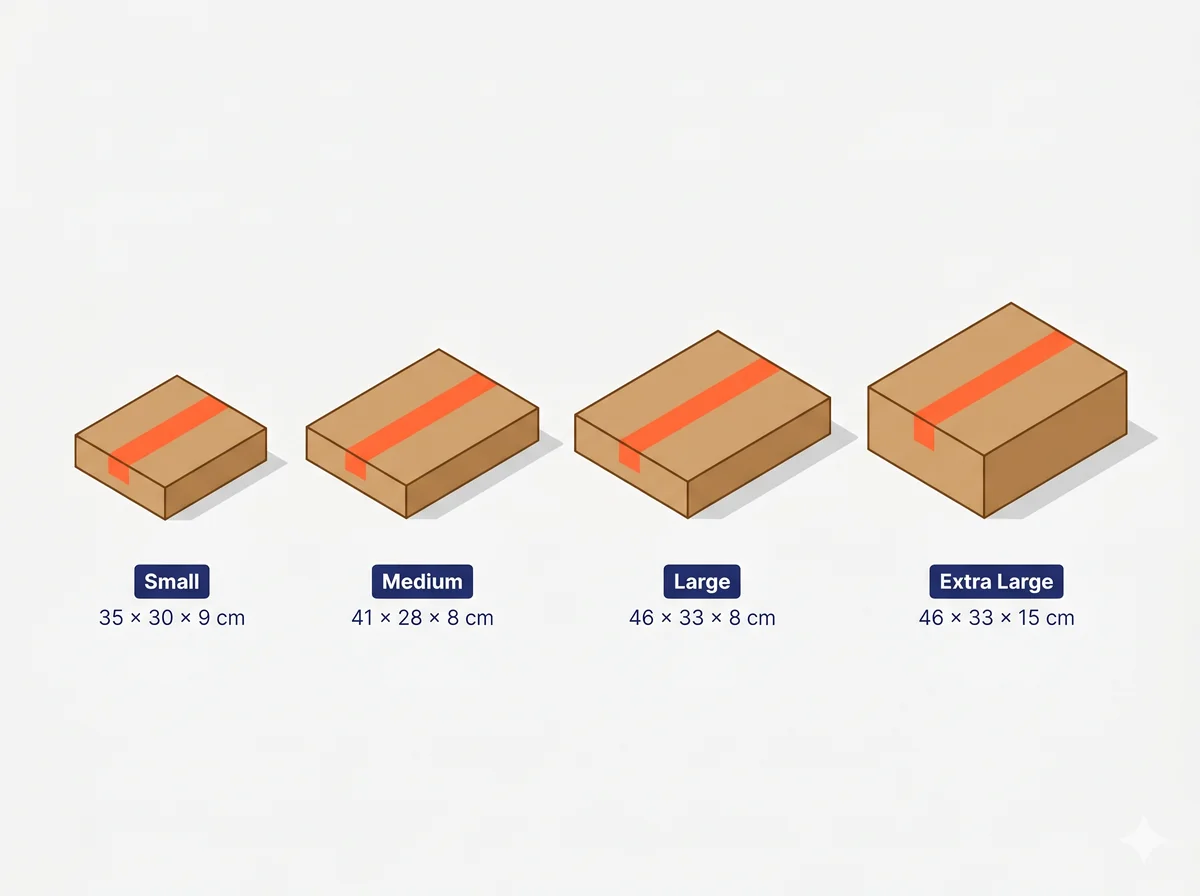
UPS Express boxes are free to UPS account holders and designed for UPS Next Day Air, 2nd Day Air, and Worldwide Express services.
| Box | Outer Dimensions (inches) | Centimeters |
|---|---|---|
| Small | 13.625 × 11.875 × 3.375 | 35 × 30 × 9 cm |
| Medium | 16 × 11 × 3 | 41 × 28 × 8 cm |
| Large | 18 × 13 × 3 | 46 × 33 × 8 cm |
| Extra Large | 18 × 13 × 6 | 46 × 33 × 15 cm |
These work well for time-sensitive shipments where the express service offsets the box selection. UPS standard ground shipments accept any custom box up to 165 cm in length and 419 cm in length-plus-girth combined.
FedEx Boxes
FedEx provides free packaging for Express services, including Priority Overnight, Standard Overnight, 2Day, Express Saver, and International Priority.
| Box | Interior Dimensions (inches) | Centimeters |
|---|---|---|
| Small | 12.375 × 10.875 × 1.5 | 31 × 28 × 4 cm |
| Medium | 13.25 × 11.5 × 2.38 | 34 × 29 × 6 cm |
| Large | 17.88 × 12.38 × 3 | 45 × 31 × 8 cm |
These are ideal for documents, flat goods, and small to medium items shipping via FedEx Express.
Quick Comparison: Small Boxes Across All Three Carriers
| Carrier | Small Box (cm) | Best Fit For |
|---|---|---|
| USPS | 22 × 14 × 4 | Books, small dense items |
| UPS | 35 × 30 × 9 | Documents, soft goods |
| FedEx | 31 × 28 × 4 | Flat documents, thin items |
Your choice between these carriers depends on weight, speed, and destination, but matching your product to the right box size is what keeps dimensional weight surcharges in check regardless of which one you pick.
Box Size Selection Principles
Selecting the right box dimensions requires balancing multiple factors. The optimal choice provides adequate protection while minimizing excess space that increases shipping costs. But before ordering inventory in a new box size, calculate the dimensional weight against your average product weight.
Also, understanding weights and dims helps you make informed decisions about box selection, especially when shipping specialty items like cosmetics or valuable accessories.
Material Selection Support
Box dimensions work together with appropriate packaging materials to create effective shipping solutions. The IWS fulfillment team provides direct guidance on selecting materials that complement chosen box sizes, considering factors like:
- Product protection requirements
- Environmental conditions during transit
- Cost-effectiveness of material combinations
Protection Considerations
- Product protection requirements: Different materials and void fill combinations provide varying levels of protection for fragile, heavy, or temperature-sensitive items.
- Environmental conditions during transit: Humidity, temperature changes, and handling impacts during shipping affect how your package needs to be protected.
- Strategic cushioning and stabilization: Proper spacing and support materials prevent product movement and protect vulnerable areas like corners and edges.
- Cost-effective material combinations: The right mix of outer boxes, inner packaging, and void fill maximizes protection while minimizing overall shipping costs.
- Current carrier guidelines and requirements: Carrier policies on box strength, maximum dimensions, and special handling affect both packaging choices and shipping rates.
Specialty Requirements
Different products require specific approaches to protection:
- Fragile items need strategic cushioning spaces
- Temperature-sensitive products benefit from specific dimension ratios
- Multi-item orders require calculated interior organization
Specialty and Oversize Box Sizes
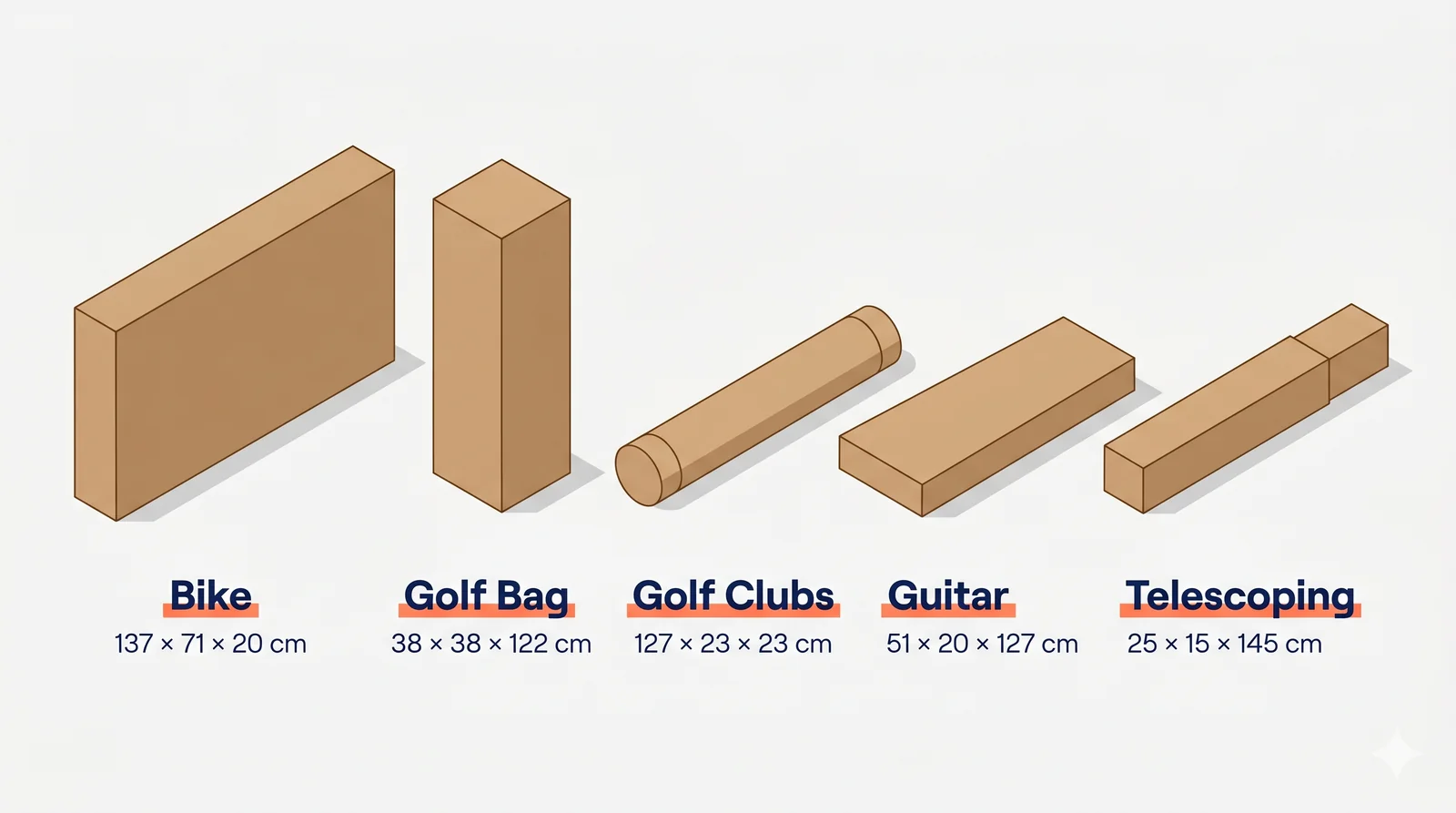
Standard shipping boxes work well for most products, but some items require specialty packaging because of their length, form, or fragility. Common oversize and specialty boxes include bike boxes, golf bag boxes, guitar boxes, and telescoping boxes for long, narrow items.
| Specialty Box | Typical Dimensions (inches) | Centimeters | Common Use |
|---|---|---|---|
| Bike box | 54 × 28 × 8 | 137 × 71 × 20 cm | Bicycles, large frame items |
| Golf bag box | 15 × 15 × 48 | 38 × 38 × 122 cm | Golf bags, ski equipment |
| Golf club tube | 50 × 9 × 9 | 127 × 23 × 23 cm | Golf clubs, fishing rods |
| Guitar box | 20 × 8 × 50 | 51 × 20 × 127 cm | Guitars, narrow musical instruments |
| Telescoping box (2-piece) | 10 × 6 × 57+ | 25 × 15 × 145+ cm | Long flat items, posters, blinds |
| Mirror or artwork carton | Custom variable | Custom variable | Framed art, large mirrors |
When using specialty boxes, several rules apply. Carriers charge oversize and additional handling fees once a package crosses set dimension, weight, or cubic volume thresholds. As of 2026, UPS and FedEx both flag packages with a cubic volume above 17,280 cubic inches or actual weight above 110 lbs, alongside their traditional length and length-plus-girth limits. Thresholds vary by carrier and update yearly, so verify current rules at the carrier’s website before shipping. Double-walled corrugated cardboard is recommended for any specialty box, since longer items face more bending stress in transit. Fragile items shipped in specialty boxes need extra cushioning too, since the box itself absorbs less impact when long.
For very high-value or fragile shipments such as artwork, antiques, or scientific instruments, a custom crate offers better protection than a specialty cardboard box. Custom crating costs more but is worth the investment when damage replacement cost is high.
Some carriers, including UPS and FedEx, accept specialty boxes within standard shipping rates. USPS limits oversize parcels to set service tiers such as Parcel Select Ground.
Standard Shipping Box Sizes in CM FAQs
How do you measure a box for shipping?
Measure a box for shipping by determining its length, width, and height. Use a tape measure to find the longest side (length), the shorter side (width), and the vertical side (height). Always measure in inches or centimeters for accuracy.
What does L × W × H mean?
L × W × H stands for Length × Width × Height. It represents the three dimensions of a box used to calculate volume, dimensional weight, and shipping costs.
What are the 3 measurements of a box?
The three measurements of a box are length, width, and height. Length is the longest side, width is the shorter side, and height is the vertical dimension.
How is box size calculated?
Box size is calculated by multiplying its length, width, and height (L × W × H). For shipping, dimensional weight may be used by dividing volume by a carrier’s dimensional factor.
How do I calculate my parcel size?
Calculate parcel size by measuring its length, width, and height in inches or centimeters. Multiply these values (L × W × H) to determine volume. Some carriers use dimensional weight formulas to calculate shipping costs.
What size is a standard shipping box?
A standard shipping box typically measures around 30 cm × 22 cm × 12 cm (small), 40 cm × 30 cm × 25 cm (medium), or 50 cm × 40 cm × 35 cm (large). Carriers like USPS, UPS and FedEx each define their own standard sizes within these ranges.
Is a 12x12x12 box considered a large box?
A 12×12×12 inch box (about 30 × 30 × 30 cm) is generally considered a medium box, not a large box. Large shipping boxes typically start at 18×18×18 inches (45 × 45 × 45 cm) or have a longest side of 24 inches (60 cm) or more.
Can you ship a 20x20x20 box?
Yes, a 20×20×20 inch box (about 50 × 50 × 50 cm) is shippable with USPS, UPS and FedEx. It falls within standard size limits for ground services. Note that dimensional weight pricing applies: 20×20×20 boxes are charged for around 58 lb of dimensional weight on most domestic services.
What are standard USPS, UPS and FedEx shipping box sizes?
USPS Priority Mail flat-rate boxes come in small (22 × 14 × 4 cm), medium top-loading (29 × 22 × 15 cm), medium side-loading (36 × 30 × 9 cm) and large (31 × 30 × 15 cm). UPS Express boxes range from small (35 × 30 × 9 cm) to extra large (46 × 33 × 15 cm). FedEx offers small (31 × 28 × 4 cm), medium (34 × 29 × 6 cm) and large (45 × 31 × 8 cm) boxes. All three carriers also accept your own packaging within their published size and weight limits.
Conclusion
Selecting the right shipping box dimensions creates a foundation for efficient operations and cost control. IWS stands apart by providing dedicated support throughout your growth journey, combining shipping expertise with transparent pricing. Our team helps you optimize box selection while delivering the personalized attention you need to succeed.
Whether you ship a few hundred parcels a month or tens of thousands, the right packaging strategy can cut shipping costs by 15 to 20% annually. Talk to our team about your fulfillment needs.
