

Fulfillment solutions


Retail Routing Guides and Chargebacks: What Walmart, Target, Amazon Vendor and Costco Require From Your 3PL
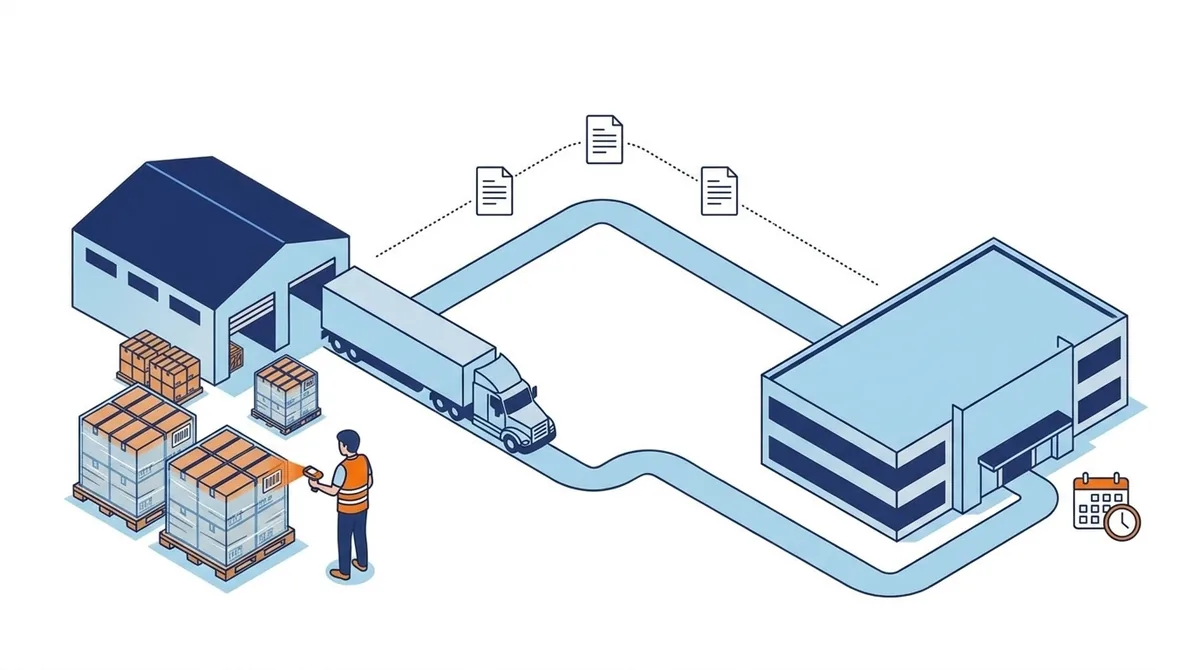
A retail routing guide is the retailer’s rulebook for packing, labeling, documenting and delivering your purchase orders, and every missed rule can become a chargeback.
For most wholesale programs, the requirements boil down to four things your 3PL has to execute on every order: the right EDI documents, an accurate advance ship notice (ASN), GS1-128 carton and pallet labels that match the ASN, and delivery inside the retailer’s window. This guide explains each requirement, what Walmart, Target, Amazon Vendor and Costco publicly say about them, and how to check that your warehouse can deliver.
What is a retail routing guide?
A routing guide is a retailer’s document that tells suppliers how to ship to its distribution centers or stores. It covers which carriers to use or how to request pickup, how cartons and pallets must be built and labeled, which EDI documents to send and when, and what delivery windows apply. It is usually paired with a vendor compliance or chargeback policy that sets the deductions for each violation.
Routing guides are not usually public. Retailers publish them inside supplier portals, such as Target’s Partners Online, Walmart’s supplier systems and Amazon’s Vendor Central. That matters for brand owners: your 3PL cannot comply with a guide it has never seen, so the first step of any retail onboarding is getting the current guide for each account into your warehouse team’s hands.
Which EDI documents does a retail order require?
At minimum, expect three X12 EDI transactions on every retail purchase order: the 850 Purchase Order, the 856 Ship Notice/Manifest (the ASN) and the 810 Invoice. Many retailers add others, and your 3PL often exchanges its own set with you.
| X12 document | Name | Who sends it | What it does in a retail order |
|---|---|---|---|
| 850 | Purchase Order | Retailer to brand | Places the order: items, quantities, ship-to, ship or arrival dates |
| 855 | Purchase Order Acknowledgment | Brand to retailer | Confirms, changes or rejects lines (required by some retailers) |
| 753 / 754 | Request for Routing Instructions / Routing Instructions | Brand and retailer | Requests and receives pickup or carrier instructions on collect freight programs |
| 856 | Ship Notice/Manifest (ASN) | Brand (via 3PL) to retailer | Describes exactly what shipped: cartons, contents, labels, carrier |
| 810 | Invoice | Brand to retailer | Bills the order; must reconcile with the PO and what was received |
| 940 / 945 | Warehouse Shipping Order / Warehouse Shipping Advice | Brand and 3PL | Tells the warehouse what to ship and confirms what it shipped |
The 850, 856 and 810 are defined by X12, the standards body that maintains these transaction sets. The 856 is the document that causes the most trouble because it is generated from what physically left the dock, so it is only as accurate as the warehouse’s picking, packing and scanning.
What is a GS1-128 label and why must it match the ASN?
A GS1-128 shipping label carries a Serial Shipping Container Code (SSCC), an 18-digit number that identifies one carton or pallet, and the same SSCC must appear in the ASN. When the retailer’s receiving dock scans the label, it looks up the ASN to know what is inside without opening the box.
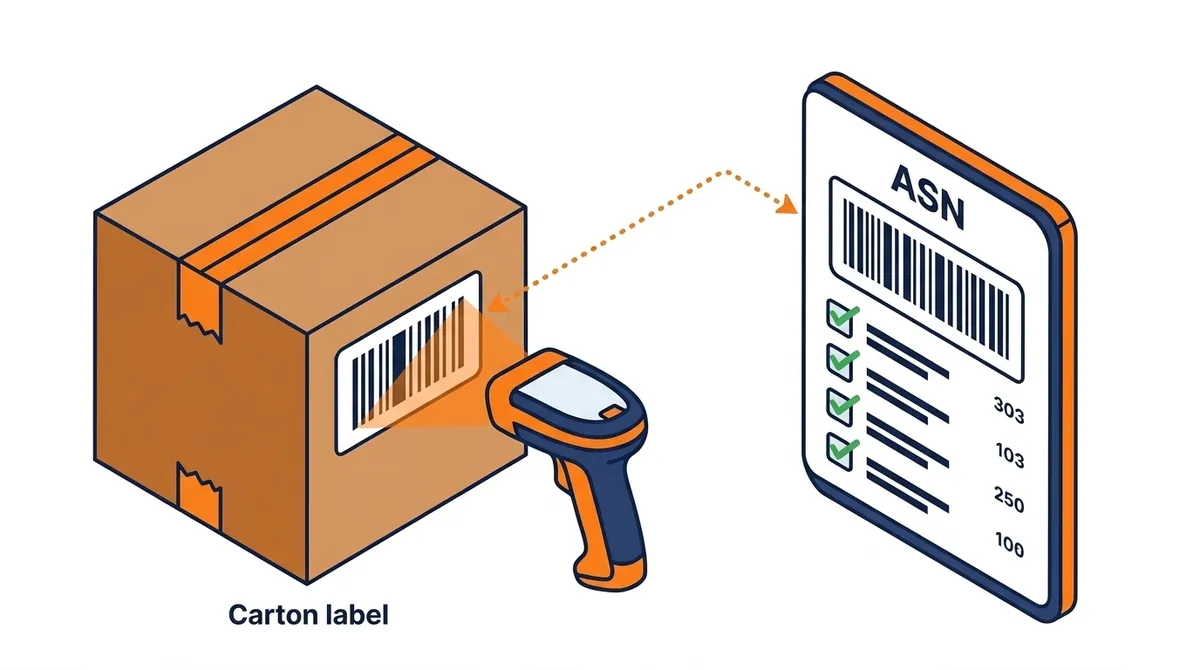
GS1 US describes the SSCC as a license plate that tracks a logistics unit through the supply chain, built from your GS1 Company Prefix. That has two practical consequences. First, you need your own GS1 Company Prefix, which retailers such as Walmart already require at the supplier application stage. Second, the warehouse system that prints labels must also feed the ASN, so the carton-level detail matches exactly. A label printed from one system and an ASN typed into another is a common source of mismatches.
What do Walmart, Target, Amazon Vendor and Costco publicly require?
Each retailer’s full rules sit behind its supplier portal, but the public material is consistent: EDI is mandatory, labels must follow the retailer’s specifications, and delivery performance is measured and enforced.
| Retailer | What its public material or trade coverage says | Where the full rules live |
|---|---|---|
| Walmart | Requires a GS1 Company Prefix on supplier applications and that case packaging can be labeled to Walmart’s specifications. Its On-Time In-Full (OTIF) program measures cases delivered within the must-arrive-by-date (MABD) window and cases delivered in full; SPS Commerce reported goals of 90% prepaid on-time, 98% collect-ready and 95% in-full as of February 2024. In 2019, Supply Chain Dive reported a fine of 3% of the cost of goods on non-compliant cases. | Walmart supplier systems and your buyer |
| Target | Lists the ability to use EDI to receive purchase orders, a certificate of insurance and EFT payment among vendor requirements. | Target Partners Online |
| Amazon Vendor (1P) | Compliance chargebacks fall into categories covering purchase orders, ASNs, prep, packaging, transportation, receiving and direct fulfillment. SPS Commerce cites a $26 chargeback for a case pack defect, where the labeled quantity does not match the units in the carton. | Amazon Vendor Central |
| Costco | All suppliers are required to use EDI. SPS Commerce summarizes pallet requirements such as load-bearing minimums and maximum stack heights for in-club and ecommerce freight. | Costco’s supplier documentation and your buyer |
Targets, fines and procedures change, so treat any published number as a snapshot and confirm the current figures in each portal before you set internal goals.
What causes most retail chargebacks?
Most chargebacks trace back to a handful of execution failures in the warehouse or in the data that leaves it. The retailer’s names for them differ, but the root causes repeat:
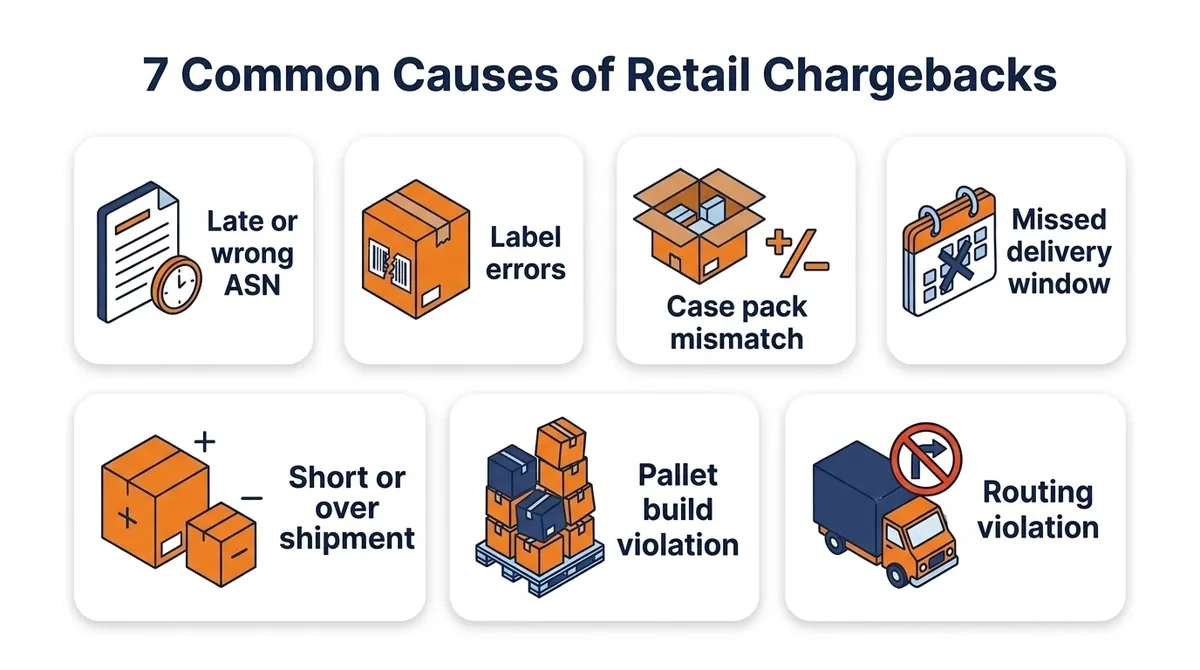
- Late, missing or inaccurate ASN. The 856 was not sent before the freight arrived, or it does not match what was in the trailer.
- Label errors. Missing GS1-128 labels, unreadable barcodes, labels on the wrong face of the carton, or SSCCs that are not in the ASN.
- Case pack and quantity mismatches. The carton holds a different number of units than the label or item setup says.
- Shipping outside the window. Delivering early or late against the MABD, or missing the pickup a collect carrier scheduled.
- Short or over shipments. Shipping quantities that differ from the PO without an approved change.
- Pallet build and packaging violations. Overweight or over-height pallets, wrong pallet type, unstable loads or prohibited packaging.
- Routing violations. Booking your own carrier on a collect PO, or failing to request routing at all.
How does a 3PL prevent chargebacks?
A 3PL prevents chargebacks by making the routing guide part of its standard work: the rules for each retailer are set up once in the warehouse system, then enforced by scanning on every order. Look for these controls:
- Retailer profiles in the WMS. Label formats, carton and pallet limits, case packs and documents configured per retailer, not left to memory.
- Scan-verified picking and packing. Each unit and carton is scanned so the ASN is built from what actually shipped.
- Labels and ASN from one system. The same system that prints the SSCC sends the 856, so the two cannot drift apart.
- Window management. Ship dates planned backward from the MABD, with routing requests sent early on collect programs.
- Pallet build standards. Height, weight and pallet type checked before the load is closed.
- Proof of shipment. Bills of lading, carrier pickup times and photos kept, so you can dispute deductions that are not your fault.
Innovative Warehouse Solutions (IWS) runs B2B and retail fulfillment from Farmingdale, Long Island, New York. Its B2B fulfillment page describes connecting to retailers through EDI so purchase orders, invoices and ASNs flow without manual entry, matching orders to each retailer’s routing guide and labeling rules including GS1 and UCC-128 carton labels, and shipping everything from small parcel to LTL and full truckload. IWS publishes a 99.98% order accuracy rate on its homepage, and its integrations page lists retail EDI alongside Shopify, Amazon and Walmart connections.
What should you ask a 3PL before handing over a retail account?
Ask for proof of process, not promises. A 3PL that does retail well can answer these quickly, and our breakdown of B2B fulfillment pricing models covers how retail work is usually billed:
- Which retailers do you ship to today, and can you show a sample GS1-128 label and ASN for one of them?
- Is the ASN generated automatically from scan data, and how soon after the trailer leaves is it sent?
- Do you connect to my EDI provider, or do you provide EDI directly? Who maps new trading partners?
- How do you handle collect freight: who submits routing requests, and how are pickup appointments tracked?
- How do you build retail-ready pallets and break bulk into store-level packs?
- When a chargeback arrives, what documentation will you give me to dispute it, and how fast?
- Can the same inventory pool serve my ecommerce orders and my retail POs?
Frequently asked questions
Is a routing guide the same as a vendor compliance manual?
Not always. The routing guide covers how freight moves and is labeled; the compliance manual or chargeback schedule covers the deductions for violations. Many retailers combine them, so request both from each account.
Do I need my own EDI software if my 3PL supports EDI?
It depends on the setup. Some brands use their own EDI provider and connect it to the 3PL; others rely on the 3PL’s EDI connections. Either way, the retailer trades documents with you as the vendor, so confirm who owns each document and trading partner setup.
Who pays when the 3PL causes a chargeback?
The retailer deducts the chargeback from you, the vendor. Whether your 3PL reimburses you depends on your contract, so put retail compliance responsibilities and any reimbursement terms in writing before the first PO ships.
Can I use UPC barcodes instead of GS1-128 labels?
No. A UPC identifies a product; a GS1-128 label with an SSCC identifies a specific carton or pallet in a specific shipment. Retail orders typically need both: UPCs on the products and SSCC labels on the cartons and pallets.
What does OTIF mean?
On-Time In-Full. It measures whether a purchase order arrived inside the retailer’s delivery window and with the full quantity ordered. Walmart’s program is the best-known example, but other retailers track similar metrics.
How long does it take to get a 3PL ready for a new retailer?
Plan time for EDI mapping and testing with the retailer, label certification where required, and a first-order review. Ask your 3PL for a realistic timeline before you accept a PO with a tight ship window.
Shipping to retail and tired of deductions? IWS handles EDI, GS1-128 labeling, ASNs and retail-ready pallets alongside ecommerce orders from the same inventory. Request a quote and tell us which retailers you ship to.
About the Author
Innovative Warehouse Solutions (IWS) is a U.S.-based third-party logistics (3PL) and order fulfillment provider. We help ecommerce and B2B brands with warehousing, pick and pack, kitting and assembly, and small parcel shipping. This article was written by the IWS operations team, drawing on hands-on experience running fulfillment for growing brands.