

Fulfillment solutions


Long-Term Storage Fees: What 3PL Brands Actually Pay
What Are Long-Term Storage Fees and When Do They Hit?
Long-term storage fees (LTSFs) are extra charges a 3PL applies when your inventory sits in their warehouse beyond a set idle threshold without moving. The critical detail most brands miss: LTSFs are additive. They stack on top of your standard monthly storage fees, not in place of them. So if you were already paying $20 per pallet per month, an LTSF does not replace that charge. It gets added to it.
The threshold that triggers the fee varies by provider. Common cutoffs are 30, 60, 90, or 180 days of idle inventory, with “idle” meaning inventory that has not been picked, shipped, or transferred during the billing period. That threshold is typically set by the provider and, more often than not, it sits in the contract rather than the published rate card.
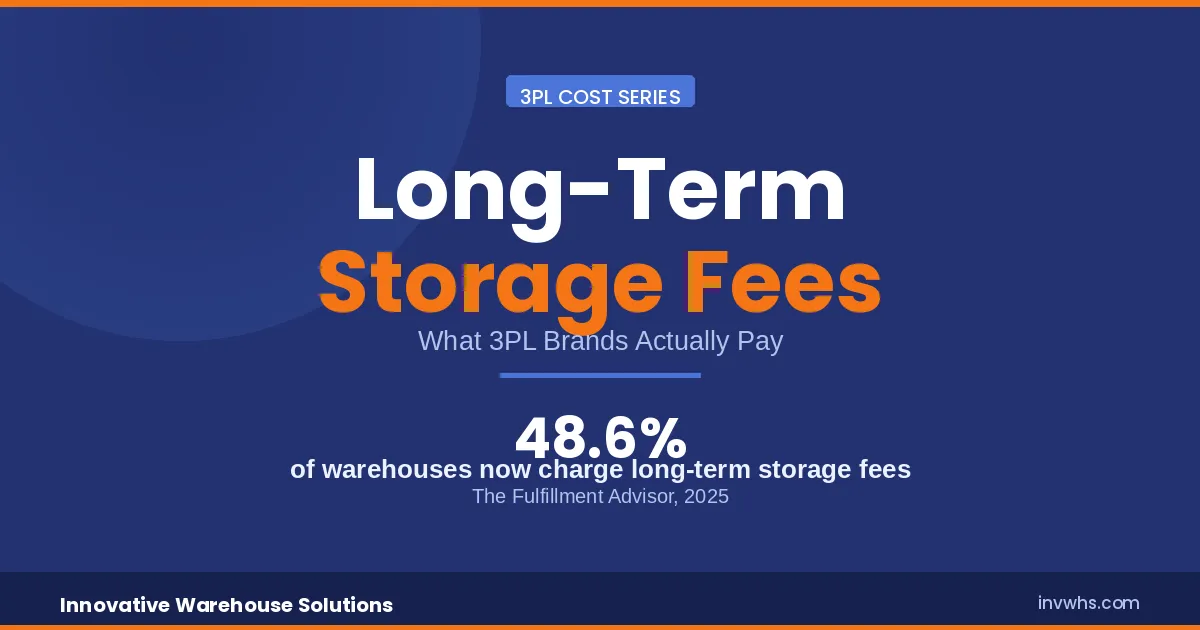
This is no longer a niche fee. According to The Fulfillment Advisor’s 2025 warehousing market report, nearly half of warehouses (48.6%) now charge long-term storage fees, up sharply from 23.33% the year prior. LTSFs have moved from an edge-case penalty to standard practice across the industry.
What Long-Term Storage Fees Actually Cost
When a 3PL does charge LTSFs, the penalty typically runs 1.5x to 3x the standard pallet rate once inventory crosses the idle threshold, according to Red Stag Fulfillment’s 2025 3PL pricing guide.
To put that in real numbers: the 2025 industry average for standard pallet storage is $20.17 per pallet per month (The Fulfillment Advisor Annual Survey). At a 2x LTSF multiplier, that same pallet now costs $40.34 per month once it ages past the threshold.
Here is a practical example. Say you have 15 pallets that crossed the 90-day idle mark. At your standard rate of $20 per pallet, you would normally pay $300 per month. At a 2x LTSF rate, those 15 pallets now cost $600 per month. That is $300 in extra charges every month the inventory continues to sit, on top of what you were already paying.
For brands storing inventory by cubic foot, the average rate is $0.46 per cubic foot per month. An LTSF multiplier pushes that to between $0.69 and $1.38 per cubic foot monthly for aged inventory.
One more thing worth knowing: some 3PLs calculate storage based on peak utilization during the billing period rather than average utilization. That means one week of high inventory can inflate your entire month’s bill.
For reference, here is how IWS structures storage with no aging multiplier and no penalty tiers:
| Storage Type | Size | Weekly Rate |
| Small bin | 14 x 14 x 5 in | $0.50 |
| Standard bin | 24 x 18 x 12 in | $1.25 |
| XL bin | 42 x 23 x 20 in | $3.75 |
| Pallet | 40 x 48 x 48 in | $8.75 |
3PL Long-Term Storage Fees vs. Amazon Aged Inventory Surcharges
If you found this article while researching Amazon FBA storage fees, you are not alone. Most searches around “long-term storage fees” come from FBA sellers trying to manage their inventory costs. Here is how the two systems compare and why a 3PL can actually solve the Amazon problem.
Amazon calls their version “aged inventory surcharges.” They kick in at 181 days, starting at $1.50 per cubic foot and increasing in tiers based on how long inventory has aged, reaching $6.90 per cubic foot or $0.15 per unit (whichever is higher) for inventory stored 365 days or more. Like 3PL LTSFs, they stack on top of Amazon’s standard monthly storage fees.
| Amazon FBA | 3PL (IWS-style) | |
| Fee name | Aged inventory surcharge | Long-term storage fee (varies by provider) |
| Trigger threshold | 181+ days | 30 to 180 days (varies by provider; IWS: none) |
| Calculation | Tiered: from $1.50/cu ft at 181 days up to $6.90/cu ft or $0.15/unit at 365+ days | Typically 1.5x to 3x standard rate |
| Stacks on standard fees? | Yes | Yes (where charged) |
| Policy transparency | Published and predictable | Varies widely |
| Pull inventory on demand? | Yes, with removal fees | Yes, typically with more flexibility |
A strategy many FBA sellers use: store overflow inventory at a 3PL and send smaller, more frequent batches to Amazon. That keeps FBA inventory levels lean, avoids the aged inventory surcharge, and gives you a lower-cost holding option for stock that is not ready to move through FBA yet.
IWS’s real-time inventory tracking and lot and expiration date monitoring make it a practical buffer storage option for FBA sellers managing product age — including a full breakdown of how this works in our 3PL for FBA Sellers overview.
Which Businesses Feel Long-Term Storage Fees the Most?
Two types of brands tend to run into LTSFs more than others, and both are ones we work with regularly at IWS.
- Health and beauty brands deal with a compounding cost problem. Short shelf lives and expiration-date pressure mean slow-moving SKUs can hit an LTSF threshold before they even expire. You end up paying a penalty for inventory you may eventually have to write off anyway. IWS’s lot and expiration tracking gives health and beauty brands a real-time view of what is aging and when to act before the fees add up.
- Beverage brands often over-order for peak season demand in summer and Q4, then find themselves holding excess stock through Q1 when velocity drops. That post-peak inventory is exactly where LTSF clocks start ticking — a pattern common among the beverage brands we work with at IWS.
Both situations are manageable with the right inventory habits, which brings us to what you can actually do about it.
How to Avoid Long-Term Storage Fees at Your 3PL
\
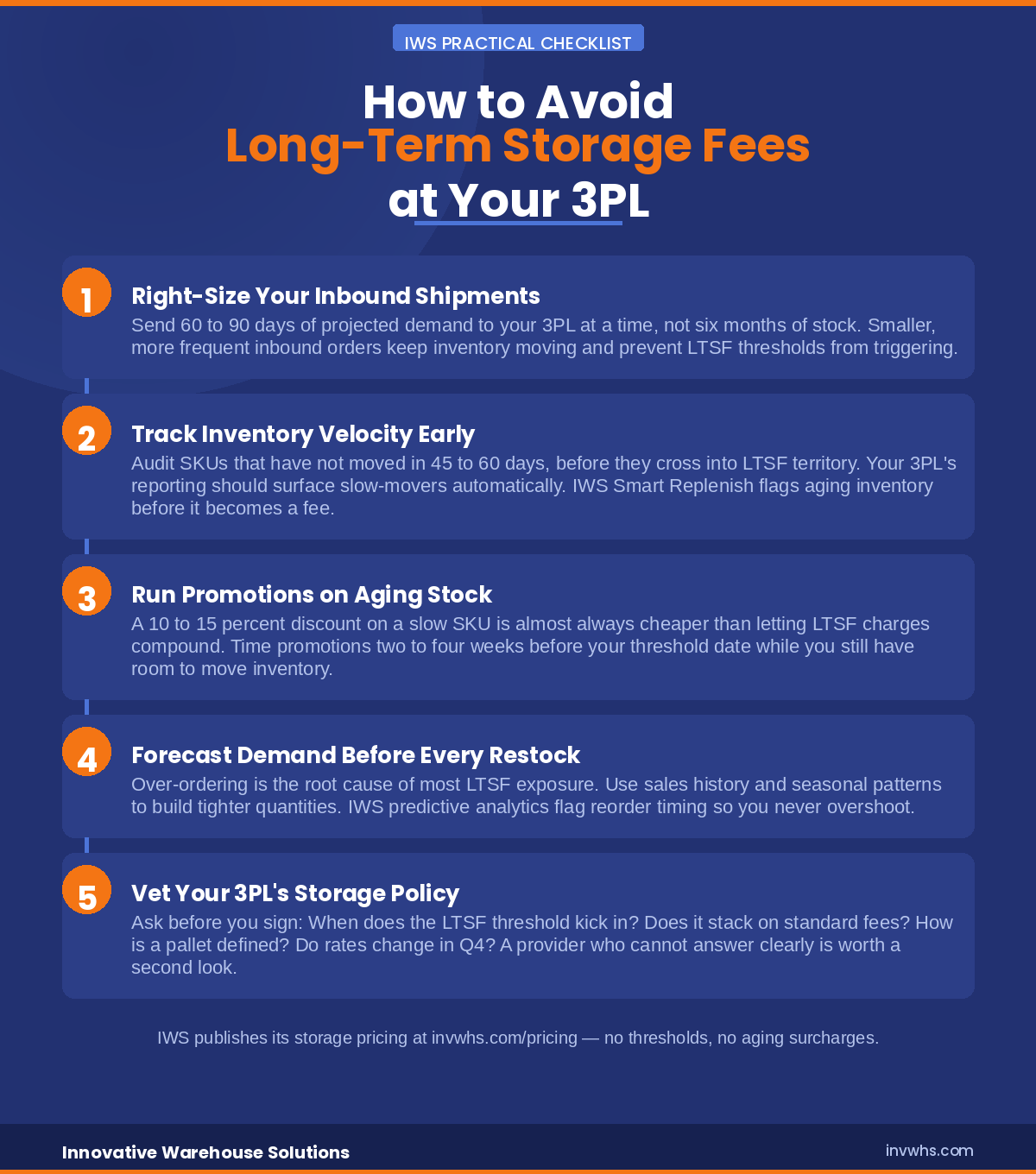
- Right-size your inbound shipments. Send 60 to 90 days of projected demand to your 3PL at a time, not six months of stock. Smaller, more frequent inbound orders are the simplest way to keep inventory moving and stay below LTSF thresholds.
- Track inventory velocity before the threshold hits. Audit SKUs that have not moved in 45 to 60 days, before they cross into LTSF territory. Your 3PL’s reporting should surface this automatically. At IWS, real-time inventory visibility and Smart Replenish monitoring flag slow-movers before they become a fee problem.
- Run targeted promotions on aging inventory. A 10 to 15 percent discount on a slow SKU is almost always cheaper than letting LTSF charges compound month over month. Time promotions two to four weeks before the threshold date, while you still have room to move the inventory.
- Forecast demand before every restock. Over-ordering is the root cause of most LTSF exposure. Use your sales history and seasonal patterns to build tighter restock quantities. IWS’s predictive analytics monitor inventory levels against your pre-loaded lead times and flag when it is time to reorder without overshooting.
- Vet your 3PL’s storage policy before you sign. Four questions to ask any provider before you commit:
- At how many days does your LTSF threshold kick in?
- Does the LTSF stack on top of my standard storage fee?
- How do you define a pallet for billing purposes (standard vs. oversized)?
- Do storage rates change in Q4 or during peak seasons?
A provider who cannot answer these clearly is worth a second look. At IWS, all of these answers are on our pricing page before you ever pick up the phone.
At IWS, storage is flat-rate with no aging surcharges or penalty multipliers. You pay for the space you occupy, and that rate stays consistent regardless of how long your inventory has been with us. Want to see exactly what you would pay before you commit? Our pricing is published, penalty-free, and has no surprises. Explore IWS Pricing.
About the Author
Innovative Warehouse Solutions (IWS) is a U.S.-based third-party logistics (3PL) and order fulfillment provider. We help ecommerce and B2B brands with warehousing, pick and pack, kitting and assembly, and small parcel shipping. This article was written by the IWS operations team, drawing on hands-on experience running fulfillment for growing brands.