

Fulfillment solutions


Local Warehousing: How It Works and What It Costs
Updated: November 2026
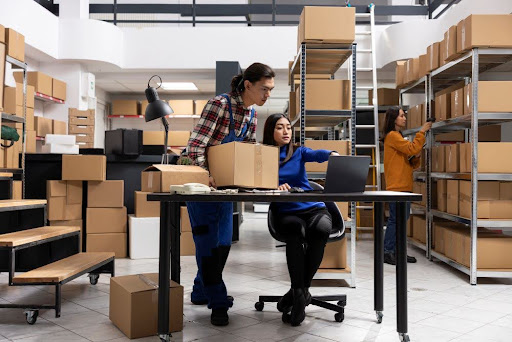
Local warehousing means storing inventory in a warehouse close to your customers or your business, so orders and restocks travel a shorter distance. For an ecommerce brand, that usually means a 3PL that stores, packs and ships for you. Closer stock means lower shipping zones, faster delivery and quicker access to your products.
What is local warehousing?
Local warehousing is storage near the people you ship to or the place you work, instead of a cheaper building far away.
“Local” can mean three different things, and they work very differently. Searching for a “warehouse near me” turns up all three, so it helps to know which one you need before you call anyone.
| Option | Who does the work | How you usually pay | Best for |
|---|---|---|---|
| Self-storage unit | You: drop-off, pick-up and shipping | Monthly rent for a fixed unit | Overflow stock and very low order volume |
| Shared or flex warehouse space | You, with a dock and some equipment on site | Monthly rent, often with a minimum term | Brands with their own staff who need a dock |
| 3PL warehouse | The 3PL: receiving, storage, pick and pack, shipping and returns | Per bin, pallet and order, based on what you use | Ecommerce brands that want orders shipped for them |
If you pack orders yourself today, start by working out what that really costs you. Our guide to the true cost of self-fulfillment walks through the numbers.
Why does warehouse location change your shipping costs?
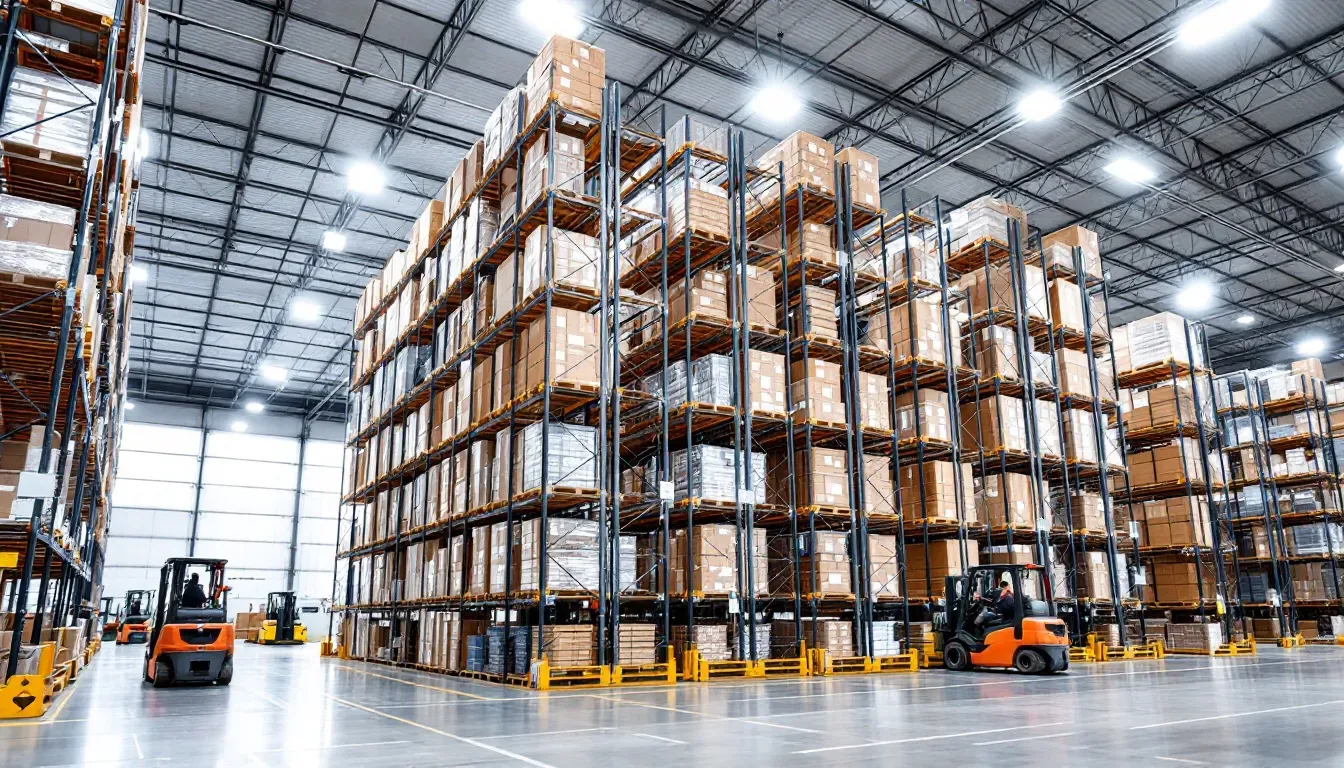
Carriers price parcels by zone, which is the distance from your warehouse to the customer. Fewer zones crossed means a cheaper label and faster delivery.
USPS, UPS and FedEx number their zones from the nearest addresses (Zone 1 or 2) up to Zone 8 for the far side of the contiguous U.S. The zone is set by the origin and destination ZIP codes, so moving your stock changes every label you buy. Here is how zones fall from the IWS warehouse in Farmingdale, NY:
| Destination | USPS zone from Farmingdale (ZIP 117) |
|---|---|
| Manhattan and Brooklyn, NY | 1 |
| Newark, NJ and Stamford, CT | 1 |
| Philadelphia, PA and Providence, RI | 2 |
| Boston, MA and Washington, DC | 3 |
| Atlanta, GA and Chicago, IL | 5 |
| Dallas, TX and Denver, CO | 7 |
| Los Angeles, CA and Seattle, WA | 8 |
Size matters too. Since July 12, 2026, USPS uses a dimensional weight divisor of 139, so bulky, light boxes are billed by size. Our dimensional weight calculator shows how that plays out for your boxes. Brands with customers on both coasts sometimes use zone skipping as well.
When does a local warehouse make sense?
It makes sense when most orders go to one region, or when you need fast delivery or frequent access to stock there.
- Most of your orders go to one region. If that region is the Northeast, a Northeast warehouse keeps most labels in the lowest zones.
- Delivery speed helps you sell. Ground parcels to nearby zones can arrive in 1 to 2 business days without paying for air.
- You restock or pull stock often. A short drive makes it easier to send new inventory, pick up samples or check on a launch.
- You supply nearby stores. Retail and wholesale accounts close to the warehouse get shorter freight runs.
When is a local warehouse the wrong fit?
It is a weaker fit when customers are spread evenly across the country or when products need conditions the warehouse cannot provide.
If your orders split evenly between coasts, one location will always leave some customers in high zones. Some brands add a second warehouse on the other coast once volume justifies it. Products also need the right building: IWS does not offer climate-controlled storage, so chocolate, some wines and temperature-sensitive skincare need a specialist provider. Our guide to strategic warehousing covers how to weigh location against these trade-offs.
What does local warehousing cost?
Self-storage and flex space charge rent for space. A 3PL charges for storage and for each order it ships, so costs follow your volume.
With a 3PL you pay mainly for storage (bins and pallets), pick and pack, and postage. These are IWS’s published rates:
| Item | IWS published rate |
|---|---|
| Small bin storage | from $0.50 per week |
| Standard bin storage | $1.25 per week |
| Pallet storage | $8.75 per week |
| Pick and pack | $2.50 first item, $0.40 each additional item |
| Receiving fee | None |
| Onboarding fee | None |
| Monthly minimum | None |
IWS bills storage weekly, and you can add storage space at any time during your contract and reduce it at your next renewal. Postage is billed separately, and returns are priced in tiers. For the full picture, see IWS pricing and our breakdowns of receiving and storage fees and pick and pack costs.
How do you choose a local warehouse?
Check location against where your orders go, then compare cutoff times, published rates, minimums, integrations and whether the warehouse can handle your product.
- Pull a few months of shipping addresses and see which zones most of them fall into from each warehouse you are considering.
- Ask for the same-day cutoff. A close warehouse helps less if orders sit a day before they ship.
- Get rates in writing, including receiving, onboarding and monthly minimum fees as well as storage and pick and pack.
- Confirm the warehouse connects to Shopify, Amazon, WooCommerce or whatever you sell on.
- Match the building to the product. Food, beverages and supplements need a warehouse with FDA food facility registration. Read our guide to FDA registered vs FDA approved warehouses before you ask.
- Ask how order accuracy is measured, and how errors are counted and fixed.
Our 3PL selection guide has a longer checklist.
How does IWS handle local warehousing for New York area brands?
IWS stores, packs and ships from one warehouse in Farmingdale, NY, where New York City, northern New Jersey and southern Connecticut are USPS Zone 1.
The warehouse is at 165 Price Pkwy, Farmingdale, NY, on Long Island. Orders in by 11 AM EST ship the same day, and expedited orders in by 1 PM EST ship the same day. IWS reports 99.98% order accuracy and stocks more than 40 packaging options to get the most accurate dimensional weight. IWS works with health and beauty, beverage, subscription box, food and supplement and apparel brands. For zones, cutoffs and costs in more detail, see our Long Island 3PL fulfillment guide.
Frequently asked questions
Is a local warehouse the same as a 3PL?
Not always. A local warehouse can be a storage unit or rented space you run yourself. A 3PL warehouse also receives your stock, packs each order and ships it for you.
How much does local warehouse storage cost?
It depends on the type. 3PLs usually charge per bin or pallet. IWS publishes storage from $0.50 per week for a small bin and $8.75 per week for a pallet.
How close should my warehouse be to my customers?
Close enough that most orders ship to USPS zones 1 to 3. Lower zones cost less and arrive sooner, so look at where most of your orders go before you pick a location.
Does IWS offer climate-controlled storage?
No. IWS does not offer climate-controlled storage, so it suits shelf-stable products. Items that need a set temperature or humidity range need a specialist provider.
Which areas does IWS serve?
IWS ships from one warehouse in Farmingdale, NY, on Long Island. New York City, northern New Jersey and southern Connecticut are USPS Zone 1 from there, and IWS ships to customers across the U.S.
How long does it take to move inventory into a 3PL?
At IWS, onboarding typically takes 2 to 3 weeks. Ask any warehouse for a written timeline, since it depends on how many products you carry.
Want your inventory closer to your New York area customers? See IWS pricing or contact IWS for a quote.
About the Author
Innovative Warehouse Solutions (IWS) is a U.S.-based third-party logistics (3PL) and order fulfillment provider. We help ecommerce and B2B brands with warehousing, pick and pack, kitting and assembly, and small parcel shipping. This article was written by the IWS operations team, drawing on hands-on experience running fulfillment for growing brands.