

Fulfillment solutions


What Apparel Brands Should Ask a 3PL Before Outsourcing Fulfillment
Choosing a 3PL is one of the biggest decisions an apparel brand can make. The partner you pick will store your inventory, pack your orders, and ship your products to customers on your behalf. If they get it wrong, your brand takes the hit.
The problem is that most “questions to ask a 3PL” advice is written for general ecommerce. It does not account for the challenges specific to clothing and fashion brands. Think about a single t-shirt design. Offer it in four sizes and five colors, and that one product becomes 20 separate SKUs. This is called SKU proliferation, and it is the number one reason generalist warehouses fail clothing brands.
On top of that, apparel return rates run two to three times higher than most other product categories. Customers buy multiple sizes, keep what fits, and send the rest back. And for most fashion brands, the unboxing experience is part of the product itself. Your packaging, your inserts, and how the garment is folded all influence how a customer feels about your brand.
The questions below are written for clothing and fashion brands that are evaluating a 3PL for the first time or considering a switch. These are the questions that will separate a true apparel fulfillment partner from a warehouse that just happens to have open shelf space.
Key Takeaways
- Apparel fulfillment has unique demands. Generic 3PL questions will not surface the right information for clothing brands.
- Prioritize questions about SKU variant tracking, garment handling, and branded packaging. These directly affect your customer experience.
- Returns processing speed and quality have a direct impact on your margins. Ask for specifics on inspection, grading, and restocking timelines.
- Demand pricing transparency. Ask for sample invoices and look for providers with no onboarding fees.
- Watch for red flags like vague accuracy rates, no returns process, and one-size-fits-all handling claims.
- The right 3PL partner acts as an extension of your brand, not just a warehouse with a loading dock.
Questions About How the 3PL Handles Apparel Products
This is the most important area to cover. The way a 3PL stores, picks, and packs your clothing affects your order accuracy, your customer experience, and your return rate.
How do you track size, color, and style variants in your warehouse management system?
A generalist warehouse may group product variants loosely or rely on manual sorting. Apparel needs barcode-level tracking for each child SKU. Without it, a picker can easily ship a Medium Black when the customer ordered a Small Navy. The poly bags look identical on a shelf if there is no scanning system in place.
A good answer here includes barcode scanning at receiving, slotting, picking, and packing. The 3PL should provide real-time variant-level visibility in their system so you can see exactly how many units of each size and color are available at any time.
What is your process for storing and picking garments without damage?
Clothing is soft, wrinkle-prone, and easy to snag. Ask about shelving setup, climate considerations, and how pickers are trained to handle soft goods versus boxed products. A 3PL that specializes in apparel will have specific procedures in place for garment care during every stage of the fulfillment process.
Can you support branded packaging, custom inserts, or specific folding methods?
Ask if the 3PL can accommodate branded tissue paper, custom packing slips, thank-you cards, specific poly mailer sizes, or particular fold-and-pack procedures. If the answer is a flat “no” or “we use standard packaging for everything,” that is a sign the 3PL is not set up for fashion brands.
Questions About Returns and Reverse Logistics for Clothing
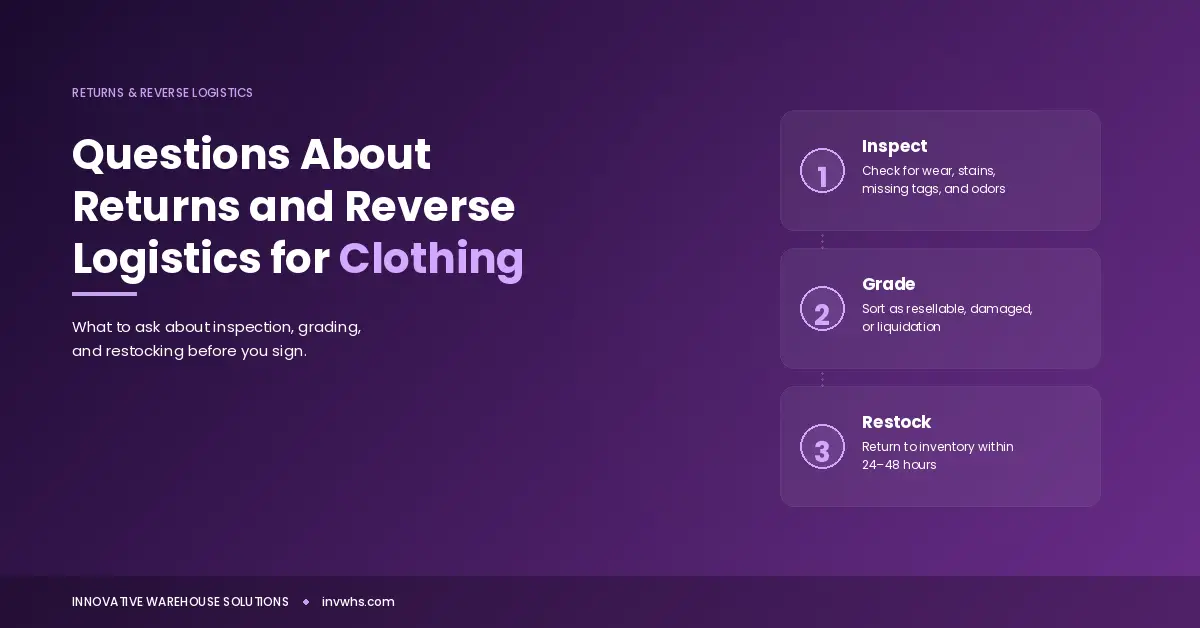
Returns are a fact of life in apparel. Customers bracket their purchases, buying two sizes to compare and returning one. A 3PL that does not have a clear returns process will let returned inventory pile up, tying up your capital and pulling sellable products off the market.
What does your returns inspection process look like for apparel?
Returned clothing needs to be checked for signs of wear, stains, missing tags, and odors before it goes back on the shelf. A 3PL that simply re-shelves returns without inspection puts your brand reputation at risk. One customer receiving a previously worn item can generate a negative review that costs you far more than the item itself.
How fast do returned items get restocked and available for resale?
Every day a returned garment sits unprocessed is a day it cannot generate revenue. A strong apparel fulfillment partner restocks inspected returns within 24 to 48 hours of receiving them. Ask for their average turnaround time and whether they track this metric.
Do you grade returns as resellable, damaged, or liquidation?
Not every return is fit for resale. The 3PL should have clear grading criteria, ideally based on your specifications, to sort what goes back into inventory versus what gets flagged for your review. If they cannot describe their grading steps, that is a gap that will cost you money over time.
Questions About Technology, Integrations, and Inventory Visibility
Apparel brands often sell across multiple channels at once. Your own website, Amazon, TikTok Shop, and wholesale accounts may all draw from the same inventory pool. If your 3PL’s technology cannot keep up, you will oversell products that are already gone.
Does your system sync inventory in real time across all my sales channels?
If the last Medium Red Hoodie sells on Shopify, it needs to disappear from every other channel instantly. Real-time inventory sync prevents overselling, reduces customer complaints, and gives you accurate data for reorder decisions. For apparel brands with high SKU counts, this is a requirement, not a bonus feature.
What ecommerce platforms and marketplaces do you integrate with?
Ask for a specific list. A vague answer like “we work with most platforms” does not tell you much. At IWS, we maintain 50+ active integrations and offer open API connections to most sales channels and stores. If we do not have your platform connected, we will build the integration. That level of commitment to connectivity is what you should expect from any 3PL you evaluate.
Can I access real-time reporting on order status, inventory levels, and fulfillment performance?
You need visibility into your own business around the clock. The 3PL should offer a reporting dashboard or software portal you can access anytime. If they cannot provide on-demand reporting, you will be relying on emails and spreadsheets for information that should be available with a click.
Questions About Pricing and Billing Transparency
Pricing is where many 3PL relationships go wrong. A low quote means nothing if the invoice is packed with fees that were not part of the original conversation. Ask direct questions, and do not move forward until you get direct answers.
The table below shows what transparent apparel fulfillment pricing looks like compared to pricing that hides the real cost.
| Transparent Pricing | Hidden-Fee Pricing |
| Pick fee listed per order (e.g., $2.50 first item) | Bundled “fulfillment fee” with no line-item breakdown |
| Additional item fee stated (e.g., $0.40 per item) | Extra charges buried in monthly invoices |
| Storage priced by bin or pallet size with weekly rates | Vague “storage fees” that fluctuate without explanation |
| No onboarding fees | Onboarding or setup charges of $500+ |
| Sample invoice available before signing | “We will send pricing after you commit” |
| Return processing fee stated upfront | Return handling billed as “special project” work |
How is fulfillment pricing structured?
The most common apparel fulfillment pricing model includes a pick fee per order, an additional item fee, and weekly storage fees based on bin or pallet size. At IWS, pricing starts at $2.50 per order for the first item pick fee and $0.40 per additional item. Storage ranges from $0.50 per week for a small bin to $8.75 per week for a full pallet. Ask every 3PL to break down their pricing the same way so you can compare accurately.
Are there hidden fees for onboarding, minimum orders, seasonal surcharges, or account management?
Many 3PLs charge monthly minimums or seasonal premiums that do not appear in the initial quote. At IWS, we do not charge onboarding fees. Ask every 3PL you evaluate whether they do the same, and request a full cost breakdown before you sign anything.
Can you provide a sample invoice?
Seeing a real invoice tells you more than a rate card ever will. It shows how charges are itemized, whether the math adds up, and what “miscellaneous” fees might look like in practice.
Questions About Scalability and Seasonal Readiness
Apparel demand shifts throughout the year. Collection drops, back-to-school shopping, holiday gifting, and spring transitions all create volume spikes that your 3PL needs to absorb without delays or errors.
Ask your 3PL how they handle seasonal volume increases. The answer should include specifics about how they scale warehouse labor, how much lead time they need before a peak period, and whether they have handled similar spikes for other clothing brands. A vague answer like “we can handle it” is not enough.
Ask whether you can increase or decrease storage space without being locked into a long-term contract. Fashion inventory footprints shift dramatically month to month, and flexible storage terms protect your cash flow during slower periods.
Ask about same-day shipping cutoff times. At IWS, standard B2C orders placed by 11 AM EST ship the same day. Orders with expedited shipping placed by 1 PM EST ship out the same day. These are the kind of specifics that tell you whether a 3PL can actually deliver on speed promises, so ask for their exact cutoff windows.
Questions About B2B, Wholesale, and Omnichannel Fulfillment
Many apparel brands start as direct-to-consumer sellers and grow into wholesale and retail partnerships. If that is part of your growth plan, your 3PL needs to handle both channels from day one.
Ask whether the 3PL can fulfill DTC orders and wholesale orders from the same inventory pool. Shipping a single t-shirt to a customer and a 50-case pallet to a department store require very different logistics skill sets. A strong partner handles both under one roof without requiring you to split your inventory across locations.
Ask about EDI (Electronic Data Interchange), retail routing compliance, and retailer-specific labeling like GS1-128 shipping labels. Retail partners impose strict requirements on how orders are packed, labeled, and shipped. Non-compliance results in chargebacks, and those fines can wipe out your profit on an entire order. If your 3PL is not familiar with B2B fulfillment requirements, you will learn that the hard way.
Red Flags: What Bad Answers Sound Like
Asking the right questions is only half the work. You need to know what a bad answer looks like. Here are the warning signs that a 3PL may not be the right fit for your apparel brand.
| Red Flag | What It Tells You |
| “We handle all products the same way.” | They have no apparel-specific processes. Your garments will be treated like boxed goods. |
| They cannot share their order accuracy rate. | If they do not track it, they do not prioritize it. For apparel, accuracy should be 99.5% or higher. |
| Pricing is vague with no line-item breakdown available. | Expect surprise charges on your first bill. Transparent partners show you how billing works before you sign. |
| No clear returns process for clothing. | Returns will pile up, and sellable inventory will sit idle instead of generating revenue. |
| They discourage facility tours or meeting the warehouse team. | Your 3PL is the physical extension of your brand. You should see where your products live. |
| No dedicated point of contact, only a support ticket system. | For a growing apparel brand, having a real person who knows your business is the difference between a partner and a vendor. |
FAQ
How many questions should I ask a 3PL before signing a contract?
There is no set number, but you should cover product handling, technology, pricing, returns, scalability, and communication at a minimum. The questions in this article cover the areas most relevant to apparel brands.
When is the right time for an apparel brand to outsource fulfillment?
Most clothing brands benefit from outsourcing when they are shipping 300 or more orders per month and spending more time on logistics than on product development or marketing. If packing orders is pulling your attention away from growing your business, it is time to talk to a 3PL.
What should apparel fulfillment cost per order?
Costs vary by order complexity and 3PL provider. The pricing section above shows IWS’s rates as a benchmark. The most important step is to request an itemized breakdown from every 3PL you evaluate so you can compare quotes on equal terms, rather than relying on bundled estimates.
Can a 3PL handle both my online store and retail wholesale orders?
Some can, but many are built for only one channel. The key factors to evaluate are whether the 3PL supports EDI connections, understands retail routing and compliance labeling, and can fulfill both order types from a single inventory pool without requiring you to split stock across locations.
About the Author
Innovative Warehouse Solutions (IWS) is a U.S.-based third-party logistics (3PL) and order fulfillment provider. We help ecommerce and B2B brands with warehousing, pick and pack, kitting and assembly, and small parcel shipping. This article was written by the IWS operations team, drawing on hands-on experience running fulfillment for growing brands.