

Fulfillment solutions


Receiving and Storage Fees: What You’ll Actually Pay for Warehouse and Fulfillment Services
If you’ve ever received a warehouse invoice with charges you didn’t expect, you’re not alone. Receiving and storage fees can be confusing, and pricing varies widely between providers. Some facilities charge by the unit. Others charge by the pallet. And many tack on fees that aren’t obvious until the bill arrives.
This article breaks down what storage fees and receiving fees actually cost. You’ll see real pricing examples for both self-storage units and fulfillment warehouses. You’ll learn what drives these costs up or down. And you’ll know exactly what questions to ask before signing any storage agreement.
Key Takeaways
- Storage fees range from $50 to $300 per month for self-storage units and $0.50 to $25 per week for fulfillment warehouse bins and pallets.
- Receiving fees are one-time charges of $4 to $15 per pallet that cover unloading, inspecting, and logging your inventory into the warehouse system.
- Fulfillment storage costs more than self-storage but includes receiving, inventory tracking, and order shipping services that self-storage does not offer.
What Are Storage Fees and What Do They Cost?
Storage fees are the recurring charges you pay for the physical space your products occupy. These fees show up weekly or monthly on your invoice, depending on the facility. The way they’re calculated depends on whether you’re using a self-storage unit or a fulfillment warehouse.
Self-storage facilities charge a flat monthly rate based on unit size. You rent the entire space whether you fill it or not. A 10×10 unit costs the same if it holds 20 boxes or 200.
Fulfillment warehouses work differently. They charge based on the actual space your inventory uses. If your products fit in bins, you pay bin rates. If you need full pallets, you pay pallet rates. This model means you only pay for what you actually use.
Here’s what self-storage units typically cost:
| Unit Size | Average Monthly Cost |
| 5×5 (25 sq ft) | $50 to $80 |
| 10×10 (100 sq ft) | $100 to $180 |
| 10×20 (200 sq ft) | $150 to $300 |
These prices shift based on your location. Storage fees near major cities run 30 to 50 percent higher than rural areas. Climate-controlled units add another 20 to 50 percent to the base price. If you’re storing household items during a move, most people need something in the 10×10 to 10×20 range.
Fulfillment warehouse storage uses a different pricing structure:
| Storage Type | Average Weekly Cost |
| Small Bin (14x14x5) | $0.50 to $1.50 |
| Standard Bin (24x18x12) | $1.00 to $3.00 |
| XL Bin (42x23x20) | $3.00 to $5.00 |
| Pallet (40x48x48) | $8 to $25 |
At IWS, our rates fall on the competitive end of these ranges. Small bins run $0.50 per week. Standard bins cost $1.25 per week. Pallets are $8.75 per week. The key difference with fulfillment storage is that you’re not paying for empty space you don’t need.
What Are Receiving Fees?
Receiving fees are one-time charges that apply when inventory arrives at a fulfillment warehouse. These fees cover the work of unloading, counting, inspecting, and logging your products into the system.
Self-storage facilities don’t charge receiving fees. You show up, unlock your unit, and unload everything yourself. Fulfillment warehouses handle that work for you, which is why the fee exists.
When your shipment arrives at a fulfillment warehouse, the team unloads it from the truck or container. They count every item and check quantities against your purchase order. They inspect products for damage. If anything needs a barcode or label, that happens here too. Then everything gets entered into the warehouse management system so you can track your inventory in real time.
At IWS, we photograph all inventory when it arrives. This gives you visual proof of what we received and catches any shipping damage right away.
Receiving fees typically follow one of these structures:
| Fee Type | Typical Range |
| Per pallet | $4 to $15 |
| Per carton | $0.50 to $2.00 |
| Per unit | $0.10 to $0.50 |
| Hourly (complex shipments) | $25 to $50/hour |
The hourly rate usually applies to floor-loaded containers or shipments that need extra sorting. Standard palletized shipments fall under the per-pallet rate.
Self-Storage vs. Fulfillment Storage: A Quick Comparison
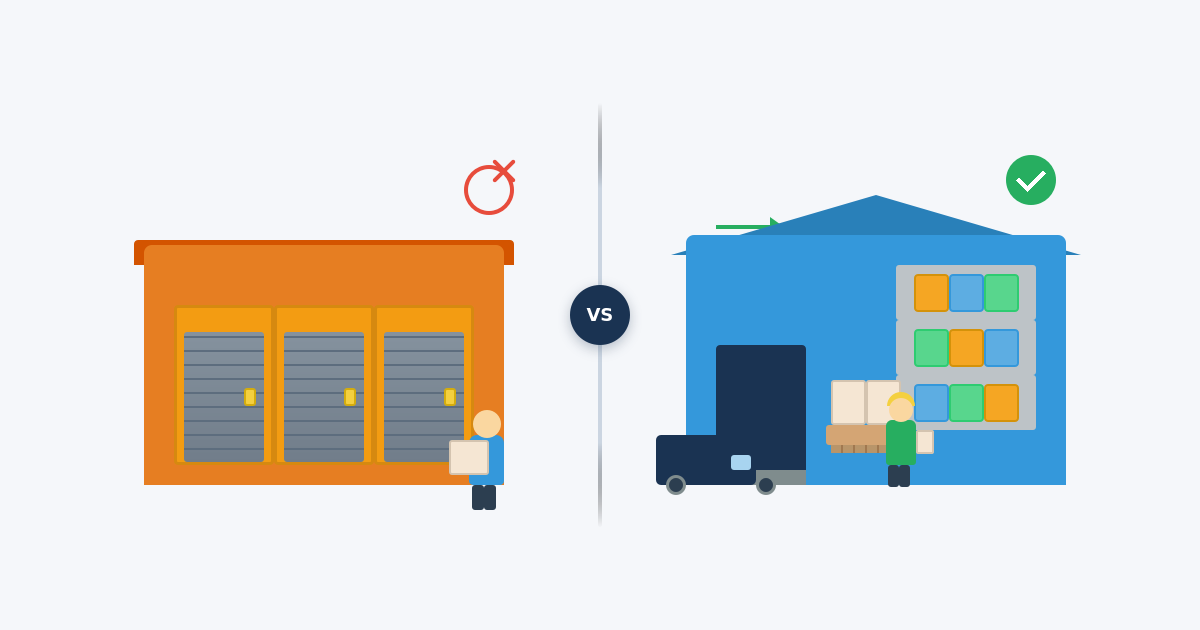
The right storage option depends on what you’re storing and what you need to do with it.
Self-storage works well for personal belongings, seasonal items, or inventory you plan to ship yourself. You get a locked space. You manage everything inside it. The monthly cost stays predictable, but you handle all the work of receiving shipments and sending out orders.
Fulfillment storage makes more sense for e-commerce businesses that ship regularly. You’re not just renting space. You’re getting a team that receives your inventory, stores it properly, and ships orders to your customers. The fulfillment process runs without you packing a single box.
| Factor | Self-Storage | Fulfillment Warehouse |
| Best for | Personal items, moving, seasonal storage | E-commerce inventory, active selling |
| Pricing model | Monthly unit rental | Weekly per-bin or per-pallet |
| Receiving service | None (you do it yourself) | Included |
| Order shipping | None | Same-day fulfillment available |
| Inventory tracking | None | Real-time software access |
For businesses shipping 300 or more orders each month, fulfillment storage typically delivers better value. You pay more than a basic storage unit, but you get receiving, inventory management, and shipping built into the service. Compare that to the true cost of self-fulfillment when you factor in your own time, packing supplies, and carrier rates.
What Affects Storage Costs (and Fees to Watch For)
Several factors influence what you’ll pay for storage. Location tops the list. Warehouses near major shipping hubs or urban centers charge more than facilities in rural areas. That said, an East Coast fulfillment location can actually save you money on shipping by putting your products closer to more customers.
Your product size matters too. Larger or heavier items need pallet storage. Smaller products fit in bins at lower rates. Matching your storage type to your actual product dimensions keeps costs down.
Inventory turnover has a big impact on your total spend. Products that sell quickly spend less time in storage. Slow-moving items sit on shelves week after week, racking up fees. Managing your inventory levels and running promotions on older stock helps control this cost.
Seasonality affects pricing at some facilities. Peak season surcharges during October through December are common. Planning your inventory around these periods prevents unnecessary charges.
Then there are the fees that catch people off guard. Self-storage facilities often add administrative fees at signup, mandatory insurance charges, and late payment penalties. Fulfillment warehouses sometimes charge onboarding fees, account minimums, or long-term storage surcharges for inventory sitting longer than 90 to 180 days.
At IWS, we don’t charge onboarding fees. We don’t have hidden account minimums. Our pricing is published on our website, and we bill weekly so you only pay for the storage you actually use.
How to Calculate Your Storage Costs
Knowing your storage costs before you commit helps you budget accurately and compare providers fairly.
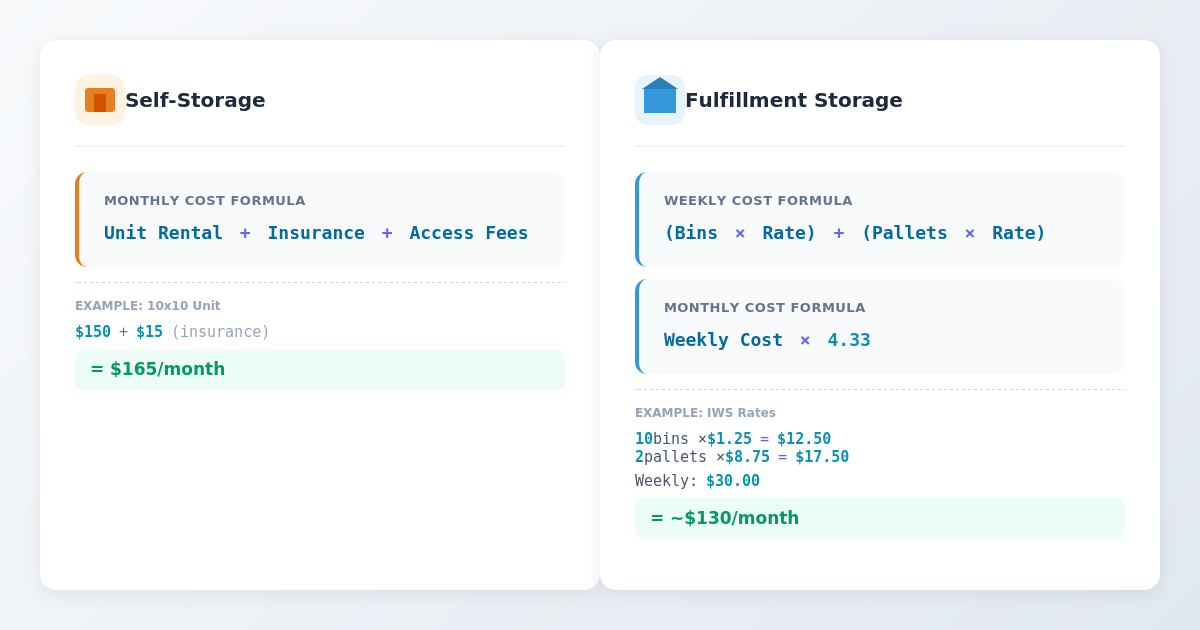
For self-storage, the math is straightforward. Add your unit rental fee plus any required insurance plus access fees. A 10×10 unit at $150 per month plus $15 for insurance equals $165 monthly.
For fulfillment storage, multiply the number of each storage type by its rate. If you have 10 standard bins at $1.25 per week, that’s $12.50 weekly. Add 2 pallets at $8.75 per week for another $17.50. Your weekly storage total comes to $30, or about $130 per month.
When comparing options, look at cost per SKU rather than just total price. A self-storage unit might seem cheaper until you factor in that fulfillment storage includes receiving, inventory tracking, and shipping services.
Get quotes from multiple providers before making a decision. Ask about every fee that could apply. The lowest advertised rate doesn’t always mean the lowest total cost.
Receiving and Storage Fees FAQs
How long does the receiving process take?
Most fulfillment warehouses process standard palletized shipments within 24 to 48 hours of arrival. Floor-loaded containers or shipments requiring extra sorting may take 2 to 3 business days.
Do I pay receiving fees every time I send inventory?
Yes, receiving fees apply each time you send a new shipment to your fulfillment warehouse. Consolidating your inbound shipments into fewer, larger deliveries can reduce your total receiving costs.
Do storage fees increase over time?
Self-storage facilities often raise rates after your initial promotional period ends, sometimes by 10 to 15 percent. Fulfillment warehouses typically keep rates stable, though some charge long-term storage surcharges for inventory sitting beyond 90 to 180 days.
Are there minimum storage requirements at fulfillment warehouses?
Requirements vary by provider. Some 3PLs require minimum monthly order volumes or storage commitments, but IWS works with growing brands without imposing strict minimums.
About the Author
Innovative Warehouse Solutions (IWS) is a U.S.-based third-party logistics (3PL) and order fulfillment provider. We help ecommerce and B2B brands with warehousing, pick and pack, kitting and assembly, and small parcel shipping. This article was written by the IWS operations team, drawing on hands-on experience running fulfillment for growing brands.